
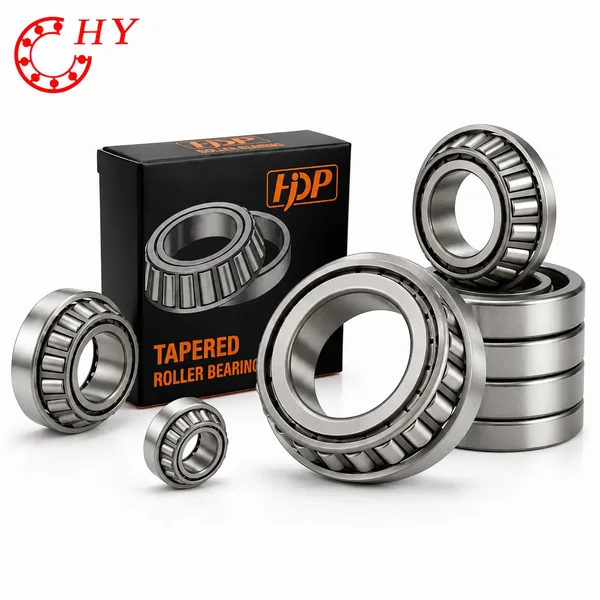
Tapered and cylindrical roller bearings are not interchangeable simply because their boundary dimensions or catalogue radial ratings are similar. Selection depends on the exact reference, bearing arrangement, load direction, speed, fits, lubrication and surrounding structure. This guide is a purchasing checklist, not a calculation of bearing life.
What the design changes
A single-row tapered roller bearing can support combined radial and axial loads in one direction. It is commonly used with another bearing to provide the required axial location. The arrangement and setting affect clearance, preload and load sharing. Neither type should be treated as self-aligning without checking the specific manufacturer's guidance.
Cylindrical roller bearing behaviour depends on its ring and flange design. N and NU arrangements can permit relative axial displacement within the bearing; other designs provide axial location in one or both directions subject to their limits. “Cylindrical” does not mean either zero thrust capacity or unrestricted thrust capacity for every design.
Questions for the specification review
| Requirement | What to confirm |
|---|---|
| Loads | Radial and axial loads, direction, shock loads and operating cycle. |
| Axial location | Which position locates the shaft and which accommodates thermal movement. |
| Speed and lubrication | Actual operating speed, lubricant, temperature and lubrication method. |
| Fits and setting | Shaft/housing tolerances, internal clearance or preload, assembly procedure. |
| Alignment | Expected shaft deflection and the permissible misalignment for the exact bearing. |
| Documentation | Approved drawing, catalogue edition, acceptance criteria and required records. |
Avoid blanket performance comparisons
Stiffness, friction, speed capability and service life cannot be ranked reliably from the type name alone. A tapered pair is not automatically the correct solution whenever axial force exists, and a cylindrical bearing does not automatically last longer under radial load. Ask the responsible engineer to review calculations and the complete arrangement.
Prepare an RFQ that can be checked
Include the complete designation with suffixes, quantity, dimensions and application. For a replacement, provide the existing drawing or reference and explain any change in operating conditions. Confirm cage, clearance, precision class, sealing and matched-set requirements where applicable. A cross-reference is a candidate for review, not approval to install.
We can help organize the quotation and specification questions. Final engineering selection and acceptance criteria should be agreed before ordering. Send your reference and requirements.
Technical reference
SKF rolling bearings catalogue: consult the sections applicable to the chosen design and arrangement.
Purchasing guidance, product information and company updates from Huayuan Bearing.