
Wheel hub bearing quality documents should identify what was assessed, which product or organisation the evidence applies to, and how the result connects to the order. Packaging should protect that same identified product through shipment, receiving and storage. Reviewing the two together gives buyers a clearer acceptance process than treating certificates, cartons and inspection reports as unrelated attachments.
This guide helps distributors and purchasing teams request useful evidence without confusing a management-system certificate with a product test or a packing photograph with an agreed specification. It also explains how to retain the information needed for repeat orders and complaint handling. The document types described here are requests to discuss with a supplier, not a statement that every document is available for every Huayuan reference.
Start with the business role and the product
Identify the company issuing the quotation, the proposed supplied product and the role of each organisation named in supporting documents. A sales company, manufacturer and independent laboratory may all appear in an order file. Their documents can be relevant, but the connection between them should be explained rather than assumed from similar names or logos.
Ask whether the document applies to the particular reference, a product family, a manufacturing location or a management system. Record the scope in plain language. If the document concerns another site or activity, establish whether it supports the claim being made for the order. A valid document can still be irrelevant to the question a buyer needs answered.
Use the Huayuan company and quality-document page as a starting point for available public information, then request order-specific clarification. Do not copy a certificate statement into a product claim without checking the holder, scope and current status. Keep the enquiry focused on the product and decision at hand.
Distinguish the main evidence types
A management-system certificate addresses the certified system and its stated scope. A test report records an evaluation performed on identified material or samples under specified conditions. An inspection record describes checks on a defined product or shipment. A declaration or statement of conformity has its own issuer and basis. These documents are not substitutes for one another.
ISO's certification guidance explains that ISO develops standards but does not itself perform certification. When a certificate matters, check the issuing body and the applicable scope through appropriate verification channels. A standard number in a brochure is not equivalent to a verified certificate or a product-specific test result.
| Document type | Question it may help answer | Additional context needed |
|---|---|---|
| Management-system certificate | What organisation and activity fall within the stated certification? | Holder, site, scope, issuer and current status |
| Product drawing | What requirements define the proposed component? | Reference, revision and approval status |
| Test report | What was evaluated and what was observed? | Sample identity, method, conditions and criteria |
| Inspection record | Which delivery or lot was checked? | Scope, results, disposition and traceability |
| Packing specification | How should the product be protected and identified? | Product reference, materials, artwork and revision |
| Accepted quotation | What supply and commercial terms were agreed? | Final revision and linked technical documents |
Review a certificate beyond its headline
Read the holder's legal name, location and scope. Check the issue and expiry information where applicable, and identify the certification body. If the supplier provides only a cropped image, request enough information to understand and verify the document. A logo displayed on a website cannot provide the same context as the actual record.
Compare the scope with the claim being made. Certification of one activity or location should not automatically be extended to every product, associated business or facility. Ask the supplier to explain any relationship that is not obvious. The purpose is to establish relevance, not to collect the largest number of certificates.
Keep a record of when the document was reviewed and what decision it supported. For a continuing programme, define how updates will be requested. A certificate valid during initial sourcing may need a later status check, while a historical copy can still belong in the original approval file. Preserve the distinction between historical evidence and current status.
Check whether a test report applies to your part
Look for the sample identification, product reference and relevant revision. Determine who supplied the sample and what the laboratory or test organisation actually received. If the report concerns a related product, ask why it is considered relevant to the proposed supply. Similar appearance or a shared category name is not enough by itself.
Read the method, conditions and acceptance basis. A result should be interpreted within the test's scope. Do not broaden a sample evaluation into a guarantee of service life, universal fitment or conformity of every shipped unit. Where a report contains limitations or exclusions, retain them in the purchasing summary rather than copying only the favourable conclusion.
If the measurement result influences an acceptance decision, ask whether the method can support that decision. NIST's measurement-system traceability discussion highlights the connection between measurement results, uncertainty and how the system is characterised. Buyers need understandable evidence, not simply a claim that a laboratory owns sophisticated equipment.
Agree the shipment inspection record before dispatch
Decide which characteristics need to be checked for the order and which records should accompany the shipment. Identity, selected dimensions, functional checks, kit contents and packaging may require different methods. The plan should name the requirement, sample or lot scope, result and disposition.
The JNHJDP wheel hub bearing inspection guide offers a technical framework for organising those fields. Use it to prepare specific questions for the supplier. It does not establish that any particular test is mandatory for every product or that every supplier can perform it in-house.
Avoid an inspection requirement that says only “all quality documents.” Instead, list the records necessary for your decision and ask the supplier to confirm availability and scope. If a requested test requires a separate arrangement, settle the method, cost, timing and sample identity before assuming that the result will be included with the order.
Connect the product, lot and documents
Traceability begins with consistent identifiers. The purchase order, supplier reference, product label and inspection record should be connected clearly enough that a receiving employee can find the relevant information. If the supplier uses a different internal code, retain a controlled mapping rather than rewriting numbers informally across documents.
Agree which lot or batch identifiers will appear on the individual pack, outer carton and accompanying record. The exact arrangement depends on the supplier's process and the order, but its meaning should be understandable. Ask how mixed cartons and split deliveries are recorded so that the relationship does not disappear when a shipment is divided.
If a label cannot be read or a document refers to an unfamiliar lot, record the discrepancy before distributing the goods. Preserve the original label and request clarification. Attaching a new internal stock label may be necessary for warehouse operations, but it should not erase the source information needed to investigate a later issue.
Specify protective packaging independently of branding
A branded carton describes presentation. Protective packaging controls contact, movement and exposure during the expected handling route. Discuss both. A plain pack can be well specified, and an attractive printed box can still leave the part or accessories inadequately protected.
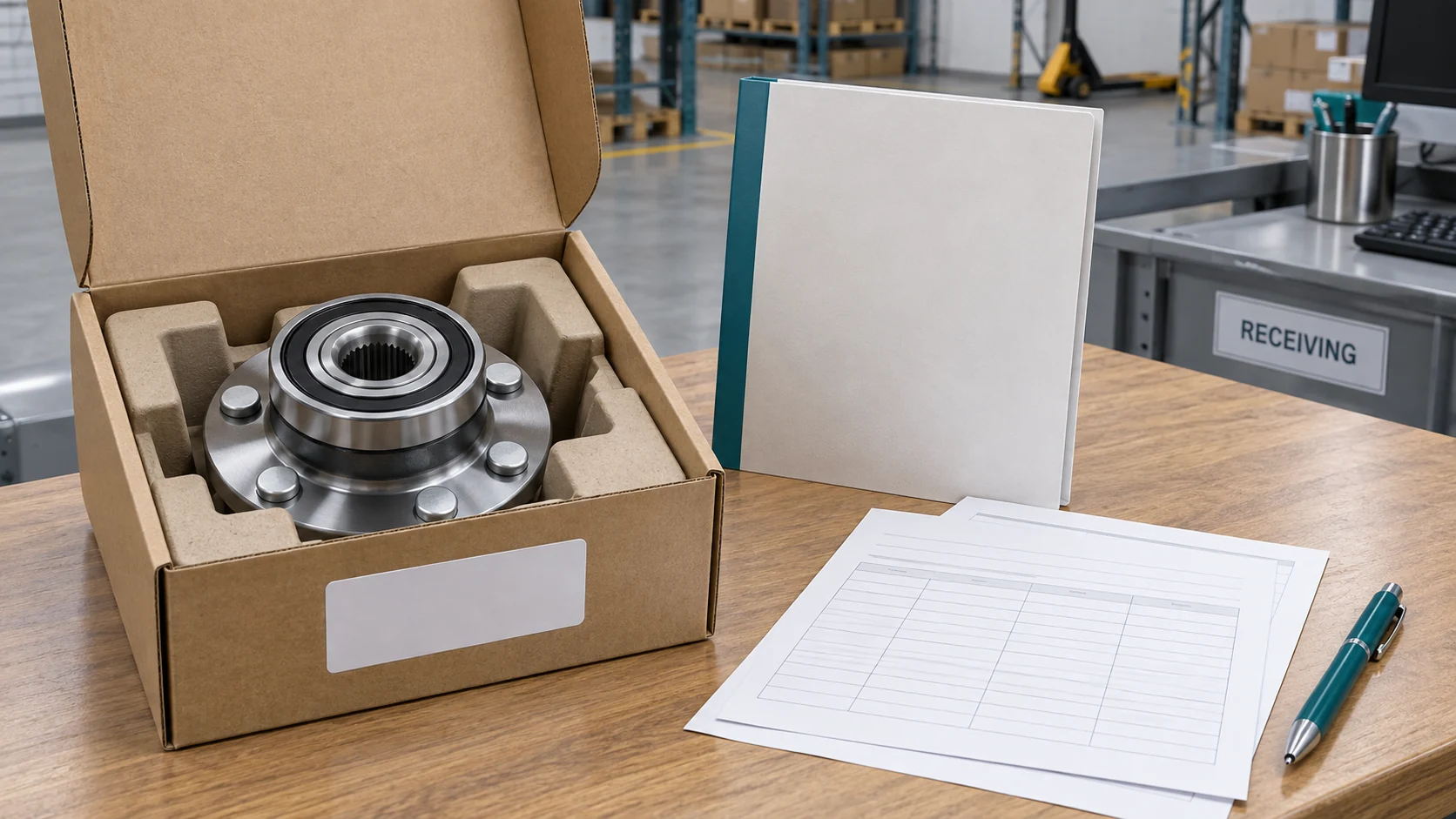
Request details of the inner protection, separators, accessory placement and outer carton. For a hub assembly, consider which projecting or sensitive features require protection in the actual design. Ask for photographs of the packed arrangement and an identified sample where needed. Keep those photographs linked to the relevant reference and packing revision.
Do not assume one pack suits every hub merely because the outer cartons share a design. Different sizes, weights, studs, cables or accessories may require different internal arrangements. The supplier should confirm the proposed packing for each relevant product group, and any exception should be visible in the order file.

Approve labels and artwork as controlled information
Prepare the exact text and artwork that the order requires. Identify the product reference, quantity, lot information and handling details that must remain readable. If barcodes are used, agree their data content and verification method with the relevant logistics team. A barcode graphic is not useful if it encodes the wrong identifier.
Keep the artwork version linked to the quotation and packing specification. Approve changes in a way that leaves an identifiable record. A supplier should not have to choose between several files named “final” with different contents. Where translated labels are needed, have the technical meaning and commercial information checked before approval.
Avoid adding unsupported claims to the package. Certification marks, origin statements, vehicle applications and performance promises require appropriate evidence and permission where relevant. The packaging process should preserve the approved product information rather than becoming a separate source of exaggerated claims.
Plan receiving checks that preserve evidence
At delivery, compare the shipment identity and quantity with the accepted order. Photograph visible transport damage or moisture before rearranging the packages. Check individual product identity and kit contents according to the agreed plan. Keep the packaging available until relevant discrepancies are resolved.
Separate different observations in the receiving record. A crushed outer carton, a torn inner bag, an unreadable label and a damaged component are related but distinct facts. Recording them separately helps determine the affected scope and the next action. Do not label every packaging issue as a manufacturing defect or assume an intact outer box proves the contents are correct.
For storage, obtain the supplied product's applicable conditions and preservation period. Timken's bearing storage guidance discusses moisture and environmental changes in its own product context. It supports asking about clean, dry storage, but its stated durations should not be copied as a universal shelf life for automotive hub assemblies.
Use document gaps to define the next action
A missing document does not always require the same response. Determine which decision it prevents. Missing packing artwork may block packaging approval; an unresolved product identity may block technical acceptance; an unrelated certificate may require a corrected explanation of the supplier's scope. Give each gap an owner and a clear closure condition.
Consider an illustrative order in which the dimensional report identifies one reference while the carton label shows another. The useful next step is to establish whether the difference is a documented internal code mapping or an actual mismatch. Replacing the label before that question is answered would destroy useful evidence and create a misleading appearance of consistency.
This is a fictional document-control example. It does not describe a Huayuan shipment. The method is to preserve the conflicting records, obtain the explanation and document the decision. The receiving team can then release, hold or reject the affected scope according to the agreed process.
Keep warranty and complaint information connected
Warranty terms should be established in the accepted commercial agreement for the product and application. Record the eligibility conditions, information required for a claim and the agreed response process. Do not infer a universal warranty from a statement about another reference or a general company presentation.
For a complaint, retain the order line, product and lot identity, installation and service information where available, and photographs of the observed condition. Ask for return instructions before cleaning, dismantling or shipping a component that may need examination. The condition in which it is received can affect the usefulness of later analysis.
Commercial resolution and technical investigation should remain distinguishable. Sending a replacement can address an immediate customer need, while understanding the cause may require further work. Record both clearly. An unexplained credit note does not establish a root cause, and a pending investigation does not by itself determine the commercial outcome.
Assemble a compact approval file for repeat orders
Keep the accepted quotation, product definition, relevant document review, sample results and packing specification together. Identify the current revision and preserve the decisions that explain it. The file should be concise enough to use but complete enough to answer why the product and supply arrangement were approved.
Before a repeat order, confirm whether the reference, source, product configuration, packaging or required documents have changed. Ask the supplier to declare relevant changes and determine whether the previous approval still applies. Reusing an old purchase description is not the same as confirming that the approved conditions remain current.
For the next enquiry, use the wheel hub bearing RFQ checklist to list the documents and packing requirements. Link application questions to the OE and fitment guide. Then contact Huayuan with the references and the evidence needed for your buying decision.
Questions about documents and packaging
Does a quality-system certificate approve every bearing?
No. Read the holder and scope, then obtain the product-specific evidence required for the order. A management-system document and a product inspection result address different questions and should be represented accurately in the approval file.
Should every shipment have the same document package?
The required package depends on the product, customer agreement and acceptance process. Define the records needed and confirm their availability before ordering. Avoid demanding unrelated documents that add volume without supporting a decision.
Can a packaging photograph replace a written specification?
It is useful supporting evidence, especially when linked to an identified sample and revision. It should be accompanied by the requirements needed to reproduce the arrangement, including contents, protection and labels. A photograph alone may leave important materials or quantities unclear.
What is the most useful record when a discrepancy appears?
A clear link between the order, delivered reference, lot, photographs and original packaging gives the investigation a strong starting point. Preserve the observation before changing the part or pack, and state the specific clarification or decision that is needed.
Purchasing guidance, product information and company updates from Huayuan Bearing.