
An OE number is a starting point for a wheel hub bearing enquiry, not a complete approval of interchangeability. Verification connects the original reference to the correct vehicle variant, wheel position, assembly interfaces and ABS configuration. When sources disagree, keep the conflict visible and obtain the evidence needed to resolve it before the proposed part becomes an accepted order line.
This guide is for buyers and catalogue teams managing replacement references. It explains how to preserve original data, distinguish candidate matches from confirmed applications, and document a decision that another person can review. It does not provide a new vehicle fitment table or validate any specific cross-reference. Actual compatibility must be confirmed against the relevant product and application information.

Preserve the original reference before searching
Keep the exact number supplied by the customer or source. Retain spaces, punctuation, leading zeros and suffixes in the original field. If a search system works better with a normalised version, create a separate search field rather than overwriting the original. This makes it possible to investigate a match or a transcription error later.
Record the reference type. An original equipment number, aftermarket brand number, supplier stock code and internal warehouse code are not interchangeable labels. Put each in its own field with the associated organisation or source. Without that context, the same character string can be interpreted incorrectly when lists from different catalogues are combined.
Photographs can help confirm what was actually printed on a component or package. Link each image to the enquiry line and include a wider view showing the object. A close-up of a number without context may be difficult to associate with the correct part when several samples are being discussed.
Record the source and the claim it makes
A reference can appear in a catalogue as an interchange candidate, a historical number, a related item or part of a kit. Do not assume every occurrence means direct replacement. Capture the surrounding description, application notes and source date or version where available. The relationship being claimed matters as much as the number itself.
When using Huayuan's wheel hub bearing reference directory, treat the result as a discovery record that leads to confirmation. It does not independently establish stock, supply of a third-party brand or universal compatibility across the listed vehicle names. Ask for the proposed supplied reference and its application scope.
Keep a source field even when the information comes from a trusted business partner. Trust in the relationship does not remove the possibility of an outdated catalogue, a mistaken suffix or a market-specific difference. A traceable source makes correction faster and allows the same mistake to be found in other records if needed.
Define the vehicle variant and wheel position
Record make, model, year and the relevant engine, drivetrain and market information. State the installation position clearly. If the available catalogue uses a production-date boundary or another distinguishing attribute, preserve it. Do not simplify the application to a model name merely because that is easier to display in a product table.
Separate the vehicle's identification from the purchasing reference. A customer may provide a registration detail, an old invoice or a photograph of a removed component. Those pieces of evidence can help, but each has a different scope. Ask the responsible technical or catalogue source to resolve the application rather than treating whichever identifier arrived first as definitive.
For front and rear positions, do not infer interchangeability from appearance. Driven and non-driven arrangements can also require different records. Where left and right are relevant, record them explicitly. If a field genuinely does not apply to the confirmed product, distinguish that from a field that has simply not been checked.
| Record | Purpose | What it cannot establish alone |
|---|---|---|
| Original OE reference | Preserves the initial identification | Complete fitment across every vehicle variant |
| Vehicle configuration | Defines the intended application | Exact delivered product identity |
| Supplier reference | Identifies the proposed supply | Equivalence without supporting evidence |
| Drawing and revision | Defines interfaces and requirements | Every service condition or application approval |
| Sample result | Supports a stated evaluation | Unlimited approval of future changes |
| Written confirmation | Records an authorised decision | Claims beyond its stated scope |
Compare mechanical configuration before approving a match
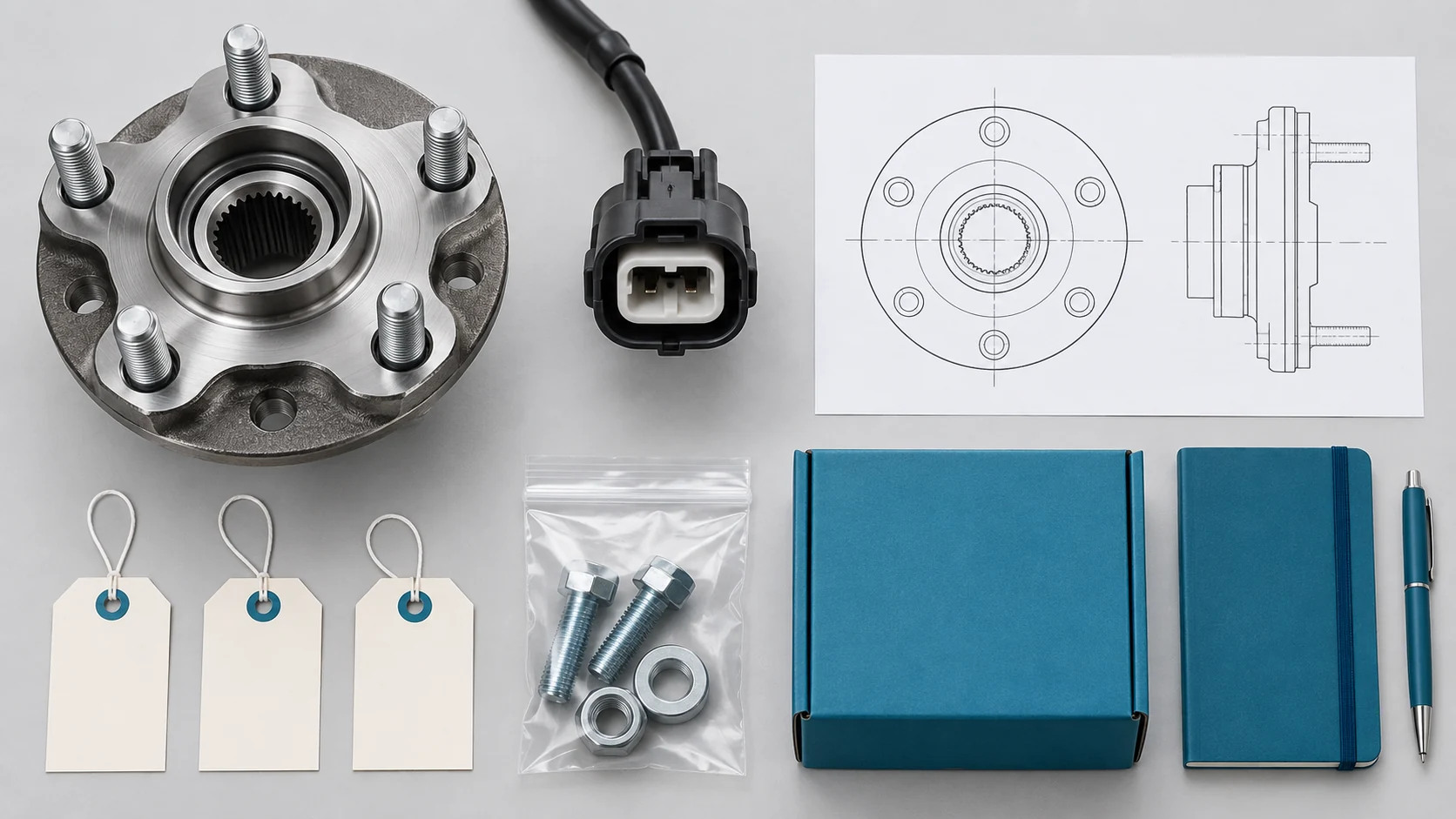
Obtain the relevant drawing or product information for the proposed assembly. Compare the mounting arrangement, pilots, wheel-side and knuckle-side interfaces, axial dimensions and driven interface where applicable. Record which features have been confirmed and which remain open. A single match such as bolt pattern should not close the whole comparison.
Keep measurements from a used sample separate from specified values. Wear, damage or a previous repair can affect the sample. If a measured discrepancy is important, document the method and condition and ask for technical review. Do not quietly amend the supplier's specification to match an uncertain measurement.
The wheel bearing and hub assembly selection guide explains the product boundary and selection sequence. Use it when the reference may describe a bearing only while the proposed supply is a larger assembly or kit. The order should clearly identify the components being approved.
Treat ABS compatibility as an independent check
Determine the required rotating target and sensor arrangement. A magnetic encoder, toothed target and supplied sensor are distinct features. Record the applicable orientation, sensor reference and connector or harness details where relevant. The description “ABS version” is too broad to resolve differences between candidates.
NTN's ASB technology explanation describes an integrated magnetic encoder and active sensing arrangement. That technical background helps interpret product descriptions, but it does not mean all encoded bearings produce an interchangeable application. Ask for the requirements of the actual wheel end.
For a deeper explanation of identification and handling, use the JNHJDP ABS encoder guide. It distinguishes a visual identification aid from a functional check. If functional evidence is needed to close a fitment question, agree the appropriate test and acceptance basis rather than assuming a similar connector or visible magnetic pattern is sufficient.
Handle supersessions and alternatives explicitly
A historical reference may have a later replacement or a supplier may propose an alternative because the original item is unavailable. Record the relationship as a claim requiring a source. Include the effective conditions and any associated hardware or application changes that the source specifies.
Do not assume the relationship works in both directions. A statement that one reference replaces another may have conditions that do not support reverse substitution. Likewise, a kit replacing an earlier assembly may include additional parts needed for the change. Keep those details connected to the reference relationship.
Maintain the original enquiry even after an alternative is accepted. The order record should show what was requested, what was proposed and why the proposal was approved. This is especially useful when a later buyer receives the old reference again and needs to understand the previous decision without repeating the entire investigation.
Resolve conflicting catalogue records with a decision log
When two sources disagree, preserve both entries and state the exact conflict. The disagreement might concern a vehicle range, wheel position, sensor configuration or dimensional feature. Avoid merging the sources into a larger application list. Combining uncertainty can create a confident-looking record that neither source actually supports.
Assign an owner and a next action. The action could be obtaining an original equipment reference, clarifying a drawing, checking the supplied sensor or requesting an application-specific technical response. Set a clear condition for closure. “Supplier contacted” is an activity; “correct connector confirmed against the approved reference” is a decision supported by evidence.
Use an explicit unresolved state where the evidence is insufficient. That state should prevent the candidate from being presented as approved while allowing unrelated lines to proceed. A catalogue team can still retain the candidate for future research without publishing its application as confirmed fact.
Use samples to answer the remaining questions
Select samples only after defining what remains uncertain. If the issue is a mounting dimension, the evaluation should identify the feature and method. If the issue concerns the sensing arrangement, obtain the relevant technical requirements and qualified evaluation. A sample does not automatically answer every question merely because it can be held beside the old component.
Record the sample's exact identity, source and revision. Keep any test report linked to that sample and state the conditions of the evaluation. If a supplier provides a different revision after the review, determine whether the earlier result still applies before accepting the new supply.
Document the scope of approval. A result may confirm the dimensions checked, a packaging arrangement or a particular application evaluation. Do not broaden it to all markets, all model years or every future production change. Precise scope allows the evidence to remain useful instead of becoming a misleading general claim.
Avoid common spreadsheet errors
Reference data is vulnerable to ordinary spreadsheet behaviour. Import identifiers as text, check that leading zeros survive, and keep source values separate from cleaned search values. Do not allow a long number to be displayed or exported in a way that changes its characters. Verify a small sample after each import or format conversion.
Use separate columns for make, model, position and source rather than one unstructured application paragraph when the data will be filtered or joined. Keep multiple source relationships identifiable. A join on a short shared fragment can attach unrelated applications to a product, especially if a reference is incomplete or the wrong field is used.
Before releasing a catalogue update, review unusually broad results and conflicting attributes. A large number of associated vehicles is not proof of strong coverage. Ask whether the relationships are supported, whether duplicates were introduced and whether exclusions remain visible. The aim is accurate scope, not the largest possible application count.
Work through a practical evidence example
Consider a fictional enquiry for a rear hub assembly. The customer supplies a reference from an old invoice, one catalogue lists it for a broad model family, and a second source distinguishes two drivetrain variants. The proposed sample also has a connector that differs from the customer's photograph. These observations create specific questions rather than a ready purchase decision.
The buyer should preserve the invoice reference, confirm the actual vehicle variant, request the relevant application source and clarify the connector requirement. If those steps identify the correct candidate, the sample evaluation can focus on the remaining uncertainty. If they do not, the line stays unresolved. Choosing the broadest catalogue entry would not close the evidence gap.
This example intentionally uses no real OE numbers. It demonstrates how to organise a decision without creating a fictional interchange that might later be copied into a catalogue. Real examples should include only references supported by records that the business is permitted to publish.
Carry the approved result into the quotation
Once the application is confirmed, transfer the accepted reference and configuration into the RFQ. Include the approved drawing revision, required accessories and any limitations. Keep quantities and commercial terms separate from technical acceptance so that a price revision does not accidentally alter the product requirement.
The Huayuan RFQ checklist and downloadable enquiry template provide a structure for this handover. The supplier's response should identify the actual proposed supply, not merely repeat the customer's original reference without clarification.
If quality records or packaging controls are part of acceptance, specify them using the quality documents and packaging checklist. Connect the documents to the order and lot where relevant. A correct fitment decision and a traceable delivery record support different parts of the buying process.
Keep catalogue claims aligned with the approval
After an application is accepted, publish only the scope supported by the evidence. Preserve source, revision and exclusions internally. If the supporting record changes or a conflict emerges, route the affected claim for review instead of allowing an old catalogue entry to remain the unquestioned source for future orders.
Maintain a clear distinction between a searchable reference, a supplied product, an available item and an approved application. These may overlap, but they are not the same data category. A directory can help buyers discover candidates while still requiring confirmation of supply and fitment.
To start a review, use Huayuan's wheel hub bearing range and contact the team with the original number, its source, vehicle details and the exact discrepancy. A focused evidence question is more useful than an instruction to confirm a large, unexplained list of vehicle names.
Frequently asked questions
Is an OE cross-reference the same as a fitment approval?
No. It identifies a relationship that must be interpreted in context. Confirm the intended vehicle variant, position, product configuration and any conditions attached to the reference. Keep the supporting source with the decision.
Can two parts fit mechanically but differ in ABS configuration?
Mechanical and sensing requirements should be checked separately. A similar mounting arrangement does not establish the correct target, sensor or connector. Obtain the application-specific information and resolve those differences before approving the candidate.
What if the customer cannot supply every vehicle detail?
Record what is available and identify the missing information. Marking the application unresolved is preferable to inventing a complete vehicle description. The technical team can then explain which additional evidence would allow a reliable decision.
Should a catalogue list every possible associated vehicle?
Only publish relationships supported by appropriate evidence and preserve their conditions. Broad association counts can include duplicates, aliases or unverified candidates. Buyers need accurate application scope and clear exclusions more than a large headline total.
Purchasing guidance, product information and company updates from Huayuan Bearing.