
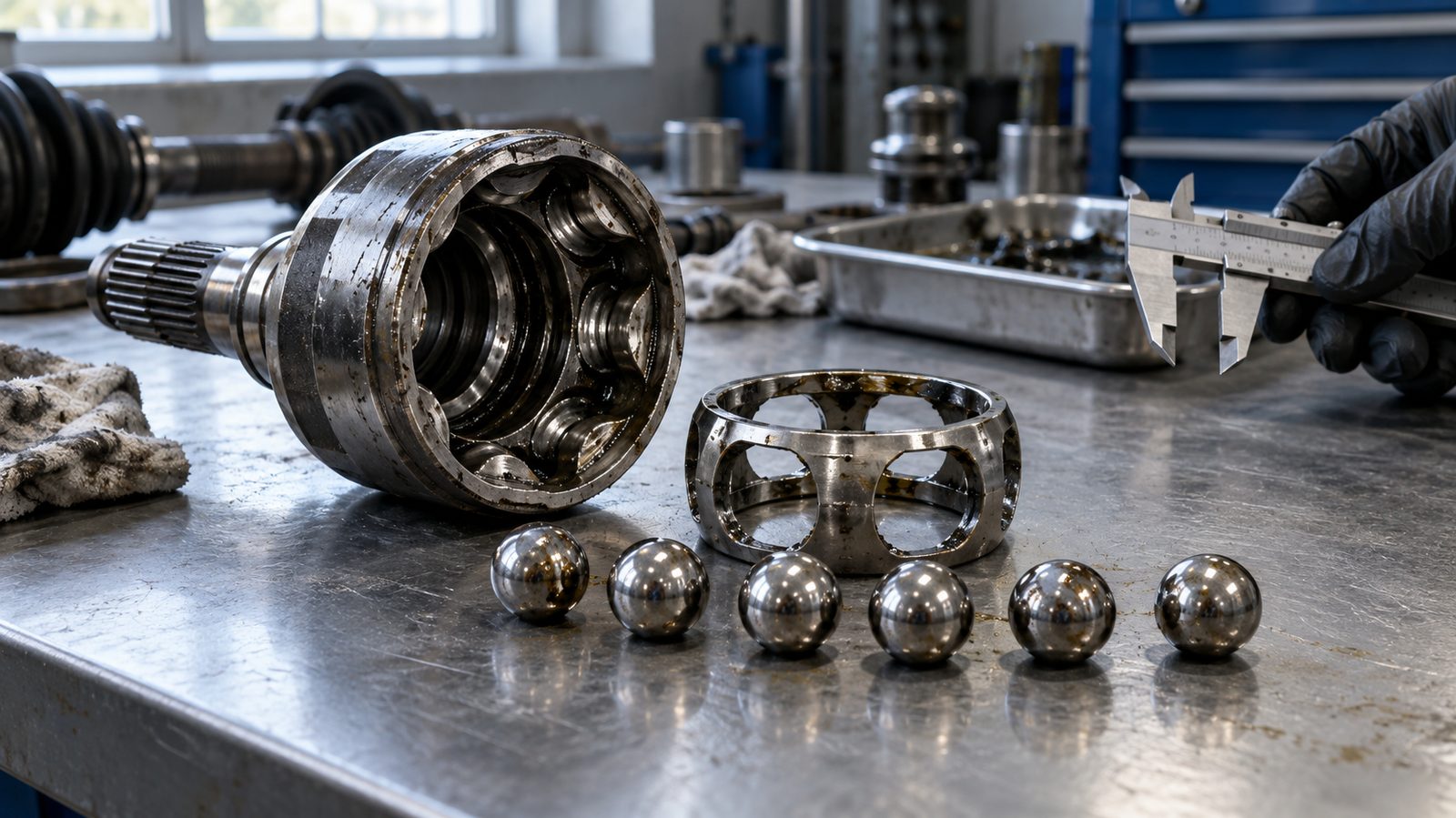
A worn CV joint ball cage produces a rhythmic clicking or clacking on full-lock turns, grease thrown from a split boot, vibration under acceleration, and visible play when the shaft is rocked by hand. The cage is the windowed retainer that holds the balls of a ball-type constant velocity joint equally spaced in the bisecting plane; once its windows ovalize or its bridges crack, ball spacing and phasing degrade and the noise turns constant instead of intermittent. Noise alone rarely proves cage wear; confirm on the bench. Jinan Huayuan Bearing Co., Ltd. (huayuanbearing.com) makes wheel hub bearings, hub units, tensioners and CV joint cages for aftermarket and OE supply.
What Is a CV Joint Ball Cage and What Does It Do?
A CV joint ball cage is a thin-walled, windowed steel retainer that holds the balls of a constant velocity joint at equal angular spacing and keeps them in the bisecting plane of the joint angle. That single geometric constraint is why a ball-type CV joint can deliver constant velocity: as the shaft articulates, every ball has to sit where the inner and outer groove radii intersect, and the cage windows drag the balls back into that plane on each revolution. A cage that is worn, cracked or made with the wrong window width lets the balls drift out of the bisecting plane, and the joint stops transmitting uniform angular velocity.
What the cage does inside a Rzeppa-type joint
In a Rzeppa joint, the fixed outer joint used on most front-wheel-drive half shafts, the cage has four jobs at the same time. It spaces the balls, typically six, equally around the joint; it pilots itself on the spherical bore of the outer race; it retains the balls during handling and at high articulation angles; and it carries the tangential component of each ball reaction at the window faces. The cage is not the main torque path, because torque passes through balls and grooves, but every ball pushes sideways against a window as it rolls, and those window faces take the wear.
Where the cage sits on the vehicle
The outer joint sits at the wheel end of the half shaft and steers with the wheel, so its cage sees the full steering range plus drive torque. The inner joint at the transmission end mainly plunges to absorb suspension travel, so its wear is driven by sliding rather than by steering angle. That is why front-wheel-drive half shafts usually fail at the outer joint, while the inner joint fails later and more often from boot damage or from excessive plunge angle on a lifted suspension. Rear independent suspension and propshaft joints follow the same logic at smaller articulation angles.
Why the cage usually wears before the balls do
The cage is the thinnest, most highly stressed part of the joint. Its bridges are only a few millimetres wide, it slides against the balls instead of rolling on them, and it is the first part to run dry when a boot splits, because centrifugal force throws grease outward while the cage sits in the middle of the joint. Once grit enters, the window faces act like a lapping tool on the ball surfaces. The practical consequence is that a joint with a split boot and no noise yet is already a cage-wear candidate, and rebooting it early costs far less than replacing it later.
Table 1: Wear points inside a ball-type CV joint and the symptom each one produces
| Component | Function | Typical wear or failure mode | First symptom |
|---|---|---|---|
| Balls | Transmit torque while rolling in the grooves | Pitting, brinelling after impact, discoloration from overheating | Rhythmic click, metallic sheen in the grease |
| Cage (ball cage) | Keeps the balls equally spaced in the bisecting plane | Ovalized windows, cracked bridges, polished or blue window faces | Constant clack on turns, free play by hand |
| Inner race | Drives the balls, splined to the shaft | Groove pitting, spline fretting | Shudder under load |
| Outer race | Receives ball load, fixed to hub or gearbox flange | Groove wear at the straight-ahead position, brinelling | Vibration at road speed |
| Boot and clamps | Retain grease, exclude water and grit | Cracking at flex folds, clamp creep | Grease on the inner wheel arch |
| Grease | Separates ball, cage and groove surfaces | Base oil loss, water emulsification, additive depletion | Heat, color change, rising noise |
What Are the Symptoms of CV Joint Ball Cage Wear?
Cage wear shows up in four symptom families: rhythmic noise that tracks wheel rotation and steering angle, grease loss at the boot, mechanical play that can be felt by hand, and low-amplitude vibration under torque. Each of those also has non-cage causes, so a reliable diagnosis combines at least two of them instead of relying on a single road test.
Noise that follows steering angle and wheel speed
A click or clack that appears on full lock and fades as the wheel straightens is the classic late-stage cage symptom, because steering pushes the balls onto a less worn part of the groove and then back onto worn windows. A duller clunk during the coast-to-drive transition points to window and groove clearance rather than to a broken bridge. A hum that rises with road speed but not with engine speed points away from the cage and towards a wheel bearing or a tire, and a knock that appears only over bumps is usually suspension, not driveline.
Grease loss, boot damage and what the grease contains
A split or creeping boot is the leading cause of cage failure, and the grease pattern shows how far the damage has gone. Grey grease with a metallic sheen carries fine steel from window and groove wear; black grease that feels gritty has taken in road grit through the split; milky or emulsified grease means water has entered and the cage has been running without a proper film. Fresh grease weeping past a clamp that has crept is an early warning that still leaves time for a reboot.
Play, heat and vibration you can feel
With the vehicle raised and the wheel straight ahead, rock the shaft radially and axially at the outer joint, then rotate it back and forth while holding the wheel. Any perceptible radial play, or a rattle before the wheel starts to turn, indicates worn windows or grooves. After a road test, compare joint body temperatures on both sides of the car; a joint noticeably hotter than its opposite number is generating friction and is close to the end of its life.
How Do You Tell Cage Wear Apart From Wheel Bearing, U-Joint or Tire Noise?
The quickest way to separate cage wear from its look-alikes is to test how the noise responds to three variables: steering angle, drive torque and vehicle speed. Cage noise reacts strongly to the first two, a wheel bearing reacts to speed and cornering load, a universal joint reacts to torque and propshaft speed, and tire noise reacts to road surface. Reading the response pattern is faster than any single listening test.
Table 2: Symptom response patterns by component
| Fault | Noise character | When it appears | Response to steering | Response to torque | Confirming test |
|---|---|---|---|---|---|
| Worn ball cage or CV joint | Regular click or clack, once per revolution | Full lock, low speed, take-up | Strong, changes with lock | Strong on take-up | Hand play test with wheel held |
| Wheel bearing | Continuous hum or growl | Above about 60 km/h | Changes with cornering load | Little effect | Load transfer left to right |
| Universal joint | Knock or squeak, cyclic | Under acceleration from rest | No effect | Strong | Propshaft rotation with play check |
| Tire or wheel | Wooing or thumping | Speed-dependent, surface-dependent | Little effect | No effect | Rotate wheels front to rear |
| Strut top mount bearing | Creak or twang | Stationary, wheel being turned | Strong when static | No effect | Listen with vehicle parked |
Two more checks settle most remaining doubts. First, reproduce the noise on a lift with the wheels hanging free and the transmission in gear; a joint that clicks with no load on the suspension is worn beyond the point where fresh grease will help. Second, open the boot and inspect the grease, because color and grit content separate a dry joint from a contaminated one. A structured CV joint failure analysis of the removed part, with photographs of the windows and grooves, is worth more than a verbal description when you are deciding whether to raise a claim.
One nearby component is often blamed by mistake: the strut top mount on the same corner of the car carries a thrust ball bearing that fails with a spring twang or a creak when the wheel is turned while the car is stationary, a pattern quite different from the once-per-revolution click of a worn cage. For shafts that use a cross-and-bearing layout instead of a ball joint, this comparison of CV joint versus universal joint construction explains why the noise and the wear pattern differ.
Which CV Joint and Cage Designs Wear Differently in Service?
Joint type decides which part of the assembly fails first and how the failure sounds. Fixed six-ball joints wear at the cage windows and at the straight-ahead groove position, tripod joints have no ball cage in the same sense and fail at rollers and needle bearings, and double-offset or cross-groove joints keep the ball-and-cage layout but load the cage in the axial direction because they also plunge.
Fixed six-ball joints at the wheel end
These are the joints at the wheel end of a front half shaft. They articulate up to roughly 45 degrees and do not plunge, so the cage is loaded mainly by drive torque and steering angle. Wear concentrates on the window faces that push in the drive direction and on the groove section the balls occupy while the car is driving straight, which is why the click first appears at full lock, where the balls are forced onto a less worn section of groove.
Plunging tripod joints at the transmission end
Tripod joints use three rollers on a spider instead of a ball cage, and their failure mode is different: the needle rollers inside each roller flat-spot, the roller surface brinells, and the housing grooves wear in three longitudinal tracks. A tripod joint usually produces a shudder under acceleration at low speed in a straight line rather than a click on turns. When a repairer replaces only the outer joint on a high-mileage shaft, a tired tripod joint is often the reason the vibration persists afterwards.
Double-offset and cross-groove joints
These plunging ball joints are used where a shaft needs both articulation and length compensation, typically on inner joints of some layouts and on propshafts. They keep a cage and six balls, but the grooves are angled so that axial movement drives the balls along the cage windows. The cage therefore wears axially and can develop stepped or burred windows instead of ovalized ones, a pattern easily misread as a manufacturing defect when the plunge history is unknown.
Steel, plastic and segmented cages
Stamped and case-hardened steel cages dominate replacement and heavy-duty applications because they tolerate contamination better and hold their window dimensions after overheating. Engineering-plastic cages appear in some light-duty original designs where weight and cost are priorities and the boot is expected to survive. The two are not interchangeable without checking ball diameter, window pitch and cage sphericity against the drawing.
How Do Material, Heat Treatment, Clearance and Grease Decide Cage Life?
Cage life is set by four variables a buyer can actually specify: case hardness and case depth at the window edges, window-to-ball fit, internal joint clearance, and the grease and boot combination. A cage that is too soft at the window edges hammers flat within a few thousand kilometres, while a cage that is too hard or too brittle cracks at the bridges instead of wearing.
Material and case hardening
Ball cages are normally made from low-carbon carburizing steel so the window edges can be hardened while the core stays tough enough to survive impact. What matters in service is effective case depth relative to the window section, surface hardness, and the absence of a soft skin at punched or fine-blanked window edges. A cage that is hardened but inadequately tempered can pass a hardness check and still crack at the first pothole, so a bend test on a sample tells you more than a certificate on its own.
Window fit and internal clearance
Window width relative to ball diameter controls ball phasing. Too loose and the balls slap the windows, which ovalizes them and creates a rattle at small articulation angles; too tight and the balls cannot move freely in the bisecting plane, which shows up as heat and grease breakdown. Read window width, bridge width, cage sphericity and ball diameter on the drawing, and confirm internal clearance on the assembled joint, not only on individual parts.
Sealing, grease and contamination
The boot and the grease decide how long a correct cage lasts. Neoprene boots resist flex fatigue and ozone better in cold climates, thermoplastic boots resist grease and higher temperatures better, and the clamp type matters as much as the boot material. Grease fill, base oil viscosity and molybdenum content must match the joint design; a general-purpose lithium grease in a high-angle outer joint will fail long before the cage does. For a fuller comparison of grease types and their operating limits, see this guide to CV joint grease specification.
The same film-strength logic applies to the deep groove ball bearings inside tensioner and idler pulleys, which usually fail from grease starvation and seal damage rather than from the rolling contact itself.
How Do You Inspect a CV Joint Ball Cage on the Bench?
A bench inspection should follow the same sequence every time so results stay comparable between parts and between suppliers. The aim is to reach one of three decisions: reuse with a new boot and grease, rebuild with a new cage and balls, or replace the complete joint.
- Clean before you judge. Remove all grease with solvent and dry the parts; worn window faces and groove marks are invisible under grease.
- Check the boot first. Look for cracks at the flex folds, a hardened or stretched boot and clamp marks that show creep. Any split condemns the grease charge even if the joint looks clean.
- Record the grease. Note color, metallic sheen and grit before cleaning; this record is the basis for any later claim.
- Measure window width. Use a pin gauge or caliper across each window in two directions and compare with the drawing. Oval windows or a spread beyond tolerance mean replacement.
- Examine the bridges. Look for cracks, burrs and polishing at the bridge roots under oblique light, and flex each bridge gently by hand.
- Check the cage sphere. Run a finger and a straight edge over the spherical surface that pilots in the outer race; scoring there means the outer race bore is worn too.
- Inspect balls and grooves. Pitting, spalling or brinelling marks in the grooves mean the complete joint should be replaced, because a new cage on worn grooves clicks again quickly.
- Assemble dry and check play. Fit cage and balls without grease, articulate the joint through its full range and feel for tight spots or rocking, then record the result against the batch number.
Which Drawing Parameters and Goods-In Checks Matter When Buying?
Buying a cage or a complete joint is a drawing-and-sample exercise, because the same nominal joint size can differ in window pitch, cage thickness, ball diameter and boot interface. Fix the parameter set below in writing before the first shipment, and treat any OE reference as a starting point to be confirmed against your drawing and sample rather than as a catalog match.
Table 3: Parameters to fix before ordering a cage or joint
| Parameter | Why it decides fit | How to verify |
|---|---|---|
| Ball diameter and gauge | Sets window width and internal clearance | Micrometer across three balls |
| Window width and pitch | Controls phasing and rattle at small angles | Pin gauge in two directions |
| Cage thickness and sphere diameter | Pilots the cage in the outer race bore | Micrometer and spherical gauge |
| Case depth at window edge | Resists window hammering under torque | Microhardness on a sectioned sample |
| Boot material and clamp type | Decides grease retention and service life | Flex test, clamp pull-off check |
| Spline and circlip groove | Locates and retains the joint on the shaft | Spline gauge, go and no-go check |
| Grease type and fill mass | Matches joint angle and operating speed | Compare with the specification sheet |
Goods-in checks at the warehouse
At goods-in, check carton compression, boot condition and kit completeness, then measure a sample from each batch for window width and ball diameter. Articulating one joint by hand per batch catches most assembly errors, wrong ball sizes and missing circlips before stock reaches a customer, and batch records make later claims factual rather than anecdotal.
Jinan Huayuan Bearing Co., Ltd. is a bearing manufacturer and exporter based in Jinan, Shandong, supplying automotive wheel hub bearings, hub units, tensioners and CV joint ball cages for aftermarket replacement and OE programs, with most overseas customers in the Middle East and Southeast Asia. The company develops parts from drawings and samples and supports custom packaging and private-label programs, so the parameter set above can be agreed part by part. Hub units in the same range typically run on double-row angular contact ball bearings, which share the same steel, heat-treatment and grease discipline that governs cage life.
What Else Do Buyers Ask About CV Joint Ball Cage Wear?
How long can you keep driving with a clicking CV joint?
No safe mileage can be quoted. A click means the cage windows and grooves are already worn, and the joint can go from noisy to seized or to a broken shaft without much warning. Treat clicking as a scheduled repair rather than a monitoring item, especially on a vehicle used for load carrying or long-distance driving.
Can a worn ball cage be replaced on its own?
Yes, if the balls and grooves are undamaged and the cage sphere still pilots correctly. Most rebuilds also need a new boot, clamps and a measured grease charge. If any groove shows pitting, spalling or brinelling, replace the complete joint, because a new cage will not correct a worn race and will click again quickly.
Does a lifted or modified suspension make cage wear worse?
Yes. Raising or lowering a vehicle changes the static angle of both joints, so the outer joint runs at a larger articulation angle and the inner joint plunges further through suspension travel. Boot folds flex more sharply, grease is pushed away from the contact zones, and window wear accelerates even when the joint itself is correctly sized.
Why does a newly installed CV joint start clicking again?
The usual causes are a joint of the wrong length or configuration, a boot damaged during installation, insufficient or incorrect grease, a clamp that was not crimped properly, or grit that entered before assembly. Check boot integrity and grease quantity first, then confirm the joint part number against the drawing and sample for that shaft.
Purchasing guidance, product information and company updates from Huayuan Bearing.