
What Is a Tensioner Bearing Pulley and What Does It Do?
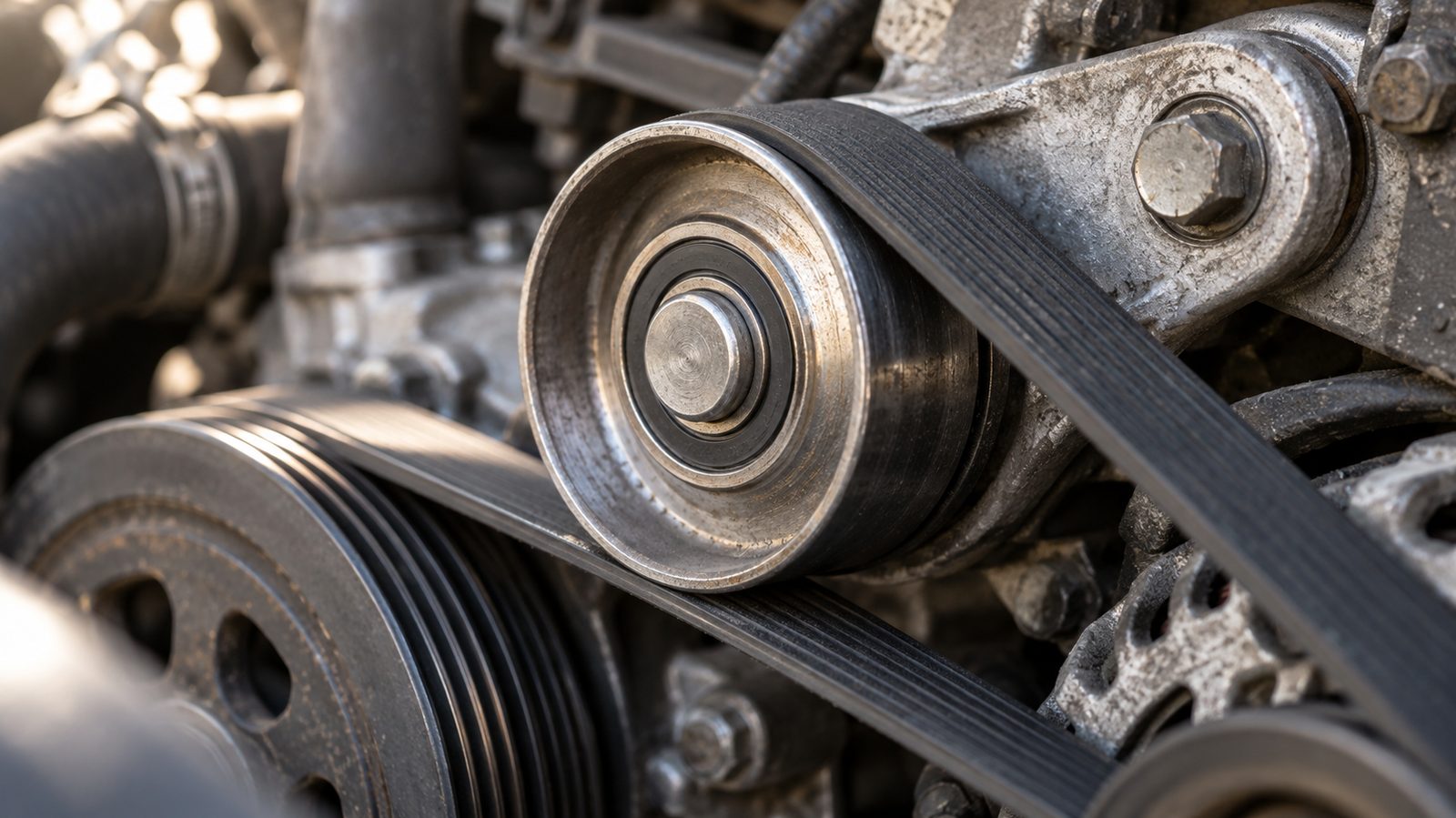
A tensioner bearing pulley is a sealed rolling bearing pressed into a pulley wheel that guides the accessory drive belt and holds it under tension. The pulley shell contacts the belt; the bearing lets the pulley spin with minimal friction while carrying the belt load. Nearly all tensioner noise comes from that bearing, its seal, or the geometry around it, not from the belt itself.
How the pulley, the arm and the bearing divide the work
Each part of the assembly has one job, and the noise usually identifies which one has failed. The tensioner arm or bracket sets belt tension and takes up slack as the belt stretches. The pulley shell provides the running surface and keeps the belt centred. The bearing carries the radial load and allows rotation. When a bearing seizes or drags, belt speed drops and the belt squeals. When the arm pivot wears, the belt wanders and chirps at idle. When the pulley face polishes, the belt slips under load. Reading the sound by component shortens diagnosis more than any single test.
What the bearing inside actually has to survive
Load on a tensioner pulley is mostly radial and close to the vector sum of the belt tensions on both sides of the pulley. Axial load is small in a correctly aligned drive and rises sharply once the pulley runs out of plane with the other pulleys. Speed depends on pulley diameter rather than on engine size: bearing speed equals belt speed divided by pulley circumference, so a small tensioner pulley can turn considerably faster than the crankshaft pulley. Add engine-bay heat, vibration harmonics, water splash and road dust, and the duty cycle resembles a high-speed industrial idler more than a slow wheel bearing.
That combination explains the usual failure order: grease first, seal second, raceway third. A bearing that still holds grease behind an intact seal rarely becomes noisy, even at high mileage, which is why seal condition is a better predictor than odometer reading.
Jinan Huayuan Bearing Co., Ltd. (huayuanbearing.com) manufactures and exports wheel hub bearings, hub units, tensioners and CV joint components from Jinan, Shandong, for aftermarket replacement and OE programs, developing parts from customer drawings and samples.
What Does Tensioner Pulley Noise Sound Like?
Tensioner pulley noise is identified by how it tracks speed: it follows belt speed, repeats once per pulley revolution, and does not change when the vehicle turns or brakes. Squeal, chirp, rumble and rattle each map to a different failure, and the table below is the fastest way to narrow the cause before any tool is picked up.
| Noise pattern | How it behaves | Most likely cause | First check |
|---|---|---|---|
| Continuous sharp squeal | Starts just above idle, rises with engine speed, briefly quiet after water spray | Dry or glazed bearing, seal lip running without grease | Belt off, spin the pulley by hand and listen |
| Rhythmic chirp once per pulley turn | Repetition rate matches pulley diameter, not firing order | Belt slip on a polished or contaminated pulley face | Inspect belt ribs and pulley groove surface |
| Low rumble or growl | Present at all speeds, louder under accessory load | Raceway spalling or brinelling | Stethoscope on the tensioner bracket, then on the hub |
| Metallic rattle at hot idle | Disappears above idle and returns when hot | Worn arm pivot or weak damper spring | Check arm free play with the belt off |
| Grinding with black dust | Rough rotation, dust ring around the pulley | Seal failure, grease loss, foreign object | Check radial play and seal lip condition |
| Squeak only on cold or damp starts | Short duration, fades after warm-up | Belt hardening or light slip, not bearing damage | Recheck after warm-up before replacing parts |
How do you separate tensioner noise from idler, alternator, water pump and hub noise?
Frequency ratio is the cleanest separator between two belt-driven pulleys. Measure or read the diameters, then compare repetition rates: the smallest pulley turns fastest and produces the highest repetition rate, so a chirp that repeats far more often than the tensioner pulley can turn belongs to a smaller idler or to the alternator. Placing a mechanic's stethoscope on the tensioner mounting bracket transfers bearing noise through the casting and isolates it from belt rub, but keep hands and tools clear of the running belt.
Hub bearing noise behaves differently and is easy to exclude. It changes with vehicle speed rather than engine speed, shifts when load transfers in a corner, and often disappears briefly when the steering is loaded the other way; a workshop guide to how to tell a wheel hub bearing is failing covers those load-transfer tests in detail. Tensioner noise, by contrast, is present standing still and follows the belt. For a side-by-side comparison of the two pulley roles in a drive, see tensioner pulley vs idler pulley.
How Do You Diagnose Tensioner Bearing Pulley Noise Step by Step?
Diagnosis works best in a fixed order, from least invasive to most, so that a belt or alignment fault is not mistaken for a failed bearing. The sequence below takes about twenty minutes on most engines and produces a decision rather than a guess.
- Confirm the noise tracks belt speed. Hold engine speed steady at the point where the noise appears, then note whether the sound continues when the vehicle is stationary and whether it changes when the air conditioning or alternator load is switched on.
- Inspect cold, before warm-up. Cold-start squeaks and belt dust are visible before heat expands the belt and softens the grease. Photograph any dust trail, because its position shows which pulley is running dry.
- Check belt tracking and pulley face condition. Look along the belt line for a belt sitting off-centre, a shiny polished pulley face, or ribs worn to a step. Any of these produces chirp without bearing damage.
- Remove the belt and spin each pulley by hand. A healthy bearing turns with light resistance and a faint smooth hiss. Dry rasp, notchiness, a gritty feel or a pulley that keeps spinning after release all indicate replacement.
- Measure play with a dial indicator. Mount the indicator against the pulley face and rim, load the pulley by hand in both directions, and record radial and axial movement. Play at the rim beyond the value agreed on the drawing is grounds for rejection, not adjustment.
- Check alignment and runout. Lay a straight edge across the pulley faces in the drive plane and rotate the tensioner pulley with an indicator on the rim. Runout from a bent bracket or a cocked bearing shows up as belt wander and edge wear.
- Check the arm, pivot and damper. With the belt off, the arm should move against spring force without side slack. Free play at the pivot, a leaking damper or a spring that no longer returns the arm means the assembly is worn even if the bearing is sound.
- Replace as a unit and verify. Where the bearing is staked or moulded into the pulley, fit the complete tensioner assembly, refit the belt to the correct routing, run the engine, and recheck with the stethoscope before releasing the vehicle.
Which checks must be done with the belt removed?
Hand-spin feel, measured play, pulley runout and arm free play are only valid with the belt off, because belt tension preloads the bearing and hides both play and roughness. Belt-on checks answer a different question: whether the noise is present, where it originates, and how it responds to load. Run both, and treat a disagreement between them as evidence of an alignment or tension fault rather than a bearing fault.
Which Tensioner Pulley and Bearing Types Are Used, and Which One Do You Need?
Three variables decide what a tensioner pulley can do: the tensioner mechanism, the pulley material, and the bearing execution inside it. The bearing execution also decides whether the part can be repaired or must be replaced as an assembly.
Automatic versus manual tensioners
An automatic tensioner uses a spring-loaded arm and a damper to hold belt tension constant as the belt stretches and accessory load changes. A manual tensioner is set once through a slotted bracket or an eccentric and then locked. Automatic units usually run a sealed deep groove ball bearing inside a stamped or machined pulley and fail at the bearing, the damper or the arm pivot. Manual units load the bearing less evenly, because tension depends on the installer, and over-tensioning is a frequent cause of early noise on those drives.
Pulley material and bearing execution
Stamped steel pulleys dominate high-volume drives: light, economical and adequate when the bearing is a proper press fit with a retaining shoulder or staking. Machined steel pulleys hold groove profile and concentricity more tightly and suit drives where belt tracking is critical. Thermoplastic pulleys reduce weight and run quietly but tolerate heat and press-fit abuse less well. Inside, most tensioner pulleys use a single-row sealed deep groove ball bearing; higher-load drives use a double-row ball bearing, while roller bearings are normally reserved for heavily loaded industrial drives.
| Construction | Key features | Where it is used | What it means for noise |
|---|---|---|---|
| Stamped steel pulley, sealed deep groove ball bearing | Pressed bearing, staked or shouldered retention | Most passenger-car serpentine drives | Bearing noise dominates; a dented shell causes tracking chirp |
| Machined steel grooved pulley | Tight groove tolerance, controlled runout | Multi-rib drives sensitive to alignment | Resists groove wear; misalignment noise still originates at the arm |
| Thermoplastic pulley | Moulded body, inserted bearing | Weight-sensitive accessory drives | Quiet running; heat damage appears as play and seal weep |
| Double-row ball bearing pulley | Two rows share radial load | Higher belt tension, larger accessory loads | Longer load life, same seal and grease limits |
| Eccentric or adjustable pulley | Offset bore with lock bolt | Manual tensioning drives | Installer-set tension is the main noise risk |
What Causes Tensioner Bearing Pulley Noise?
Noise is a symptom of one of a small number of physical causes, and each cause leaves a different trace on the part. Identifying the trace matters for the buyer as much as for the mechanic, because a repeat failure usually means the specification or the installation, not bad luck.
- Grease loss through the seal lip. Heat, age and shaft-speed churn degrade the base oil; the bearing runs dry at the outer raceway and squeals before any play develops.
- Seal ingress. Dust, steam cleaning and winter road salt pass a hardened lip and act as lapping compound, producing a gritty rumble and grey paste around the seal.
- Over-tension. A belt one size short or a manual tensioner set too tight multiplies radial load, raises temperature and can brinell the raceways while the vehicle is parked.
- Misalignment. A worn arm bushing or a bent bracket tilts the pulley, adding axial load, edge-loading the ball set and wearing the seal lip unevenly on one side.
- Contamination on the belt side. Oil, coolant or power-steering fluid reaching the pulley face causes slip chirp that is often misdiagnosed as a failing bearing.
- Installation damage. Pressing on the outer ring, hammering a pulley onto a stud or reusing a distorted circlip preloads the bearing and shortens life regardless of part quality.
- Standing brinelling. Long storage under tension, or vibration in transit, leaves evenly spaced indentations that rumble as soon as the drive runs. This is why packaging and storage conditions belong in a purchase specification.
Several of these overlap with the mechanisms described in this analysis of common wheel bearing failure causes, because the same grease, seal and preload rules govern both product families. A dedicated belt tensioner pulley failure analysis covers how to read wear patterns on the pulley face and raceway.
Which Dimensions and Tolerances Must Be Confirmed Before You Order?
Every tensioner pulley is defined by a small set of dimensions and material decisions, and each one can produce noise or a fit problem if it drifts. Confirm them against a drawing and a physical sample before a production order; part numbers and OE references alone are not sufficient evidence of fitment.
| Parameter | Why it decides fit or noise | How to confirm |
|---|---|---|
| Bearing bore diameter | Must match the stud or bolt with the specified interference | Micrometer on sample, tolerance on drawing |
| Effective (pitch) pulley diameter | Sets belt speed, ratio and bearing rpm | Drawing, checked with a profile gauge |
| Overall width and hub height | Controls clearance to bracket and belt run | Drawing plus assembled trial fit |
| Groove or rib profile | Rib count, angle and depth must match the belt | Section the sample or use a groove gauge |
| Offset and back spacing | Places the pulley in the same belt plane as its neighbours | Drawing, verified with a straight edge |
| Bearing width, shield or seal type | Determines contamination resistance and grease retention | Teardown of sample, drawing note |
| Radial internal clearance | Too tight runs hot and noisy, too loose rattles | Stated on the drawing or component specification |
| Runout and tolerance class | Directly controls vibration at belt speed | Inspection report per batch |
| Retention method | Staking, circlip or shoulder decides serviceability | Teardown of sample before ordering |
The same parameter discipline applies to wheel hub bearing and hub assembly selection, where clearance, seal design and flange geometry decide both fit and noise. For pulley-specific measurements, this reference on tensioner pulley dimensional data shows how the values are normally presented. Huayuan Bearing develops tensioners and hub units from drawings and samples and supports custom packaging and private-label programs, so the confirmed parameter set can be carried straight into a purchase order; the hub bearing RFQ checklist lists the data a supplier needs to quote without assumptions.
What Should You Check When Tensioner Pulleys Arrive?
Incoming inspection is the cheapest place to catch a noise problem, because almost every cause leaves a visible sign before the part is fitted. Check a sample from each batch, not only the first delivery.
- Packaging and preservation. Look for crushed cartons, water staining and grease weep at the seal; vibration damage in transit shows as brinelling that no visual check of the raceway will reveal until the part runs.
- Seal lips and grease condition. The lip should sit square and even, with clean grease behind it and no rust bleed from the bore. The seal inspection points used for hub bearings apply unchanged here.
- Hand-spin assessment. Rotate every sampled pulley: consistent light drag and a smooth hiss are acceptable, while notchiness, a dry rasp or a wobbling pulley is not.
- Dimensional spot check. Measure bore, effective diameter and overall width against the confirmed drawing, and check pulley runout on a mandrel.
- Groove and surface finish. Confirm rib count and profile with a gauge, and reject pulleys with tool marks, chatter or coating runs on the belt contact surface.
- Marking and traceability. Confirm that the agreed marking and batch identification are present so that a field failure can be traced back to a production lot.
Frequently Asked Questions
Can I replace only the bearing in a tensioner pulley?
Only when the pulley is designed for it. Many pulleys retain the bearing by staking, crimping or moulding, and pressing a new bearing into a deformed housing destroys the interference fit and leads to early noise. Check the retention method on the drawing or in a sample teardown; if the bearing is not a serviceable press fit, replace the complete assembly.
How long should a tensioner pulley bearing last?
There is no fixed interval, because life depends on belt tension, alignment, contamination and heat. A correctly specified bearing with an intact seal can run for a long time, while an over-tensioned or misaligned drive can destroy one in a fraction of that. Replace on measured play, roughness or seal damage rather than on mileage alone.
Does a noisy tensioner pulley mean the belt must be replaced too?
Often yes, but for a different reason. A slipping or contaminated belt glazes the pulley face and loads the bearing unevenly, so a new pulley fitted to a worn belt repeats the fault. Inspect ribs for cracking, glazing and missing sections, and replace the belt when it shows any of them.
Can a failing tensioner pulley damage other components?
It can. A worn pivot or seized bearing lets the belt wander, which raises load on the alternator, water pump and air-conditioning compressor bearings and can throw the belt entirely. That is why a noise that repeats after replacement should trigger a check of alignment, arm condition and belt routing, not another bearing.
Purchasing guidance, product information and company updates from Huayuan Bearing.