
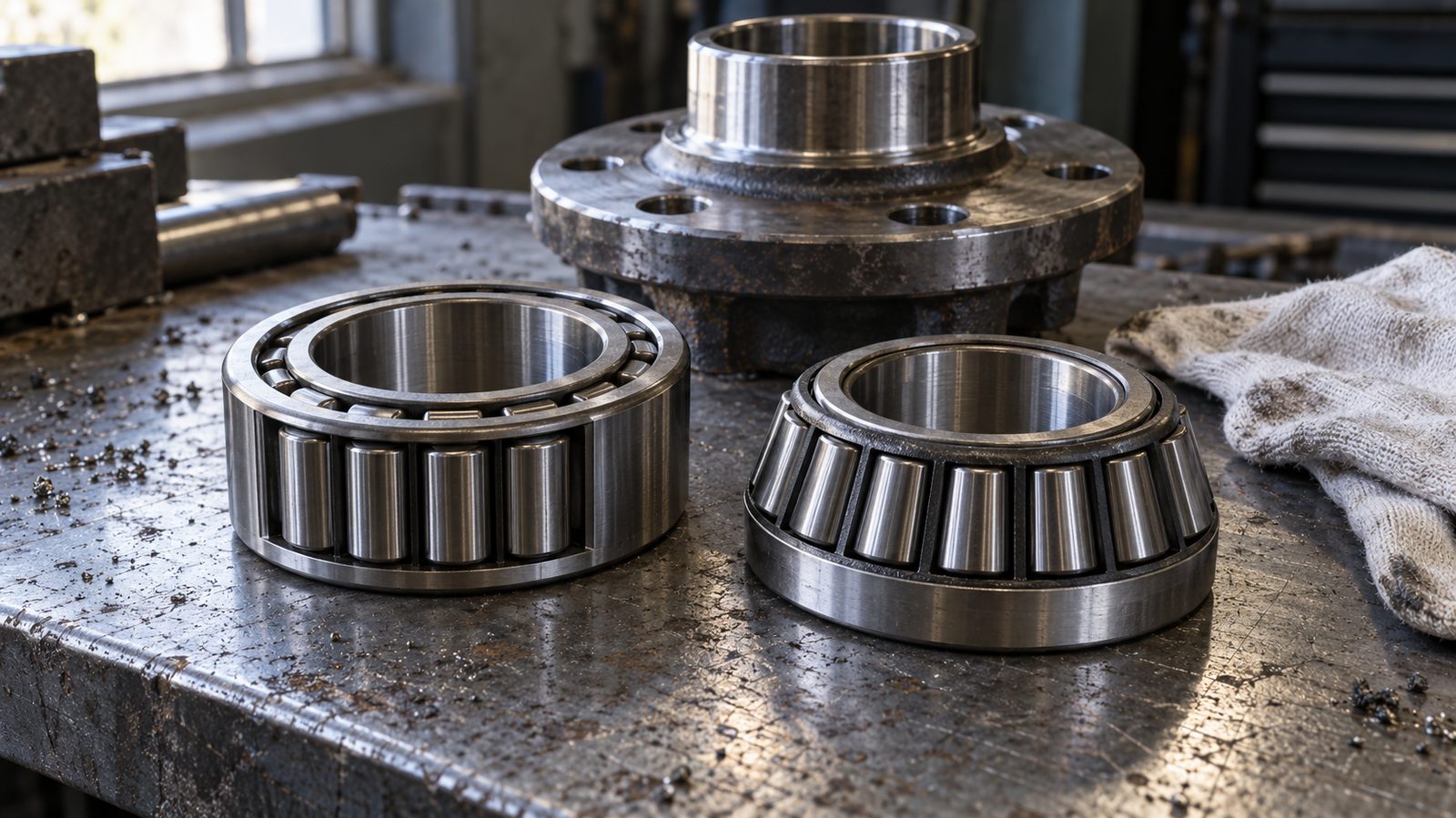
A cylindrical taper roller bearing is not one single standard bearing type. The name is used for two different roller bearing families: cylindrical roller bearings, whose straight rollers carry heavy radial load, and tapered roller bearings, whose conical rollers carry combined radial and axial load. Both exist in single-row and multi-row versions, both appear in vehicle running gear, and both should be ordered from a drawing rather than from a name. Load direction, stiffness and the way the bearing is adjusted at mounting decide which family is correct.
Jinan Huayuan Bearing Co., Ltd. (huayuanbearing.com) manufactures and exports running-gear components from Jinan, Shandong: automotive wheel hub bearings, hub units, tensioner pulleys and CV joint cages, supplied to the aftermarket replacement market and to OE programmes, mainly for customers in the Middle East and Southeast Asia. This guide explains the two roller families as they appear in that range, so an importer, distributor or workshop buyer can read a drawing, select a type and check what arrives.
What Does a Cylindrical Taper Roller Bearing Actually Mean?
The term covers two separate bearing families, so the first task is to identify which family the application needs; the words cylindrical and tapered describe roller shape, and roller shape sets what load the bearing can carry.
Cylindrical roller bearings use straight rollers for radial load
Cylindrical roller bearings run straight, parallel-sided rollers between flanges on one or both rings. Line contact between roller and raceway gives high radial capacity for the bearing envelope, and friction is lower than in a tapered bearing of the same size, which is why the family is standard in gearbox shafts, electric motors and pulley positions. The flanges also decide how the bearing locates a shaft: an NU design allows axial displacement inside the bearing, an NJ design locates in one direction, and an NUP design locates in both. That difference matters whenever a shaft has to float with thermal growth. Huayuan lists the sizes and variants it builds on its cylindrical roller bearings page.
Tapered roller bearings use conical rollers for combined load
Tapered roller bearings use conical rollers running on conical raceways whose projected apexes meet on the shaft axis, so one row carries radial and axial load together. A single row takes axial load in one direction only, which is why wheel hubs, differential pinions and output shafts use tapered bearings in opposed pairs, back-to-back or face-to-face, or as a matched pair with a controlled set width. Axial capacity rises with contact angle: a steeper cup angle carries more thrust, a shallower one carries more radial load for the same envelope.
Why the two names get merged in catalogues and search
Buyers merge the two names because the parts look similar in a photograph and both are roller bearings in a parts-counter conversation, but three things still have to be confirmed: roller shape, number of rows, and the adjustment method at mounting. A drawing may also use the word tapered for the crowned profile of a roller rather than for the bearing type, so a name is never enough to quote from. Confirm geometry and dimensions from a drawing or a physical sample before ordering; the families are not interchangeable even when bore and outer diameter match. A side-by-side comparison of tapered and cylindrical roller bearings settles the first question before price or availability is discussed.
How Are Roller Bearings Built, and What Do Material and Tolerance Change?
Steel grade, heat treatment and tolerance class decide how long a roller bearing survives in a given position, and they are the three items most often missing from an inquiry.
Rings, rollers and cages
Rings and rollers are normally made from through-hardening bearing steel of the 100Cr6, GCr15 or AISI 52100 type, hardened to roughly 58 to 64 HRC and ground after heat treatment. Tapered roller bearings for shock-loaded positions such as wheel hubs are often made from case-carburizing steel of the 20CrMnTi or AISI 8620 type, which leaves a hard case over a tough core. Cages are stamped steel for volume automotive parts, machined brass or steel for heavier duty, and polyamide for quiet, lightly loaded pulley positions. The cage spaces the rollers and does not carry load, but a cage failure ends bearing life early.
Heat treatment and dimensional stability
Heat treatment sets hardness, case depth and retained austenite, and therefore wear resistance, shock resistance and behaviour at operating temperature. A bearing that runs hot needs a stabilising treatment so the rings do not grow in service; a bearing that takes impact needs a tougher core rather than maximum surface hardness. These are process decisions taken against the drawing, which is why a buyer should state operating temperature, load type and duty cycle instead of sending a part number alone.
Tolerance class and internal clearance
Tolerance class controls dimensional and running accuracy, written in the ISO 492 system as P0 (normal), P6, P5 and P4; internal clearance controls the gap between rollers and raceways and is grouped as C2, CN, C3 and C4. A hub or gearbox designed around C3 will run hot and noisy with a CN part, and a spindle will lose accuracy if the class is relaxed. In tapered bearings the working clearance is set at mounting through endplay or preload and measured with a dial gauge, so the clearance group marked on the box is only the starting point.
Which Roller Bearing Type Fits Your Load Case?
Load direction decides first; speed, stiffness, misalignment tolerance and the mounting arrangement decide second.
| Property | Cylindrical roller bearing | Tapered roller bearing |
|---|---|---|
| Roller shape | Straight, parallel-sided | Conical, apex meets the shaft axis |
| Load direction | Radial, with limited axial location in flanged designs | Radial and axial together, one direction per row |
| Axial capacity | None to limited | Rises with contact angle |
| Stiffness under load | Moderate | High, especially when preloaded |
| Misalignment tolerance | Small | Very small; needs square abutments and a rigid housing |
| Typical mounting | One locating bearing plus one floating bearing | Opposed pair, matched pair, or set endplay |
| Typical heat treatment | Through-hardened bearing steel | Often case-carburized for hub and pinion duty |
| Typical vehicle positions | Gearbox shafts, idler positions, some pulley hubs | Wheel hubs, trailer hubs, differential pinions, output shafts |
| Usual failure signature | Raceway fatigue driven by contamination or misalignment | Rib and end-face wear, spalling from wrong preload or seal loss |
Start with load direction
For a purely radial load on a shaft that has to float, a cylindrical roller bearing is the more efficient choice. For combined radial and axial load, or a position that needs a stiff preloaded assembly, a tapered roller bearing is the usual answer. Mixed positions, such as a gearbox shaft with helical gears, often use one of each: a cylindrical bearing to carry radial load and locate the shaft, and a tapered or angular contact bearing to take thrust.
Then check speed, stiffness and misalignment
Cylindrical roller bearings usually run cooler at high speed because the roller ends do not slide against a guide rib in normal running. Tapered bearings are stiffer but far less forgiving of shaft deflection and housing misalignment, and they need clean, square abutments to deliver their rating. Where misalignment cannot be designed out, a self-aligning ball or spherical roller bearing belongs in the design instead of either family.
When neither family is the answer
Many modern wheel positions no longer use a separate roller bearing at all. Second- and third-generation hub units integrate the bearing rows, the flange and often the ABS sensor ring into one sealed assembly, and the workshop replaces the whole unit. Belt tensioner and idler pulleys often run sealed deep groove ball bearings, because the load is light and the priorities are noise and grease life. CV joints transmit torque through balls in a cage, not through rollers. Ordering a roller bearing for one of these positions is a common source of wrong shipments, so the difference between a wheel hub bearing and a hub assembly is worth checking before the inquiry goes out.
Where Do These Bearings Sit on a Vehicle, and What Do They Carry?
Roller bearings in a vehicle sit at four kinds of position, and each one loads the bearing differently.
Wheel hubs and hub units
First-generation hub bearings are separate double-row assemblies, either two tapered cones with a spacer or a double-row angular contact bearing, pressed into the hub or the knuckle. They carry vertical load, cornering load and the torque reaction from braking, and they are set to a defined endplay or preload at assembly. Second-generation units add an outer flange bolted to the knuckle; third-generation units add the hub flange itself and are sealed for life and not adjustable. In all three, seal quality and the internal setting decide service life far more than the dynamic load rating printed in a catalogue.
Tensioner and idler pulleys
Automatic belt tensioners and idler pulleys carry the radial load from belt wrap plus a small axial component from belt misalignment. The bearing inside is usually sealed and greased for life, and the assembly more often fails through seal wear and grease loss than through raceway fatigue. Because the part is frequently replaced as a complete unit, a buyer should confirm whether the offer is the bearing alone, the bearing with pulley, or the tensioner with arm; these are different SKUs with different failure economics.
Gearboxes, differentials and driveline
Cylindrical roller bearings dominate gearbox shafts, where helical gears produce both radial and thrust loads and a paired arrangement separates the two duties. Tapered bearings appear in differential pinion heads, gearbox output shafts and trailer hubs, where combined load and shock are normal. Constant-velocity joints on the driveshaft use ball cages rather than roller bearings, so a CV joint inquiry and a roller bearing inquiry should be quoted as separate items.
How Do You Confirm a Replacement From a Drawing and a Sample?
A roller bearing is confirmed by dimensions, geometry and marking together; an OE number is only a cross-reference until it has been checked against the drawing, and final confirmation is by drawing and sample.
The parameters that have to match
| Parameter | Symbol or form | Why it decides the part |
|---|---|---|
| Bore diameter | d | Shaft fit; must match to tolerance, not nominal size only |
| Outer diameter | D | Housing fit and press force |
| Width and set width | B, C, T | Stack height in the hub; a tapered pair's set width changes endplay |
| Contact angle | Cup angle | Axial capacity and stiffness of a tapered bearing |
| Chamfer and fillet radius | r, r1 | Seating against shoulders; a wrong radius can crack a ring |
| Internal clearance | C2, CN, C3, C4 | Running temperature, noise and preload behaviour |
| Tolerance class | P0, P6, P5, P4 | Running accuracy at the shaft or wheel |
| Cage type | Steel, brass, polyamide | Speed limit, load sharing and lubrication retention |
| Seal or shield | Contact seal, shielded | Contamination protection and grease life |
| Features | Snap ring groove, sensor ring, flange | Fit, retention and ABS function |
A step-by-step confirmation route
- Clean the old part and photograph it next to a rule from the front, the side and the seal face, so roller shape and row count are visible.
- Record every marking on the ring face, seal and cage; partial numbers often identify the series even when the suffix is worn away.
- Measure bore, outer diameter and width with calipers, and for tapered bearings measure cone and cup separately instead of assuming a set width.
- Note the features that decide fit: seal or shield type, snap ring groove, sensor ring, flange bolt pattern and cage material.
- Write a one-page application note covering position on the vehicle, load type, operating temperature and annual volume, and send it with the drawing and the sample.
- Approve a first-article sample against the drawing, then approve packaging artwork and marking, because custom packaging and own-brand marking are separate approval steps from the part itself.
A complete package shortens the loop for both sides. Huayuan develops parts to drawing and sample and supports custom packaging and own-brand marking, so the drawing, the sample and the artwork are agreed before a first batch is built. For buyers who file documents in Indonesian, the site also publishes an Indonesian-language cylindrical roller bearing page.
Why Do Roller Bearings Fail Early, and What Does the Evidence Show?
Most early failures are not normal fatigue: contamination, lubrication loss, wrong adjustment and installation damage account for far more returns, and the wear pattern usually identifies which one applies. Noise that appears only in service is a separate question from wear found at strip-down, and it is worth separating with a structured method for diagnosing hub bearing noise by frequency and road behaviour.
| What you see | Most likely cause | What to check before reordering |
|---|---|---|
| Spalling on one side of the raceway | Misalignment or a housing face out of square | Abutment faces and housing bore |
| Even spalling around the whole raceway | Normal fatigue at the end of service life | Hours in service against the rated load |
| Bright indentations spaced like the rollers | False brinelling from vibration in storage or transport | Storage position and shipping conditions |
| Blue or brown discoloration | Overheating from wrong clearance or insufficient grease | Clearance group, grease fill, preload setting |
| Rust or gritty dark grease | Water or dirt ingress, damaged seal | Seal type, handling during fitting |
| Rib or end-face wear on a tapered bearing | Poor lubrication or incorrect endplay | Setting procedure and lubricant grade |
| Cracked ring or broken cage | Fitting force passed through the rollers, or impact | Press procedure and driver size |
What incoming inspection should cover
Goods-in inspection catches the errors a drawing cannot: the wrong part in the box, torn seals, rust from transport, or a clearance group that does not match the order. A workable routine is to check carton marking and quantity against the purchase order, measure bore, outer diameter and width on a sample from each batch, rotate every unit by hand for roughness or tight spots, inspect seals for cuts and spring contact, verify the clearance marking, and keep one sealed first-article sample as a reference for the next order. A written incoming inspection routine keeps that evidence usable if a claim is raised later.
Frequently Asked Questions
Is a cylindrical taper roller bearing the same as a tapered roller bearing?
No. A tapered roller bearing has conical rollers and conical raceways and carries radial and axial load together. A cylindrical roller bearing has straight rollers and carries mainly radial load, with limited axial location in some flanged designs. The combined phrase usually means the buyer is not yet sure which family the application needs, so roller shape and load direction should be confirmed before a quotation is prepared.
Can I fit a cylindrical roller bearing where a tapered one was used, if the dimensions match?
Usually not. Matching bore, outer diameter and width does not reproduce the axial location, stiffness or preload setting the position was designed around, and a cylindrical bearing may let the shaft move axially. Where a hub or pinion was designed for an opposed tapered pair, the replacement has to keep that arrangement. Confirm any substitution against the drawing and the application note.
How do I tell whether my hub takes a bearing or a complete hub unit?
Look at how the part is retained. A first-generation bearing is pressed into the knuckle or hub and held by a circlip or a shoulder; a second- or third-generation unit has its own flange, usually with wheel bolts or a bolt pattern, and is removed as one piece. An ABS sensor ring and the absence of a separate inner race are further signs of an integrated unit.
What does a supplier need to quote a custom roller bearing?
A dimensioned drawing or a physical sample, the application position and load type, the clearance and tolerance class if specified, the seal or shield requirement, annual volume, and the packaging or brand marking required. Suppliers that develop to drawing and sample, as Huayuan does through huayuanbearing.com, can quote from that package; a part number alone rarely covers the variants.
Purchasing guidance, product information and company updates from Huayuan Bearing.