
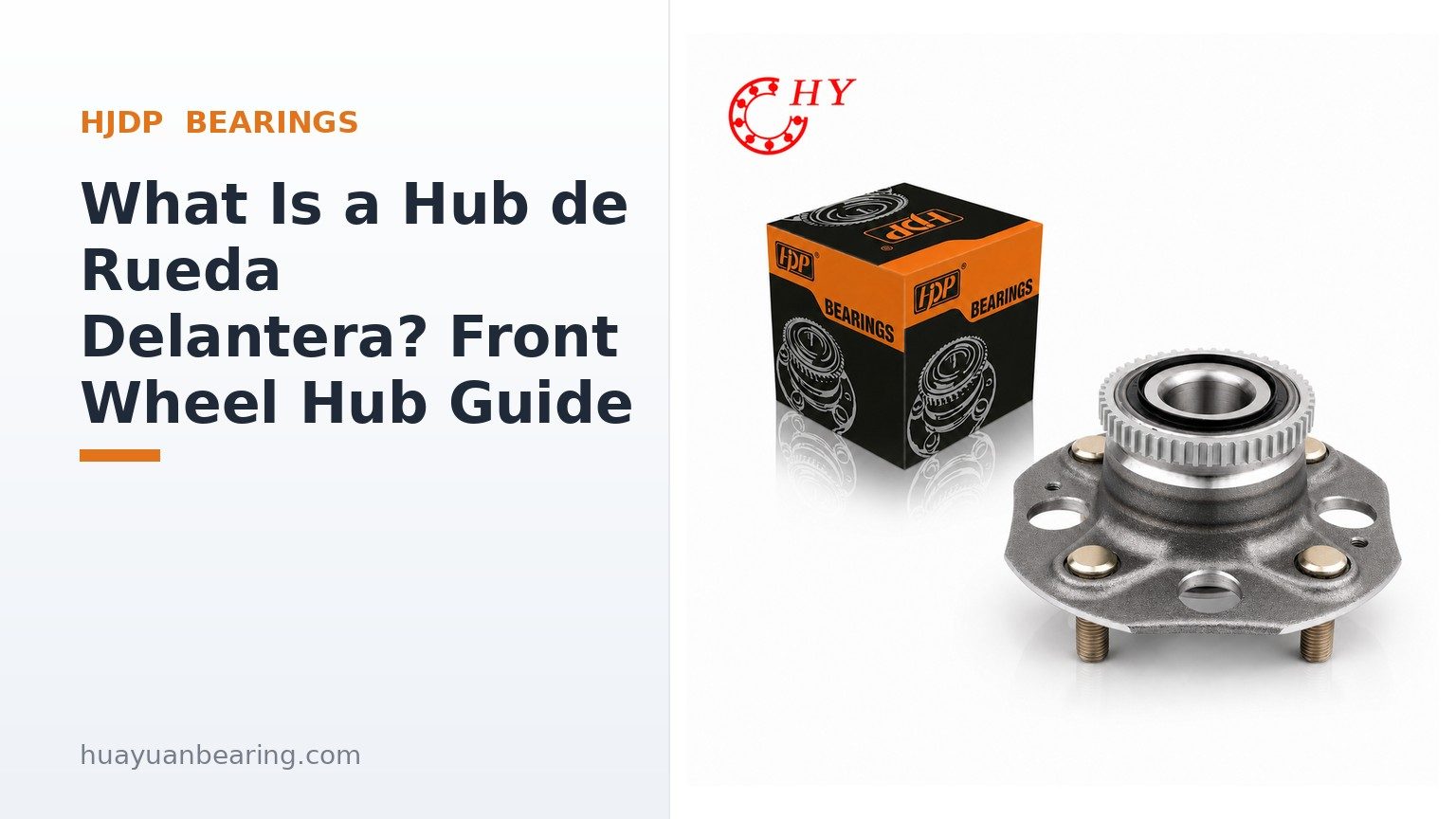
A hub de rueda delantera is the front wheel hub assembly: the sealed bearing unit that carries the front corner of the vehicle, locates the brake disc and road wheel, and on ABS-equipped cars provides the rotating reference the wheel-speed sensor reads. It combines rolling elements, a mounting flange, a sealing system and a pre-packed grease charge into one part that is set at the factory and is not adjustable in service. Spanish-speaking buyers use the term for the same object that English catalogues call a front wheel hub bearing or front hub unit. The naming changes by market; the function does not.
What Is a Hub de Rueda Delantera and What Does It Do?
The front hub is the load path between the suspension and the road wheel. Every force the tyre generates, from vehicle weight to cornering, braking and kerb impact, passes through the hub into the knuckle and the strut. That is why a front hub is specified as a structural assembly and not simply as a bearing with a flange attached to it.
Where the Front Hub Sits in the Corner Assembly
The hub sits between the steering knuckle and the brake disc. On a driven front axle it also carries the outer end of the driveshaft, and the splined bore transmits drive torque through the same component that carries wheel load. On a non-driven axle the hub is a pure carrier: no splines, no shaft nut, but the same radial and axial duties. This distinction matters at ordering stage, because a driven-axle hub and a non-driven hub for the same platform are different parts even when their flange dimensions look similar.
What Loads a Front Hub Actually Carries
Front hubs usually carry more radial load than rear hubs on passenger cars, because the engine and transmission sit over the front axle and because braking transfers weight forward. A front hub must also resist axial load from cornering and from caliper clamping, and it must tolerate the small angular misalignments that appear as the suspension moves through its travel. Double-row designs handle this by splitting load between two rows set at a defined preload or clearance. Tapered roller pairs handle it through a contact angle chosen for combined radial and axial load.
Why Front and Rear Hubs Are Not Interchangeable
A rear hub often runs at lower load, without drive splines and, on many cars, without steering input. Fitting a rear-specified unit at the front reduces load margin and can change the ABS signal if the encoder differs. Jinan Huayuan Bearing Co., Ltd. lists front and rear wheel hub bearings and hub units as separate lines for this reason, so that buyers can match position by position instead of by appearance.
Which Front Hub Unit Type and Generation Fits Your Application?
The generation of the hub unit decides what can be serviced and how the part is installed. Generations are not upgrade paths: a Generation 1 axle cannot take a Generation 3 unit without changing the knuckle, and a Generation 3 hub cannot be rebuilt with a loose bearing. Matching the generation correctly is the first filter in any front hub enquiry.
Generation 1: Bearing Pair in the Original Housing
A Generation 1 front hub is a bearing pair pressed into the knuckle, with the hub flange as a separate component. The bearing may be ball or tapered roller, and axial setting depends on the retaining nut torque or on a spacer and shim arrangement defined by the vehicle manufacturer. Because bearing and hub are separate, this is the only generation where the bearing alone can be renewed, and it is also the generation most sensitive to installation practice: press force applied to the wrong ring damages the raceways before the vehicle is even lowered.
Generation 2: Flanged Outer Ring Bolted to the Knuckle
A Generation 2 unit carries the bearing pair in a flanged outer ring that bolts to the knuckle, with the inner rings running on a separate hub. The ABS encoder is normally built into the seal. Replacement is faster and cleaner than Generation 1 because there is no press fit into the knuckle, but the hub still has to be matched to the inner rings, and a worn hub journal can spoil a new unit quickly.
Generation 3: One-Piece Unit with Integrated Flange
A Generation 3 hub unit is a complete assembly: double-row bearing, flange on the inner ring, wheel studs, seals, grease and encoder in one part that bolts straight to the knuckle. Preload, clearance, grease fill and encoder position are fixed by the manufacturer and cannot be adjusted. The practical consequences are a single part number per corner, no bearing setting operation, and a unit that fails as a whole rather than at the bearing alone. The difference between a bearing and a complete assembly is set out in this comparison of a wheel bearing versus a hub assembly.
Tapered Roller, Ball or Cylindrical Roller
Tapered roller bearings suit combined radial and axial load and are common on older front axles and on light commercial vehicles. Ball bearings give low friction and quiet running at moderate load, which is why they dominate passenger-car Generation 2 and 3 units. Cylindrical roller bearings carry high radial load with limited axial capacity and appear in heavier applications. The choice is a design decision made by the vehicle manufacturer, not a substitution a buyer can make freely.
| Configuration | What it contains | Mounting method | Typical front-axle use | Service consequence |
|---|---|---|---|---|
| Generation 1 | Bearing pair with separate inner and outer rings | Pressed into knuckle and onto hub; retained by nut or circlip | Older passenger cars, light commercial front axles | Bearing and hub serviced separately; press practice and axial setting decide life |
| Generation 2 | Bearing pair in a flanged outer ring; separate hub | Bolted to knuckle; hub fitted to inner rings | Mid-generation passenger cars, compact SUVs | No knuckle press fit; encoder usually in the seal |
| Generation 3 | Complete double-row unit with flange, studs, seals, encoder | Bolted to knuckle as one assembly | Current passenger cars and SUVs | One-piece replacement; preload and encoder fixed by supplier |
The same three configurations are described from a sourcing angle in this note on how a wheel hub differs from a wheel hub assembly.
How Are Front Hub Bearings Built: Steel, Heat Treatment, Precision and Clearance?
Front hub life is decided by four variables: steel cleanliness, heat treatment, raceway geometry and the clearance or preload the unit runs at. Each of them is visible on a drawing and each can be checked, which is why a technical discussion is more useful than a catalogue photo.
Bearing Steel and Heat Treatment
Rings and rolling elements are normally made from through-hardening bearing steel of the GCr15 or 100Cr6 type, with controlled inclusion content and a carbide structure that resists rolling-contact fatigue. Hardening and tempering produce a martensitic structure with hardness in the region of 58 to 62 HRC on the raceway, followed by a tempering step that stabilises dimensions at operating temperature. Shock-loaded applications may use case-carburising grades, where a hard surface case over a tougher core resists impact damage. Raceways are then ground and superfinished, because surface roughness drives both noise and lubricant film formation.
Precision Grades and Internal Clearance
Dimensional and running accuracy are classified by ISO 492 and the equivalent ABEC scale. For hub units the relevant measures are bore and outer diameter tolerance, flange runout and the runout of the assembled unit, because runout at the flange becomes brake judder at the pedal. Internal clearance follows ISO 5753 for bearings that are supplied with clearance, and is usually expressed as a class such as C0 or C3. A hub unit may instead be supplied preloaded with no user adjustment, in which case the axial play measured on the bench is a factory setting and not a tuning parameter.
Preload, Not Only Clearance
Too much preload raises running temperature, thickens the lubricant film demand and can end in seizure. Too little preload or excessive clearance allows the rolling elements to skid, which produces noise, false brinelling marks and early spalling. On Generation 1 tapered axles the setting is made at installation, which is why nut torque and end-float measurement belong in the workshop procedure rather than in the parts catalogue.
| Drawing parameter | What it controls | What to verify before quoting |
|---|---|---|
| Bore, outer diameter, flange pilot diameter | Fit and concentricity in the knuckle | Tolerance and fit class, not only nominal size |
| Bolt circle, stud thread, stud length | Attachment to knuckle and wheel | Stud knurl diameter, pitch, runout callout |
| Clearance or preload value | Operating temperature, noise, life | Whether the value is set in production or at assembly |
| Seal type and encoder specification | Contamination resistance and ABS signal | Signal type and sensor gap expected by the vehicle |
| Grease type and fill quantity | Life at temperature and speed | Thickener, base oil viscosity, fill definition |
| Runout and balance callouts | Brake judder and vibration | Measurement plane and datum used on the drawing |
How Do Seals and Grease Decide Front Hub Service Life?
Most front hubs that fail early fail because contamination reached the raceway, not because the steel was wrong. The seal and the grease charge are therefore specification items, not accessories.
Seal Architectures
A single-lip contact seal is the simplest arrangement and relies on a rubber lip running on a ground surface. Double-lip and cassette seals add a secondary lip or a labyrinth path that keeps water and grit away from the primary lip. On ABS axles the seal often carries a magnetised encoder ring, and the wheel-speed sensor reads that ring across a small air gap; a distorted or contaminated ring produces a signal fault without any bearing noise at all.
Grease Fill and Contamination Control
Hub units are greased for life, with the fill quantity defined against the free volume inside the unit. Underfilling starves the raceway; overfilling can push grease past the seal as the unit warms up. Cleanliness during assembly matters as much as the grease specification, because a single hard particle trapped between roller and raceway starts a dent that becomes a spall.
What Sealed for Life Actually Means
Sealed for life means the unit has no relubrication point and no service interval for grease. It does not mean indefinite life: the grease degrades at high temperature, and the seal wears as the shaft rotates. In practice the seal is the life-limiting component on a well-installed hub, and immersion, pressure washing and damaged boots shorten that life sharply.
Which Other Running-Gear Parts Belong to the Same Front-Axle Programme?
Front-axle programmes usually consolidate several running-gear parts into one purchase order, and hub buyers often ask for them together. Two of the most common companions are belt tensioners and constant-velocity joint assemblies.
Tensioner and Idler Pulleys
A tensioner assembly combines a pulley, a sealed ball bearing, an arm and a spring or damping element that holds the accessory belt at the correct tension. Its bearing is small but runs at high speed and constant preload, so pulley noise, belt chirp and bearing play are the usual failure indicators. Tensioners share the same steel, grease and sealing discipline as hub bearings, which is why they are frequently sourced together.
CV Joint and Ball-Cage Assemblies
A constant-velocity joint transmits drive torque through an angle. It consists of an outer race, an inner race, a cage and a set of balls running in matching grooves, packed with grease and protected by a rubber boot. Because the boot is the only barrier against grit, boot damage is the leading cause of joint failure, and a split boot found at inspection is a reason to replace the joint rather than to regrease it. Jinan Huayuan Bearing Co., Ltd. manufactures hub bearings, hub units, tensioners and CV joint components for aftermarket replacement and OE supply from Jinan, Shandong, which allows a mixed front-axle order to be consolidated with one supplier.
How Do Front Hubs Fail, and What Evidence Confirms It?
Front hub failures follow a small number of recognisable patterns, and the physical evidence on strip-down usually identifies which one applies. Distinguishing fatigue from installation damage matters commercially, because the two carry different responsibilities and different corrective actions. A symptom-led version of this diagnosis is covered in this guide to signs of a failing wheel hub bearing.
Bearing-Fatigue Failures
Rolling-contact fatigue appears as spalling or pitting on a raceway after the calculated life has been consumed, and it is a normal end-of-life mode rather than a defect. Fatigue that appears early usually points to lubrication starvation, contamination or an overload condition such as a kerb strike.
Seal and Contamination Failures
Water ingress leaves reddish-brown grease, corrosion staining on the raceway and a worn or hardened seal lip. Grit ingress leaves matte, lapped surfaces and fine debris embedded in the grease. Both indicate that the environment beat the seal, and both are worth investigating at vehicle level rather than only at part level.
Installation-Induced Failures
Pressing or hammering through the rolling elements leaves indentations spaced to match the ball or roller pitch, and those dents become spalls within a short distance. Over-torqued shaft nuts, dirt trapped between mating faces, and reused stretch bolts produce their own signatures: preload loss, flange runout and fretting discoloration on the bore.
| Observed symptom | Physical evidence on strip-down | Most probable mechanism |
|---|---|---|
| Hum or growl rising with road speed | Spalling or pitting on one raceway row | Rolling-contact fatigue or inadequate lubrication |
| Vibration after long storage or transport | Evenly spaced indentations matching element pitch | False brinelling from vibration without rotation |
| Noise soon after fitting | Indentations across both rows, cage deformation | Installation force passed through the rolling elements |
| Grease weeping, rough rotation | Reddish-brown grease, corroded raceway, worn lip | Water or grit past a damaged or displaced seal |
| ABS lamp on at one corner | Damaged encoder ring, debris on sensor face | Encoder damaged during fitting or incorrect air gap |
| Brake judder, wheel shake | Flange runout beyond drawing limit | Flange distortion or dirt between mating faces |
How Do You Install a Front Hub and Check an Incoming Batch?
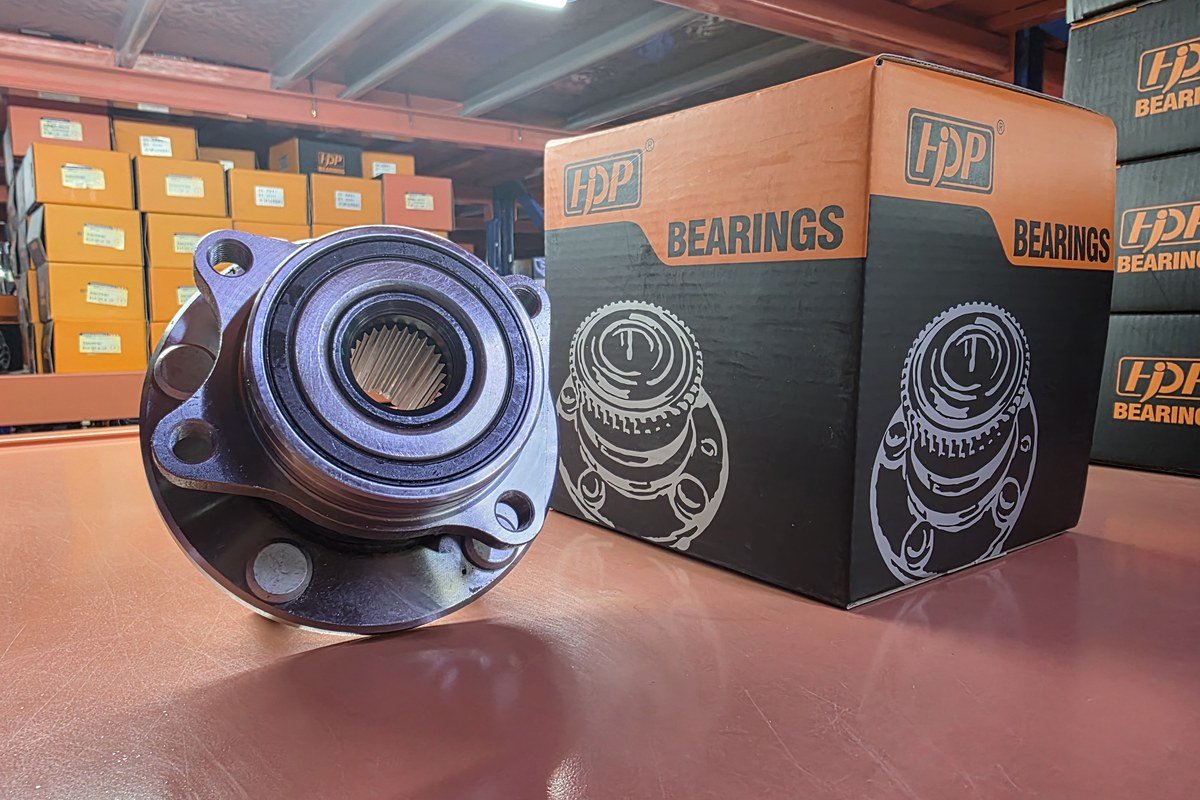
Correct installation and disciplined goods-in inspection remove most of the avoidable failures on a front hub line. The steps below apply to passenger-car units in general; the vehicle manufacturer procedure and torque values always take precedence.
Installation Sequence
- Confirm the part against OE references, the drawing and, where available, a physical sample before the vehicle is raised.
- Clean the knuckle bore and the hub seat, remove corrosion and old retaining compound, and check bore diameter and roundness.
- Support the correct ring: press on the outer ring when fitting into the knuckle, press on the inner ring when fitting a hub onto a bearing.
- Use a driver that contacts the full ring face, and never transmit force through the rolling elements or the cage.
- Fit the circlip or retaining bolts to the specified torque with a calibrated tool, and use a new shaft nut where the vehicle manufacturer specifies one.
- Check the encoder ring and sensor face, set the air gap, and route the sensor harness clear of moving parts.
- Measure flange runout and check wheel-end play before the wheel goes back on.
- Road test, then re-check torque at the interval the vehicle manufacturer defines.
Incoming Inspection Points
- Carton and label: OE and interchange references, batch marking, quantity, no transit damage.
- Part identity: stud thread and pitch, bolt circle, flange pilot diameter, machining marks.
- Seal and encoder: lip intact, encoder ring flat and clean, no metallic debris on the sensor face.
- Grease: no leakage into the packaging, no separation at the seal.
- Rotation: smooth and quiet by hand, no click, no detectable roughness.
- Dimensional spot check: bore, flange pilot, stud spacing against the drawing.
- Traceability: batch marking that links the carton to the supplier records.
Storage also belongs in the checklist. Hubs should stand or lie on the flange, never on the studs, and should stay in their packaging until fitting, since condensation and dust do more damage in a warehouse than most buyers expect. Practical controls are collected in this note on warehouse storage and corrosion control, and defect identification under workshop lighting is covered in this visual inspection reference.
Frequently Asked Questions
Is a hub de rueda delantera the same as a front wheel bearing?
Not exactly. A wheel bearing is the rolling element set; a hub de rueda delantera is the complete front assembly that contains the bearing plus flange, studs, seals, grease and, in most current designs, the ABS encoder. On Generation 3 axles the two cannot be separated, while on Generation 1 axles the bearing can be renewed on its own, so the terms are often used loosely in trade catalogues.
Can I replace only the bearing instead of the whole hub unit?
Only on Generation 1 axles, where the bearing is pressed into the knuckle and the hub is reused. Generation 2 and Generation 3 units are supplied as complete assemblies, and pressing a new bearing into a used flanged unit is not a supported repair. Always confirm the configuration on the vehicle before quoting a bearing-only solution.
Does replacing a front hub require a new ABS sensor?
Usually not the sensor itself, but the encoder must be checked. Inspect the sensor face for metallic debris, clean the mounting surface, confirm the air gap and verify that the encoder ring was not distorted during fitting. A sensor that was working before removal is normally reused unless it is damaged or the vehicle manufacturer specifies replacement.
How do I confirm front hub fitment before ordering?
Match the OE number first, then verify the critical dimensions against the drawing, and where possible against a physical sample. Part numbers and OE references in a quotation are indicative and are confirmed against drawing and sample before production. Jinan Huayuan Bearing Co., Ltd. develops parts to drawing and sample, supports custom packaging and private-label programmes, and serves importers and distributors mainly in the Middle East and Southeast Asia; the ordering data set is summarised in this wheel hub bearing RFQ checklist.
Purchasing guidance, product information and company updates from Huayuan Bearing.