
A wheel bearing is the rolling-contact support at a vehicle wheel end. It lets the wheel rotate around its supporting structure while carrying the radial and axial loads that reach the wheel. A wheel hub is the interface that centers and supports the wheel, and a hub assembly combines a bearing with a hub flange and, depending on the design, other integrated parts. The names are related, but they do not describe the same thing in every catalogue. For purchasing, identify the complete unit and application rather than choosing from a label alone.
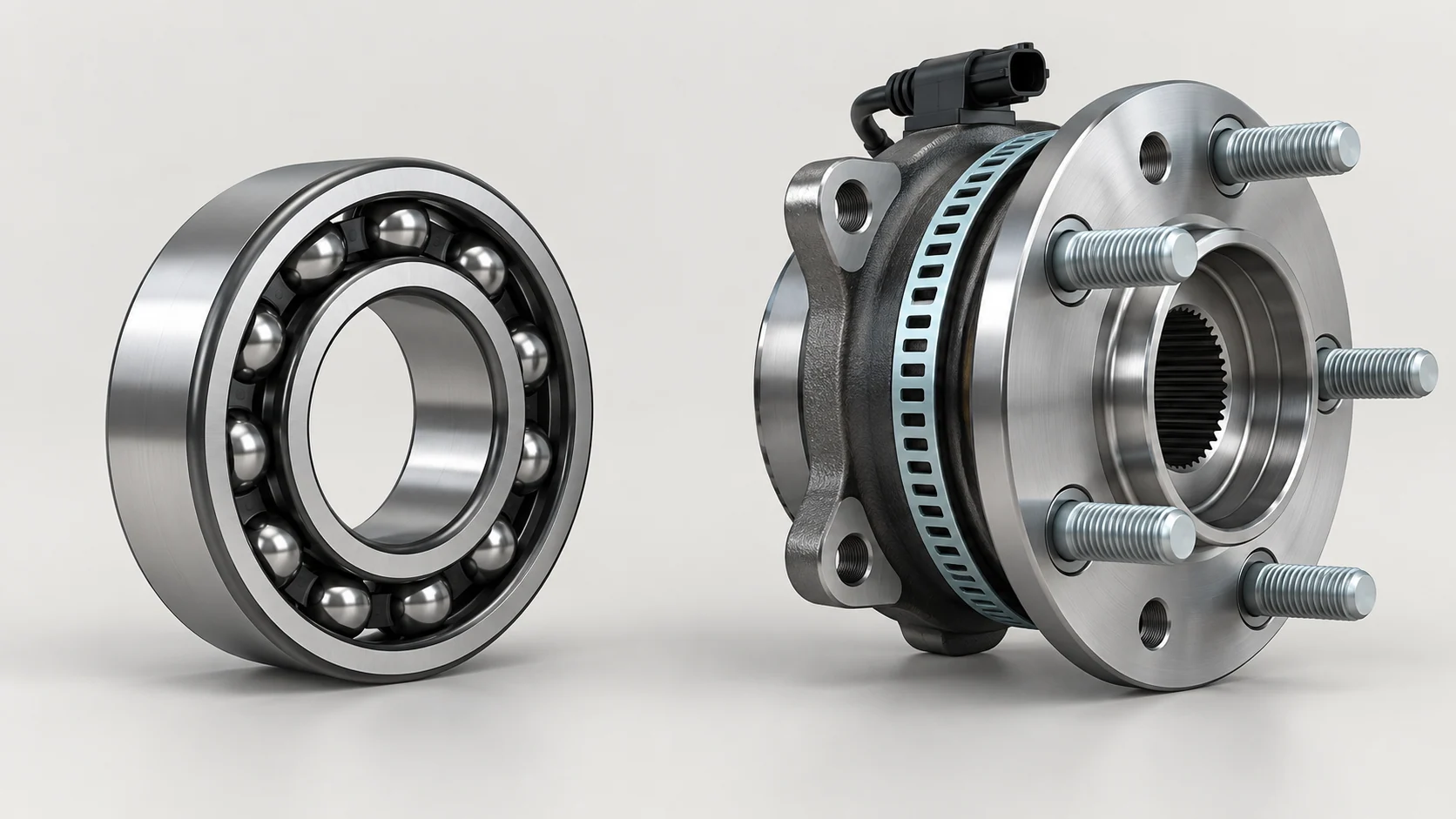
Conceptual editorial illustration only. It is not a Huayuan product photo, approved drawing, or fitment reference.
Wheel bearing: the rotating support
A wheel bearing contains rolling elements between raceways. Depending on the design, those elements may be balls or rollers. The inner and outer rings provide the raceways; a cage spaces and guides the rolling elements; and the lubricant and sealing arrangement support operation in the intended environment. The actual construction varies by bearing family and vehicle application.
The bearing has to let the wheel end rotate with controlled friction while supporting loads from the vehicle and road. Radial load acts across the bearing axis; axial load acts along it. Cornering, braking, acceleration, vehicle mass, road inputs, and wheel geometry affect the combined forces reaching the wheel end. A bearing selected for one arrangement cannot be assumed to suit another simply because its bore or outside diameter looks similar.
The word “bearing” may describe a separable component in a serviceable arrangement, a pre-adjusted bearing unit, or the bearing function inside a more integrated assembly. That distinction matters when a buyer compares catalogues. Ask whether the quoted item is a bearing only, a bearing-and-hub unit, or a complete kit containing additional fasteners or accessories.
Wheel hub: the wheel interface
The hub provides the wheel-mounting interface. Depending on the design, it may include a flange, a center pilot, threaded holes or studs, and a surface associated with the brake rotor. The wheel and brake components attach to defined interfaces; the bearing supports rotation between the rotating and stationary parts of the wheel end.
In some designs the hub is a separate component assembled with a bearing. In others, one bearing ring carries an integral flange that performs part of the hub’s mounting function. In a highly integrated unit, there can be a wheel flange and a separate flange that attaches the assembly to the suspension. These are different architectures, not universal stages that every manufacturer or vehicle follows in exactly the same way.
SKF’s public overview of hub-unit evolution describes examples of first-, second-, and third-generation arrangements, including designs where a flange is integrated into a bearing ring and designs with wheel and suspension flanges. Those examples help explain the vocabulary; they do not identify a particular replacement part. See the SKF hub-unit evolution overview and compare the relevant manufacturer’s controlled product data.
Hub assembly: a system-level part name
“Hub assembly” is often used for a wheel-end unit supplied as one assembled component. The assembly may integrate one or more bearing rows, a hub or flange, seals, and an encoder or sensor-related feature where the application requires it. Some products are supplied with additional hardware; others are not. The words on a web page or carton do not prove which components are included.
A complete assembly can simplify identification and procurement because the bearing and mounting interfaces are packaged together. It also makes exact application control more important. A mismatch in the flange, pilot, stud arrangement, connector, encoder pattern, or vehicle variant can make an item unsuitable even when a broad “hub bearing” description appears to match.
Ask the supplier to define the supplied content in writing. Record the product reference, drawing revision if available, the OE or cross-reference numbers being evaluated, whether hardware is included, and any application limits. If a quote uses “hub bearing,” “wheel hub,” or “wheel bearing kit,” ask what physical components those words mean for that specific line.
What does a wheel bearing do?
At a high level, a wheel bearing allows controlled relative rotation while supporting the wheel end. A vehicle does not hang the tire directly on a bearing name: the bearing works within an arrangement involving the hub, spindle or axle, suspension, brake parts, fasteners, and sometimes sensing components.
The bearing’s type and arrangement affect how radial and axial forces are carried. A double-row angular-contact unit, a tapered roller arrangement, and a flanged hub-bearing unit are examples of different design approaches. Their load paths, adjustment requirements, interfaces, and servicing assumptions differ. The correct design is application-specific; the presence of a similar-looking bearing or a matching dimension does not establish interchangeability.
Wheel-speed sensing can also be part of the wheel-end design. Depending on the vehicle, an encoder or magnetic impulse ring may be integrated into a bearing or seal, and the sensor connector or signal arrangement may be specific. Do not infer ABS compatibility from the phrase “ABS bearing” alone. Verify the source data for the exact OE reference and vehicle configuration. Huayuan’s OE, fitment, and ABS verification guide explains why the part number, vehicle variant, and sensing details must be checked together.
Where is the wheel bearing located?
The wheel bearing is located at each wheel end, between the rotating wheel-side components and the supporting structure. The exact position and assembly method differ between front and rear axles, driven and non-driven wheels, and vehicle platforms. Some arrangements put the bearing within a hub; others use a bearing unit attached to a hub or knuckle. A catalogue may therefore describe the same general wheel-end area using different component names.
A question such as “where is the wheel bearing located?” can be answered generally, but a part-order decision needs more than a general location. Confirm the axle, left or right position if the part differs by side, drive configuration, brake and sensor details, and the vehicle’s exact model year and variant. When the catalogue or the removed component conflicts with an OE reference, preserve the conflict and request clarification rather than choosing the closest-looking part.
How many wheel bearings does a car have?
There is no single count that applies to every car as a universal purchasing rule. A typical passenger vehicle has a bearing support at each wheel end, but the arrangement may use separate bearing components, integrated hub units, or assemblies whose service parts differ by axle and platform. Some products also package components together, changing the number of serviceable line items without changing the number of wheel positions.
For a quotation, do not translate “four wheels” into an assumed quantity of four identical units. Build the list by position and part reference. The front-left, front-right, rear-left, and rear-right locations may not share the same OE number or assembly. Driven and non-driven wheels can use different interfaces or sensing arrangements. Verify quantities against the vehicle’s parts catalogue, a reliable application source, or an approved customer record.
What does a wheel bearing or hub assembly look like?
A loose bearing may appear as a compact ring-shaped component with visible rolling elements or as a sealed cartridge. A hub unit may have a flange or studs and a more substantial mounting body. A complete assembly can also include a sensor lead, connector, encoder-related surface, caps, or packaging pieces. Those appearances vary widely; a photograph is only an initial identification aid.
Do not identify a part by visual similarity alone. Seals can hide the rolling elements, finishes can differ, and images may show a different generation or market variant. Product photos may also omit parts supplied in a kit. Use the picture alongside dimensions, reference numbers, connector details, and a clear included-components statement. If a photograph is not from the exact item or an approved controlled drawing, treat it as an illustration rather than engineering evidence.
Why “bearing,” “hub,” and “assembly” are not interchangeable terms
Suppliers, distributors, workshops, and catalogues sometimes use overlapping shorthand. “Wheel bearing” may refer to a bearing component or to a complete wheel-end product in a search query. “Hub” may refer to the wheel-mounting component or to a larger assembly. “Hub bearing” can describe the bearing unit used in a hub, while “hub assembly” usually signals an integrated product. None of those labels is sufficiently precise for order approval by itself.
This is why a title such as “what is a wheel hub assembly” has a different question from “which wheel hub assembly should I buy?” The first asks for terminology and function. The second asks for selection and application matching. Huayuan’s wheel bearing and hub assembly selection guide focuses on buyer selection inputs; this explainer defines the component vocabulary used in those discussions.
A practical identification sequence for buyers
Use the same sequence before adding a wheel-end part to a catalogue or quotation:
- Capture the reference. Record the exact OE or catalogue number as written, including suffixes and separators. A partial number is not an approved cross-reference.
- Define the vehicle. Include make, model, model year, engine or trim where relevant, drive type, axle, and position. Market variants can differ.
- Confirm the architecture. Establish whether the requested line is a bearing only, hub, integrated hub-bearing unit, or a kit.
- Compare interfaces. Use the controlled dimensions and mounting features for the exact reference. Do not estimate from a web photo.
- Confirm sensing configuration. Record ABS/encoder presence, sensor type, connector arrangement, and any known signal requirements from a reliable source.
- List supplied components. State whether bolts, nuts, studs, sensor leads, caps, or other hardware are included.
- Resolve gaps before approval. Mark uncertain dimensions or application references as pending and ask for supporting data.
This checklist aligns part names with evidence. For a complete order file, use the wheel hub bearing RFQ checklist to record quantities, packaging, delivery destination, and quotation assumptions.
Common buyer questions
Is a wheel bearing the same as a wheel hub?
No. A wheel bearing supports rotation and carries load at the wheel end. A hub provides the wheel-mounting interface. A product can combine bearing and hub functions in one integrated unit, but the terms still describe different roles.
Is a hub assembly the same as a wheel bearing?
Not necessarily. “Hub assembly” commonly refers to an integrated wheel-end product, while “wheel bearing” can mean the rolling bearing itself or be used loosely in a catalogue. Confirm the included components and exact part reference before comparing price or fitment.
Does every hub assembly contain an ABS sensor?
No universal statement applies to all vehicle applications. Some designs integrate an encoder or interact with a separate sensor; other configurations differ. Confirm the exact OE reference, sensor/encoder arrangement, and connector information.
Can a bearing with matching dimensions replace a hub unit?
Matching one or two dimensions is not enough. Flange geometry, interfaces, load arrangement, sensing, fit, and application must also correspond. Use a documented cross-reference or engineering approval for the exact application.
How should I request a quote if I only know the term “wheel bearing”?
Send the number from the old part or catalogue, vehicle details, axle and position, quantity, and any photos or drawings you can share. Ask the supplier to confirm whether the quoted line is a bearing, hub, or complete assembly and to state unresolved points.
Use component language as the start of verification
The useful distinction is simple: the bearing supports rotation, the hub connects the wheel-side interface, and a hub assembly may combine those functions with additional wheel-end features. In real catalogues, names overlap and integrated designs vary. A safe sourcing decision starts by converting the customer’s wording into a defined part, application, and list of included components.
When data is incomplete, mark it for confirmation instead of filling the gap with a visual guess. Link each cross-reference to its source and market, then confirm the dimensions, position, ABS details, and supplied hardware for the order. For buyer support, browse Huayuan’s wheel hub bearing range or send the reference and application through the quotation contact page.
Authoritative references
Purchasing guidance, product information and company updates from Huayuan Bearing.