
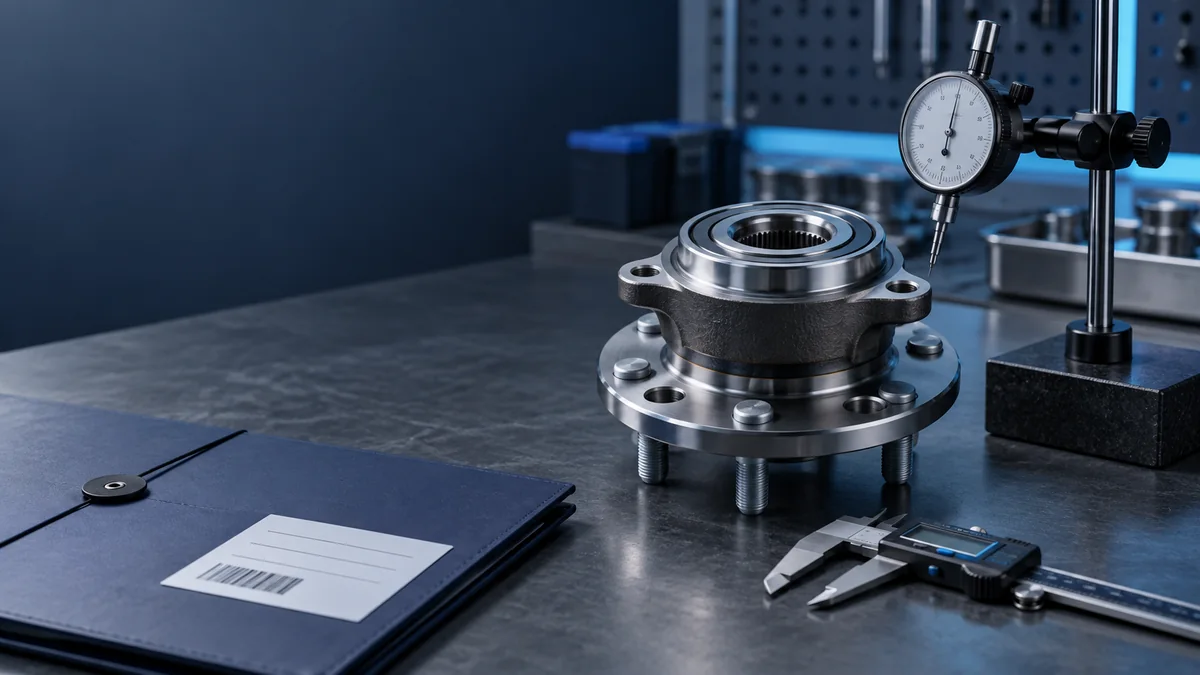
A competitive quotation does not show whether a wheel bearing and hub assembly supplier can deliver the same documented specification across repeat orders. B2B buyers need to evaluate the product definition, manufacturing controls, inspection evidence, quality documents, batch identification, packaging, and commercial communication as one sourcing system. This guide provides a practical framework for comparing suppliers without treating a certificate, factory photograph, or test adjective as proof of every product’s performance.
Separate a supplier claim from verifiable evidence
Start by writing down the decision you need to make. Are you approving a new source, comparing an alternate part, placing a replenishment order, or investigating a quality issue? The required evidence differs. A new source may require a review of the legal entity, site, processes, capability, sample, and product records. A repeat order may focus on the approved drawing, batch, changes, inspection status, packaging, and delivery. An after-sales investigation needs the order and lot trail as well as the returned part and installation context.
For each claim, ask four questions: which exact part and revision does it cover; which site and legal entity are responsible; what was measured or reviewed; and what record can be shared with the buyer? A general company statement can be useful background, but it cannot prove a critical feature on a particular hub. Likewise, a sample report does not automatically prove every unit received the same check.
Keep three evidence levels separate. First are statements and certificates that describe an organization or its management system. Second are technical documents that define a product, process, or inspection plan. Third are records from a particular order or lot. A buyer should not use an organization-level credential as a substitute for a part drawing, and should not use a product catalogue as a substitute for shipment-level identification.
Review material and process control with specific questions
Ask for lot-linked material and process records
For the offered design, request the material specification or grade where it is relevant to your approval, and ask what document links supplied material to the production lot. If heat treatment, grinding, assembly, lubrication, sealing, or surface protection is a critical operation, ask which process controls and acceptance records apply. The purpose is not to demand proprietary recipes; it is to understand how the supplier defines the process, controls approved changes, and handles a result that falls outside requirements.
Ask whether the record is a material certificate, supplier declaration, process log, inspection result, or a third-party laboratory report. These documents answer different questions. A material certificate relates to the material represented by the record; it does not by itself establish that a finished assembly meets every drawing requirement. A process description explains what is intended; it does not prove that a specific batch followed the process. A test report should name the sample, method, date, result, and acceptance basis.
Confirm who approves process or material changes and how the buyer is notified. A change to a subcomponent, seal, lubricant, source, process sequence, tooling, or site can affect an approved configuration even when the catalogue number remains the same. Define which changes require advance notification, sample approval, or requalification. Record the agreed change-control route in the purchase specification rather than leaving it as an informal email assumption.
If the supplier cannot share a detailed process document, ask for a suitable summary, control-plan extract, certificate, or audit discussion under an agreed confidentiality process. A refusal to disclose proprietary parameters does not automatically indicate poor control. The useful test is whether the supplier can demonstrate controlled responsibility and provide evidence appropriate to the risk and your contractual requirements.
Compare dimensions against an approved drawing
For a wheel hub unit, request a controlled drawing that identifies datums, units, tolerance zones, critical-to-fit features, and revision status. Check the mounting face, bearing interfaces, flange offset, pilot features, bolt or stud arrangement, and relevant sensor or connector features as applicable to the part. Do not assume every dimension has the same importance. Agree which characteristics affect assembly, function, or safety and how they will be verified.
Ask how measurement equipment is selected and controlled, how operators are instructed, and how results are recorded. A supplier may use gauges, fixtures, coordinate measurement, or another method depending on the characteristic. The method should be suitable for the tolerance and datum scheme; the equipment’s presence alone is not proof that the measurement was valid. If calibration status matters under your quality agreement, define what evidence you require and how often it is reviewed.
Clarify whether dimensional inspection is first-piece, sample-based, periodic, or performed on every unit. There is no universal sampling plan that suits every part, customer, or contract. Ask who defines the frequency, what triggers an increased inspection, and how nonconforming results are contained. If your drawing includes special or customer-specific characteristics, identify them explicitly and agree the record format before production.
When qualifying a sample, compare the actual received part with the approved drawing and keep the sample identification. A photograph and hand measurement can help flag a mismatch, but may not resolve a tight tolerance. If a substitution or engineering change is proposed, require a revised drawing, a deviation approval, or a formal change record before the new design is treated as equivalent.
Define functional and performance checks without vague promises
Separate design validation from production inspection
“Tested” is incomplete unless the supplier describes what was tested, on which population, by what method, and against which limit. Depending on the approved specification, a review could include rotation, noise or vibration, seal condition, runout, play, torque, sensor or encoder output, or another characteristic. The exact test list belongs to the product and customer requirements; this article does not prescribe the same test for every wheel bearing and hub assembly.
Ask whether a check is a type test used to validate a design, a periodic verification, a sample inspection, or an end-of-line check on each unit. Ask how a failed result is handled and whether the production lot is held while the issue is investigated. A test report should identify the sample or batch, equipment or method as relevant, acceptance limit, measured result, date, and responsible approval. If the supplier quotes a life, load, noise, or durability claim, request the conditions and evidence behind that claim before using it to compare sources.
ABS and wheel-speed interfaces deserve their own line in the approval plan. Confirm the encoder type, position and orientation, the sensor or connector configuration, and the check used to confirm the specified feature. SKF and NSK technical material show that integrated sensing and encoder arrangements vary by design; a general “ABS compatible” statement is not a full technical definition. For the selected part, tie the requirement to the controlled drawing or application specification.
Keep installation evidence distinct from manufacturing evidence. A workshop procedure, torque instruction, or vehicle-specific service step does not prove a factory inspection occurred. Conversely, a factory record does not replace the installer’s obligation to follow the vehicle-maker procedure. For an actual product decision, ask for the supplier’s current instructions and follow the applicable vehicle or equipment documentation.
Read quality certificates for scope, not just logos
Verify the legal entity, site, scope, and validity
A quality-management-system certificate describes a management system within the certificate’s defined scope. It is not automatically a product certificate and does not establish that every bearing or hub in a catalogue has been tested or approved. ISO explains that ISO 9001 certification is voluntary; buyers should therefore distinguish a supplier’s claimed management practices from any contractual, regulatory, or customer requirement that applies to their own program. ISO’s introduction to quality-management systems explains the system-level purpose.
For any certificate, check the exact legal entity, address or certified site, defined scope, standard and edition, issuing certification body, certificate number, validity, and any exclusions. Verify the certificate with its issuer or an authoritative directory where available. A certificate held by a parent, affiliate, trading company, or another facility does not automatically cover the manufacturing site or product you are buying. Ask how the named entity relates to the contracting seller and the location responsible for the work.
IATF 16949 is an automotive-sector quality-management standard developed through the International Automotive Task Force. Whether an IATF certificate is required depends on the customer, supply-chain position, and program requirements; it should not be treated as a universal legal requirement for every aftermarket supplier. Review the current certificate and the relevant customer-specific requirements before placing it in an approval checklist. See the IATF overview for the standard’s automotive supply-chain context.
Also ask for product-specific records separately: the approved drawing, inspection plan, sample approval, material or process evidence where applicable, batch inspection report, declaration of conformity if contracted, and shipment identification. A supplier may not provide every document for every order by default. Agree in writing what is available, which parts and lots it covers, what format is supplied, and whether there is a charge or lead-time effect.
Make traceability work from carton back to order
Test the traceability path with a real receiving scenario
Traceability is useful only if identifiers connect the received product to records that can be retrieved. Ask what appears on the inner packaging, outer carton, pallet label, packing list, invoice, and quality documents. Determine whether the lot, production date, supplier code, product reference, drawing revision, or other identifier is used, and how mixed lots are prevented from becoming indistinguishable during picking and repacking.
Test the process with a realistic question: if a carton arrives with a concern, what order, product, batch, and records can the supplier locate? Ask how long records are retained and who handles a traceability request. If the supplier repacks, private-labels, or consolidates products, define how original lot identity is preserved and how labels remain consistent with the approved product and shipment documents.
Agree on the action path for a suspected nonconformity: notification window, photos and measurement evidence, sample or return authorization, containment, initial response timing, root-cause method where required, corrective-action format, and disposition approval. Make clear which party pays freight or sorting costs under the contract. These terms prevent a quality issue from turning into a dispute about who was expected to keep which evidence.
For repeat orders, compare the new shipment against the approved reference and note changes in lot code, packaging, product marks, or documents. An unchanged part number does not always mean that every supply-chain detail stayed the same. Ask about planned changes and record the approved baseline so purchasing, quality, and receiving teams work from one version.
Assess packaging and cross-border execution
Protect the part and preserve its identification
Packaging is part of protecting and identifying the product through storage and transit. Confirm how the bearing or hub is protected from corrosion, impact, dust, moisture, and contact damage; whether caps or protective inserts are used; and whether the package keeps the encoder or connector protected. The appropriate design depends on the item, route, storage duration, and handling system. Request a packaging sample or photos for a new pack format, and state any required label, barcode, language, brand, or carton-marking rule.
Clarify carton quantity, mixed-SKU rules, pallet dimensions, stack limits if specified, gross and net weights, and packing-list detail. Align those requirements with the destination warehouse and forwarder. Ask whether a change in inner pack, label, pallet, or carton quantity needs approval. If retail or private-label packaging is involved, approve artwork, version, barcode, and proof before production rather than after the cartons are packed.
Cross-border purchasing adds documents and handoffs that should be visible in the quotation. Specify ship-to location, named Incoterm and version, currency, payment terms, expected dispatch or production window, transport mode, export and customs documents, country-of-origin evidence where required, and how partial shipments are approved. Do not treat a supplier’s estimated date as a guaranteed arrival date unless the contract states that commitment and the delivery basis.
Request a dated quotation with the exact SKU or reference, quantity, packaging, included components, unit price, minimum, sample cost if any, lead-time basis, validity, and exclusions. If the supplier cannot confirm stock or timing at quotation stage, ask for a confirmation checkpoint and a written update before payment or release. Use one named contact for technical changes and one for commercial execution when the organization supports that arrangement.
Use a consistent supplier-review scorecard
Rather than choosing the supplier with the longest presentation, compare each candidate against the same categories. Mark each item as documented, partially documented, open, or not applicable. Record the evidence and unresolved risk next to the rating; do not hide a critical gap inside an average score.
| Review area | Evidence to request | Decision question |
|---|---|---|
| Product definition | Part number, controlled drawing, revision, included components | Can the offered assembly be identified and compared without ambiguity? |
| Application and sensing | Fitment source, configuration limits, encoder and connector details | Does the evidence cover the actual vehicle or equipment variant? |
| Process and material | Applicable specifications, change control, lot-linked records | Can the supplier explain how critical requirements are controlled? |
| Inspection | Plan, sample scope, method, acceptance criteria, result records | Are checks appropriate for the agreed drawing and risk? |
| Quality system | Certificate scope and site, audit response, product-level records | Do organizational credentials apply to the responsible entity and site? |
| Traceability | Labels, order and lot references, retention, claim workflow | Can the supplier retrieve the evidence for a received carton? |
| Delivery and packaging | Pack sample, labels, quantity, Incoterm, dated timing, export papers | Can the goods be received, identified, and transported as required? |
| Communication | Named contacts, response plan, written quotation and change notices | Are open points and commercial commitments recorded clearly? |
Weight the categories according to your program, regulatory obligations, and customer requirements rather than copying a generic internet score. A missing certificate may be a blocker in one contract and irrelevant in another. A weak product traceability path may matter more than a polished presentation where you need to investigate repeat-order issues. Document your reason for approval, conditional approval, or rejection.
Prepare a supplier enquiry package
Give each prospective supplier the same controlled information: product and OE references, vehicle or machine configuration, quantity by line, drawing and revision, critical dimensions, sensing configuration, required marks and packaging, destination, target delivery window, and required quality documents. Identify the decisions that are already fixed and those that need a technical proposal. Ask each respondent to list assumptions and deviations rather than silently filling in missing information.
For a sample, define what it will verify and who will approve it. A sample can help compare interface dimensions, connector arrangement, packaging, or workmanship; it does not demonstrate production consistency by itself. If sample approval releases mass production, state that in the order and require the production reference to match the approved sample and drawing.
Use Huayuan’s public quality-document section to review the currently listed document holders and scopes; do not infer product certification or part-specific testing from the presence of a document. Start a product discussion through the wheel hub bearing range or quotation page, and ask which drawings or order-specific records can be provided for the exact item.
Warning signs that deserve a follow-up
A supplier changes a part reference or drawing without a dated revision. A certificate shows a different entity or scope but is presented as covering all products. A test report omits the sample, acceptance limit, or date. A model or OE match is claimed without market or configuration boundaries. A packaging change removes the lot label. A performance statement cannot be tied to a product, test, or operating condition. Each point calls for clarification and evidence; it is not automatically proof of wrongdoing.
Likewise, a website with a broad catalogue is not necessarily a source-qualified product list, and a factory video is not a traceability record. Treat promotional material as an introduction. Use controlled drawings, current certificates, sample approvals, order records, and agreed inspection evidence to make sourcing decisions.
Conclusion: approve a defined supply system
A dependable wheel bearing and hub assembly sourcing decision connects the product definition to the responsible supplier, the relevant process and inspection evidence, lot identification, and the delivery terms. The best supplier discussion is precise about what can be proven for this part and this order, and just as clear about what remains open.
Before approving a source, close the application, drawing, ABS, documentation, traceability, packaging, and commercial questions that matter to your program. Save the approved baseline with the purchase order and review later changes against it. For background on the product-level enquiry, see the wheel bearing and hub assembly selection guide and the quality-document and packaging checklist.
Authoritative references
Purchasing guidance, product information and company updates from Huayuan Bearing.