
Selecting a wheel bearing and hub assembly starts with the application and the exact product required. Confirm the original reference, vehicle variant and installation position, then compare the mechanical interfaces, wheel-speed sensing arrangement and supplied kit contents. Only after those points are clear should a buyer compare sample proposals, packaging and quotation terms. A familiar product name or similar photograph cannot complete that process.
This guide helps distributors, wholesalers and purchasing teams organise a selection enquiry. It covers both replacement sourcing and requests that need further technical development, while keeping their approval requirements separate. Use the steps to identify what is known, what remains uncertain and which decision should happen next. It is not a substitute for vehicle-specific service information or engineering approval.
Decide what the order must contain
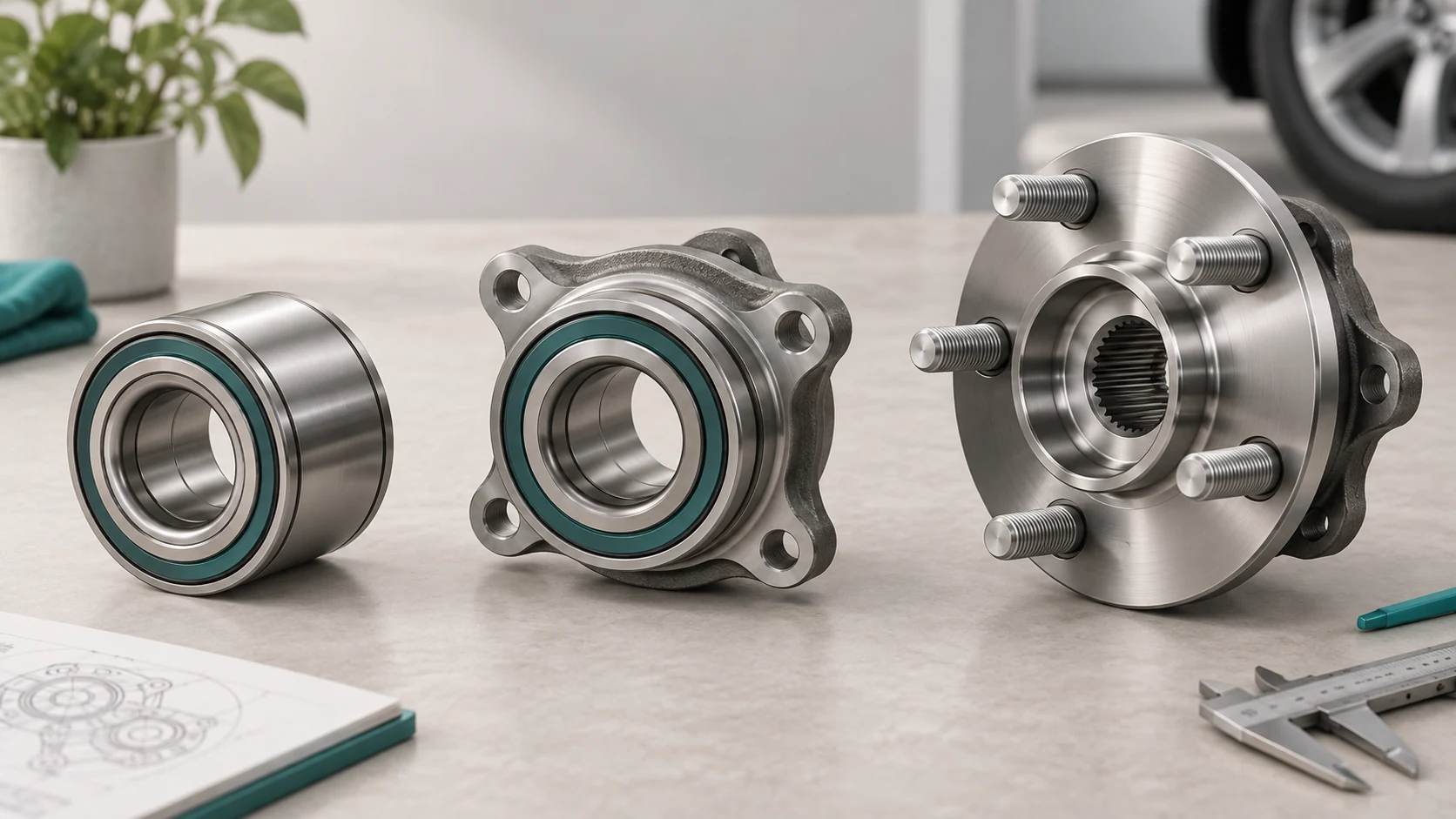
Buyers often use wheel bearing, hub bearing and wheel hub assembly as if they describe the same package. In a quotation, that ambiguity matters. A bearing cartridge, a flanged unit and a complete assembly can involve different components, fitting requirements and accessories. State the required product boundary rather than expecting the supplier to infer it from the enquiry title.
A kit should have a clear contents list. Confirm whether the order includes hardware, a sensor, cable clips or other accessories required by the agreed specification. Do not assume that a photograph showing an axle nut means the nut is included in every quoted reference. Ask the supplier to identify the contents against each line.
Generation labels can help describe broad construction, but they are not unique part identifiers. SKF's Generation 1 hub-unit technical guidance illustrates a particular bearing architecture. For purchasing, the reference and application evidence remain necessary even when the general product family is understood.
| Selection question | What to record | Why the answer matters |
|---|---|---|
| What is being purchased? | Bearing, flanged unit, assembly or defined kit | Establishes the quotation boundary |
| Where will it be used? | Vehicle variant, market and wheel position | Narrows application matching |
| What identifies the requirement? | Original reference and source | Makes the enquiry traceable |
| Which interfaces must match? | Drawing and configuration details | Supports technical comparison |
| What remains unresolved? | Specific question and responsible contact | Prevents assumptions entering the order |
Identify the application with enough detail
Record the vehicle make, model, year and relevant engine or drivetrain information. Include the intended market where the catalogue distinguishes regional variants. State the wheel position explicitly, including left or right when applicable. A sales description may cover several configurations, so preserve the source of the application information.
If an OE number is available, keep its original formatting and any suffix. If the request comes from a removed part, photograph its marking and identify the position from which it was removed. If the request comes from a catalogue, record that source and the applicable entry. A reference copied through several spreadsheets can lose useful context before it reaches a supplier.
Use Huayuan's wheel hub bearing reference directory for discovery, then request confirmation against the actual application. A catalogue record is not a stock statement or a guarantee that every listed cross-reference is approved for every vehicle variant. The OE and fitment verification guide explains how to manage that confirmation.
Separate replacement matching from product development
A replacement enquiry normally begins with an existing application and a requirement to match its approved interfaces and function. A development enquiry may instead involve a new assembly, a changed duty or a custom specification. Those are different tasks. Do not present a proposed design change as an ordinary replacement simply because an existing hub looks similar.
For replacement sourcing, identify the authoritative reference and the evidence needed to establish equivalence. For development work, describe the application requirements and ask the responsible engineering team to define the necessary calculations, drawings and validation. A public product catalogue cannot replace that work.
This distinction also affects samples. A sample sent for visual identification has a different purpose from a sample intended for functional evaluation. State the intended use before dispatch so that the supplier can confirm whether the proposed sample and available evidence are appropriate. Avoid treating receipt of a sample as acceptance of the design.
Compare the interfaces that define the assembly
The comparison should cover the relevant mounting faces, pilot surfaces, fastening arrangement and driven interface where present. Ask for a controlled drawing or an equivalent technical record. Identify the revision, and keep nominal requirements separate from measurements taken from a used sample.
Do not select by bolt pattern alone. A matching wheel-side pattern does not describe every mounting relationship. Axial distances, pilot details, splines and the sensing arrangement may still differ. If two supplier tables use different terminology, ask them to identify the measured surfaces rather than comparing unexplained numbers.
For a detailed explanation of these features, the JNHJDP flange dimension guide provides a complementary technical reference. Use that terminology when preparing questions, while obtaining the actual dimensions and acceptance requirements from the product-specific records. No dimensions in a generic illustration should be copied into a purchase specification.
Check ABS and wheel-speed sensing as a separate requirement
Confirm whether the application uses a magnetic encoder, another target arrangement and a separate or supplied sensor. The statement “with ABS” is not enough to establish the exact configuration. Record the sensor reference, connector and harness details where those items form part of the supplied assembly.
NSK's wheel bearing guidance for magnetic encoder applications demonstrates the relevance of encoder orientation. For a buyer, the action is to request the appropriate identification and fitting information, not to assume a dark seal always indicates the same arrangement.
Ask how any unresolved sensing requirement will be checked. A visual comparison can identify a connector difference, but it cannot demonstrate complete electrical compatibility. If functional evidence is required, agree the test scope and acceptance basis with competent technical staff before approving the sample or order.
Describe the operating context without inventing performance claims
Provide the information that distinguishes the real application from a generic passenger-car description. Relevant circumstances may include the vehicle duty, environment or a known service issue under investigation. The technical team should decide which requirements follow from that context. Purchasing should not translate a difficult environment into an unsupported promise such as universal waterproof performance.
Similarly, avoid setting a general temperature, speed or service-life limit from an unrelated catalogue entry. Product performance depends on its design and application. Ask for the applicable requirement and supporting evidence where a particular claim influences the buying decision. Keep any limitation attached to the claim when comparing quotations.
For existing service complaints, first obtain a qualified diagnosis. A noise report alone is not enough to select a replacement reference, and replacing a hub should not become a substitute for identifying the affected component. Record the diagnostic information separately from the product enquiry so the two can support each other without being confused.
Create a short list with visible reasons
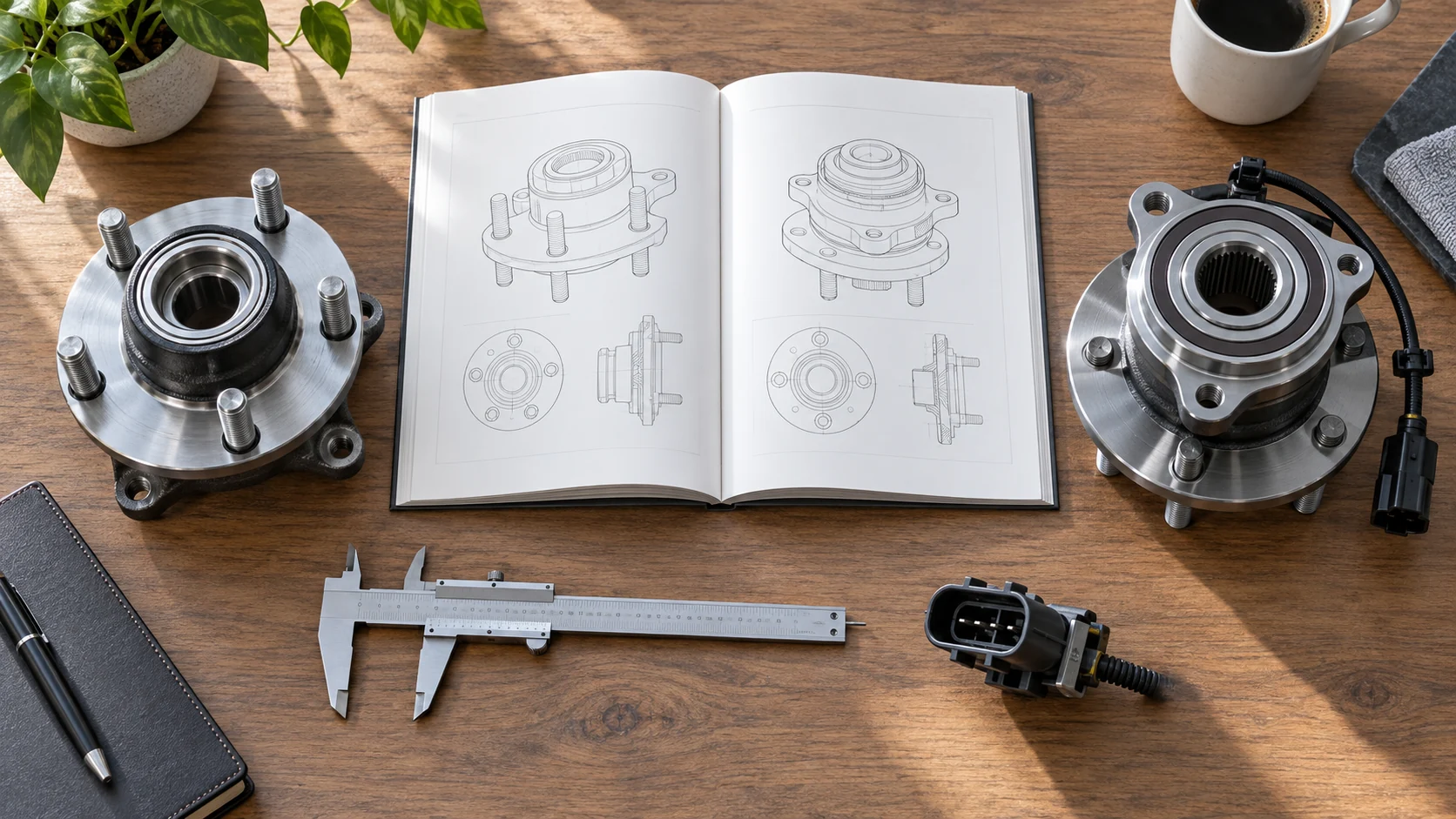
For each candidate, record what supports the match and what remains open. A simple comparison table is better than a folder of product screenshots. Include the original reference, proposed supplier reference, application source, drawing status, sensing configuration and required accessories. Add a decision column with a specific reason.
Useful states might be “awaiting drawing,” “application conflict,” “sample review required” and “approved for the stated scope.” These descriptions communicate more than an unexplained red or green cell. Do not mark a candidate approved merely because the quotation is complete or the supplier has stock available.
An illustrative case can clarify the sequence. A distributor finds two assemblies associated with the same model name. One has a different sensor connector, and the other lacks a confirmed market application. Both remain candidates. The next step is targeted clarification, not choosing the cheaper line and assuming the differences can be resolved at installation.
Set a purpose for sample evaluation
Before ordering samples, list the questions the evaluation must answer. It might confirm identity and dimensions, assess the supplied kit, verify packaging or support an agreed functional evaluation. Name the sample quantity and destination, then confirm the cost, availability and transport arrangements in the quotation.
Agree how the sample will be identified and how the result will be recorded. If the supplier provides a test report, establish that it applies to the proposed reference and relevant revision. If the buyer arranges testing, communicate the requirements and preserve the sample identity throughout the process.
Define the approval boundary. Acceptance of a packaging sample does not approve vehicle fitment. A drawing review does not prove service life. A successful application-specific evaluation should not be broadened into a claim that the product suits every vehicle sharing a brand name. Clear scope makes subsequent repeat orders and changes easier to manage.
Compare quotations only after the specification is aligned
Commercial comparison becomes meaningful when the product and supply scope are consistent. Confirm the unit of sale, included accessories, packaging, quantity, currency and dispatch assumptions. A price for a bare bearing and a price for a complete kit cannot be compared directly without accounting for the difference.
Ask suppliers to separate available-stock timing from production timing and to identify any conditions affecting their proposal. Minimum quantities, packaging charges and sample terms should be confirmed for the actual references. A general company statement does not establish the terms of every order.
The wheel hub bearing RFQ checklist turns these requirements into an enquiry structure. Use one line per requested item and maintain a consistent identifier when suppliers propose alternatives. Keep the original request visible so that a revised quotation does not silently change what is being compared.
Prepare the receiving handover before shipment
The team receiving the order should know what was approved. Provide the accepted reference list, packaging requirements, kit contents and agreed inspection scope. Include the document revision and a contact for unresolved questions. A warehouse should not have to repeat the original sourcing exercise to recognise the shipment.
Request the records needed to connect the delivery to its agreed specification. The quality documents and packaging checklist explains the difference between general organisational documents and records tied to a shipment. Ask for evidence that supports the actual acceptance decision, rather than collecting documents with no clear application.
At receipt, retain the original labels and document any visible discrepancies before repacking. Where the identity or condition is uncertain, follow the agreed hold and clarification process. A shipment arriving on time does not remove the need to resolve a mismatch, and a familiar supplier name does not identify an unlabelled part.
Keep repeat orders tied to the approved record
After approval, store the original enquiry, accepted quotation, technical confirmation and sample results together. Record any exclusions and outstanding actions. The next buyer should be able to understand why the reference was accepted without reading a long chain of informal messages.
Ask the supplier how changes to the product, source, sensing arrangement or packaging will be communicated. Define which changes require renewed review. Even when a catalogue number remains unchanged, a change affecting the approved requirement may need attention. Do not assume that every future delivery is identical solely because the order description is familiar.
When ready to enquire, browse Huayuan wheel hub bearings and send the original reference, application, position and quantity through the contact page. Identify any unresolved requirement clearly. This gives the team a practical starting point for confirming the proposed product and quotation scope.
Buyer questions about selection
Is a complete hub assembly always the better purchase?
The correct purchase depends on the vehicle application, service requirement and agreed supply scope. A complete assembly may include functions that a bearing cartridge does not, but that does not make it a universal substitute. Confirm the required product and fitting arrangement before comparing price or convenience.
Can I select a bearing from a photograph?
A photograph can support identification and reveal visible differences. It cannot establish dimensions, internal specification, sensing compatibility or the complete application range. Use it with a traceable reference and the appropriate product information, and mark remaining questions for confirmation.
What should happen when catalogue references conflict?
Preserve both sources and describe the conflict. Ask for application-specific clarification and, where needed, controlled technical comparison. Do not combine the widest vehicle lists from both sources into a larger assumed fitment range.
What is the minimum useful enquiry?
Provide the original reference, its source, intended vehicle and position, required product scope and quantity. Add the target market and any known ABS or dimensional distinction. If a field is unknown, say so and explain what information is available to help resolve it.
Purchasing guidance, product information and company updates from Huayuan Bearing.