
There is no reliable single mileage number that answers how long wheel bearings last for every vehicle. A wheel-end bearing’s service life depends on the exact design, loads, speed, lubrication, sealing, environment, interfaces, and how the assembly is handled and used. An engineering rating-life calculation is not a promise that a complete vehicle hub will reach a particular odometer reading. Buyers should compare estimates only when the application assumptions and evidence are stated.
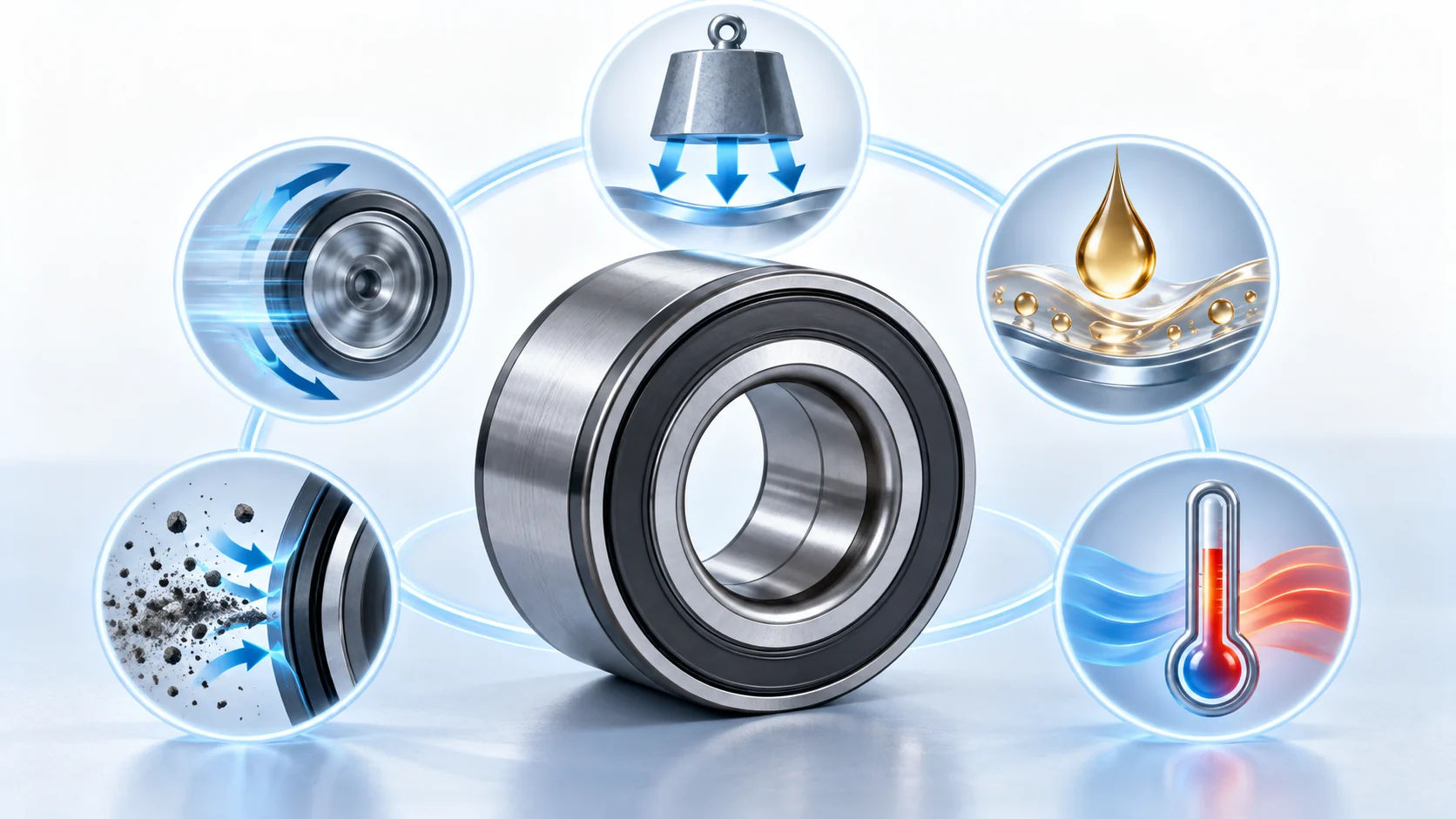
Conceptual editorial illustration. It does not show a measured Huayuan test result or a predicted service-life value.
The short answer: service life is application-specific
Searches for “how long should a wheel bearing last” usually expect a mileage or calendar interval. A dependable answer cannot give one universal number without knowing the vehicle, bearing arrangement, operating profile, and condition. Two similar-looking vehicles may carry different loads, travel on different roads, operate in different climates, or use different wheel-end designs. Those differences affect the bearing system and can make a generic internet estimate misleading.
For a purchasing team, the better question is: what evidence supports the expected life for this part in this application, under which stated conditions? Ask for a controlled product reference and the data needed to evaluate it. If a supplier offers a numeric claim, request the calculation or test basis, the assumptions, the test sample and acceptance criteria, and any limits. A marketing statement without a traceable method is not an engineering comparison.
Rating life is not the same as vehicle service life
ISO 281 defines methods for calculating basic dynamic load ratings and rating life for specified rolling bearings. Its basic rating life is associated with 90 percent reliability under the standard’s stated assumptions; the standard also describes modified rating-life calculations that account for other reliability levels, lubrication conditions, contaminated lubricant, and fatigue load. The ISO page describes the scope and exclusions of ISO 281:2007. Use the edition and method required by the customer or application; verify its current status and applicability before using it in a contract.
A statistical rating-life value describes a population under a calculation model. It does not predict the exact failure date of an individual bearing, and it does not automatically equal the service life of an automotive hub assembly. A complete wheel end includes interfaces and conditions beyond a single bearing calculation. Wear, corrosion, electrical erosion, seals, adjacent components, maintenance, and real-world operating cycles may affect the outcome; ISO’s published abstract specifically notes some influences it does not cover.
The L10 concept is especially easy to misread. It does not mean that every unit will last for the stated number of miles, nor that a failure before that value proves a defect. It is a statistical measure tied to specified assumptions. When a life calculation is supplied, record its inputs and units, then compare those inputs with the intended duty. Do not compare one supplier’s calculated hours with another supplier’s mileage estimate as if they were equivalent.
Operating load and duty cycle change the estimate
Wheel-end load is not just the vehicle’s curb weight divided by four. Axle load, passenger or cargo loading, braking, cornering, acceleration, road profile, tire and wheel geometry, and dynamic impacts can change the forces applied at the bearing. The load pattern may vary through a route or operating cycle. A single static figure therefore does not capture the entire duty.
For a fleet or aftermarket program, define the vehicle population and use profile as clearly as possible. Include vehicle type, axle and position, typical payload range, operating environment, route mix, stop-start use, and any special duty. If a product is intended for multiple models, do not assume that the same duty description covers every variant. Ask the supplier to identify which configuration the estimate addresses and which differences are outside its scope.
The operating cycle matters as well as peak load. Repeated short journeys, long steady-speed operation, frequent cornering, rough surfaces, high payload frequency, or seasonal storage may create different conditions. The point is not to infer a numeric life from a route description. It is to give the engineer a realistic set of assumptions so that a comparison is not based on an idealized or incomplete duty.
Speed and temperature are linked to the application
Bearing speed affects operating conditions and lubricant behavior. The relation between wheel speed, tire size, gearing, and vehicle operation is application-dependent. A bearing’s rating or maximum speed from a general catalogue cannot be treated as a complete life statement for an assembled wheel end. Use the exact manufacturer data for the product and the application.
Temperature is also a system condition rather than a stand-alone prediction. Ambient conditions, brake heat transfer, friction, lubrication, load, and sealing can interact. If temperature data is used in an assessment, record where and how it was measured, under what duty, after what stabilization period, and which wheel-end components were compared. A single surface reading without test context is not evidence of life expectancy.
For a buyer comparing alternatives, ask whether the supplier’s technical document states the speed and temperature assumptions, the bearing configuration, lubricant and sealing boundaries, and any exclusions. If the answer is “same as original equipment” but the source is not identified, request the exact application evidence. Do not turn a general design description into a guaranteed mileage claim.
Lubrication and cleanliness matter, but are not the only factors
Lubricant type, quantity, condition, and compatibility contribute to bearing operating conditions. The relevant details depend on the bearing design and whether the assembly is supplied sealed or intended for a maintenance procedure. Do not add lubricant, open a sealed unit, or change a lubricant based on a generic article; follow the product maker’s and vehicle manufacturer’s controlled instructions.
Contamination can affect the lubricant film and rolling surfaces. Solid particles, moisture, and other contaminants may enter through handling, storage, installation, or compromised sealing, depending on the design and use environment. SKF’s bearing-damage analysis explains how lubrication and contamination relate to several bearing damage modes and why an investigation should distinguish symptoms from the underlying cause. See SKF’s explanation of ISO 15243 bearing damage analysis.
When reviewing a supplier claim, ask what cleanliness and sealing assumptions apply to the exact assembly. A general statement such as “sealed for life” is not a substitute for confirming the actual product’s design, application, packaging, and handling requirements. Where a maintenance interval or inspection method is specified, identify the issuer and the document revision.
Seals and environment influence wheel-end protection
A sealing arrangement helps manage the interface between the internal bearing environment and outside contaminants, but the design and function vary. Exposure to water, dust, road salt, wash procedures, temperature variation, and storage conditions can differ substantially between vehicles and regions. A product intended for one environment should not be assumed suitable for another without application data.
This is why regional use and distribution matter to procurement. A catalogue covering several markets may need separate notes about vehicle variants, storage, packaging, and operating environment. Ask the supplier which seal or encoder arrangement is used for the exact reference and whether external checks or handling restrictions apply. If a seal appears displaced, cut, contaminated, or wet, quarantine the sample and request a documented assessment instead of disassembling it.
Huayuan’s quality documents and packaging checklist describes how buyers can link product and lot information to receiving records. The checklist is a procurement aid, not a claim that every document or inspection is provided by default.
Fit, alignment, and mounting interfaces must match
Bearing life calculations assume defined geometry and operating conditions. The actual product is installed into interfaces that must correspond to the approved design. Fit, clearance or preload where applicable, alignment, surface condition, fastener requirements, and adjacent parts are relevant to the application. A part that is dimensionally close but has the wrong fit or interface cannot be made equivalent by choosing a different brand name.
For a complete hub unit, check the flange, mounting pattern, pilot, sensor or encoder details, axle and position, and supplied components against the exact OE reference or controlled drawing. Do not infer tolerances, torque, preload, or mounting steps from a supplier’s generic life article. Those values belong to the applicable technical and vehicle documentation.
If a customer reports early returns, separate product identity from installation and application facts. Confirm the lot, vehicle variant, position, mileage and duty, prior service history if available, mounting record, and whether the part or surrounding components changed. That information can help specialists assess the issue; it does not let a web page diagnose the cause remotely.
Storage and transport are part of the chain
The part’s conditions before installation can affect its state and traceability. Packaging, moisture exposure, vibration, impacts, temperature, shelf controls, and handling practices should be reviewed against the supplier’s instructions and the buyer’s logistics route. A bearing that has been dropped, repacked without lot identification, or stored outside an agreed condition should not be treated as equivalent to an intact, traceable unit.
For repeat orders, preserve the original label or an approved record that links the carton to the product reference and lot. Note the receiving date, storage location, package condition, and any nonconformity. If the buyer or distributor transfers the product to different packaging, define how product identity and lot traceability remain visible. Huayuan’s bearing storage and handling guide offers a general purchasing and receiving checklist; use the supplier’s current instructions for the exact product.
What buyers should request before accepting a life claim
Before comparing service-life statements, request a concise, traceable evidence package:
- Exact part number, revision, application, and the bearing or hub-unit configuration being discussed.
- Calculation standard and edition, if a rating-life calculation is used.
- Loads, speed, duty cycle, reliability basis, and other calculation inputs.
- Lubrication, sealing, temperature, cleanliness, and operating assumptions.
- Test method, test sample, duration or cycles, measured variables, acceptance criteria, and results if a test claim is made.
- A statement of what the evidence does not cover, such as installation, vehicle interfaces, misuse, or non-standard operating conditions.
- Record identification, date, authoring organization, and the product or lot to which it applies.
A test and a calculation answer different questions. A calculation is based on model inputs; a test records a defined set of observations under a particular procedure. Neither should be represented as the guaranteed field life of every supplied part unless the written agreement clearly says so and defines its scope.
For supplier comparisons, use the same application, units, duty, and evidence requirements for each candidate. If the assumptions differ, place the estimates side by side as separate scenarios rather than ranking them directly. Huayuan’s supplier evaluation guide outlines a broader method for comparing documented product, process, traceability, and delivery information.
Common questions about wheel-bearing life
How many miles should a wheel bearing last?
There is no universal mileage figure that applies to all vehicles and operating conditions. Use the vehicle maker’s inspection or service information and request application-specific engineering evidence for a particular product. A generic online estimate is not a warranty or a verified life calculation.
Does L10 mean that 90 percent of bearings will reach a fixed mileage?
No. The basic rating-life concept is statistical and tied to the calculation’s stated assumptions and units. It is not a promise that an individual wheel-end assembly will reach a certain odometer reading. ISO 281 defines the calculation scope and related assumptions.
How often should wheel bearings be replaced?
Do not assume a fixed replacement interval for every car or product. Follow the vehicle manufacturer’s maintenance guidance and use a qualified inspection process. A supplier’s rating-life calculation should not replace the applicable vehicle maintenance instructions.
Can two bearing designs be compared by their rated hours?
Only if the comparison uses compatible methods, inputs, reliability assumptions, units, and application boundaries. If one value uses different load, speed, lubrication, or contamination assumptions, the figures do not represent a like-for-like comparison.
Does a longer warranty prove longer bearing life?
A warranty is a commercial term with conditions and exclusions; it is not the same as a standardized rating-life calculation or a controlled test result. Review the written coverage and keep it separate from engineering evidence.
Can service life be estimated from a symptom or returned part alone?
A symptom or a damaged component may justify a qualified technical investigation, but neither alone proves the root cause or a general service-life limit. Preserve the product, packaging, traceability, application details, and installation records for review by the responsible technical parties.
Use a defined application, not a generic promise
The answer to “how long do wheel bearings last?” is a documented range or assessment tied to a particular design and duty, not one universal mileage figure. ISO rating life can help engineers compare rolling-bearing designs under stated assumptions. It should not be converted into an unconditional field-life promise for an automotive hub assembly.
Buyers can make the discussion more useful by supplying the exact application, identifying the expected duty, asking for evidence and assumptions, and keeping the product, lot, and installation records together. For a quotation, start with the wheel hub bearing RFQ checklist and keep unresolved life, fitment, and test questions explicit.
Authoritative references
Purchasing guidance, product information and company updates from Huayuan Bearing.