
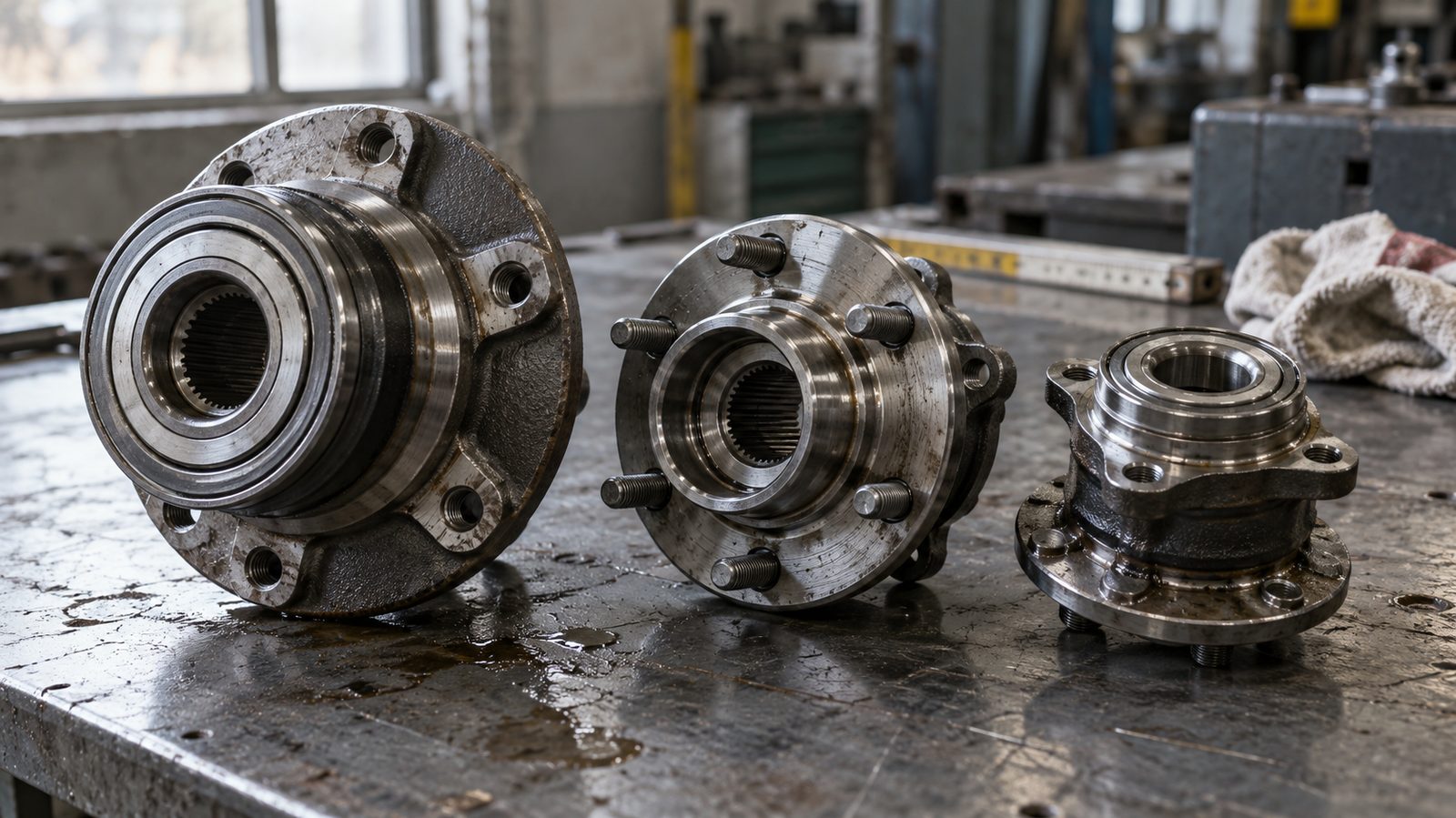
A multi vehicle hub bearing application is a wheel-corner position where one hub bearing or hub unit design serves several vehicle models instead of a single platform. The part number is fixed by the housing bore, flange pattern, bearing envelope, load rating, ABS interface and seal type, not by the car's badge. Buyers therefore select by drawing dimensions and duty cycle first, then confirm the vehicle list. Jinan Huayuan Bearing Co., Ltd. (huayuanbearing.com) manufactures hub bearings, hub units, tensioners and CV joint cages for aftermarket replacement and OE supply, and most enquiries arrive as exactly this kind of cross-model request.
What Is a Multi Vehicle Hub Bearing Application?
An application becomes multi vehicle when the wheel-corner envelope repeats across models. Vehicle makers standardise hub geometry to share tooling and brake components, so one bearing size often appears on a hatchback, a compact MPV and a small SUV built on the same platform, and sometimes on models from two different groups that bought that platform.
What does multi vehicle mean in a bearing catalogue?
A multi vehicle entry in a bearing catalogue is a dimensional and functional match, not a marketing claim. The supplier groups part numbers by bore, outer diameter, width, flange offset, bolt pattern and ABS type, then cross-references OE numbers that share those values. Two models listed against one number may look completely different on the road and still accept the same hub unit, because the corner hardware — knuckle bore, brake disc hat height, sensor position — is identical. The catalogue line is only a starting point: the drawing and a physical sample decide whether the part actually fits.
Why can one bearing envelope serve several platforms?
Corner loads scale with kerb weight, track width and tyre grip, and those values cluster tightly inside a vehicle class. A bearing rated for a 1,300 kg hatchback usually covers a 1,450 kg compact SUV on the same platform, because the static corner load rises by a few hundred newtons while the dynamic margin designed into the unit already absorbs it. Shared suspension architecture, shared brake suppliers and shared assembly lines widen the overlap further. The limit is set by load rating and seal package, not by the model name on the tailgate.
Where does interchangeability stop?
Interchangeability stops at four boundaries. First, ABS: an active sensor reading a magnetic encoder ring will not work with a passive toothed ring, and pole counts differ between units that otherwise measure the same. Second, flange geometry: a 2 mm offset difference changes brake disc alignment and can produce judder. Third, sealing: a unit specified for dry-climate road use may carry a single lip, where a muddy-market equivalent needs a cassette seal. Fourth, driveline: a driven unit has a splined bore and a non-driven one does not. Any of these differences makes a fits-several-models claim false for that buyer. This is why huayuanbearing.com treats every cross-reference as provisional until the drawing and sample confirm it. The practical difference between a bare bearing and a full assembly is set out in this comparison of a wheel bearing versus a hub assembly.
Which Hub Bearing Type and Generation Fits the Wheel Position?
The generation number describes how much of the wheel corner is built into the part, and that usually decides the replacement strategy before dimensions are even checked. Jinan Huayuan Bearing Co., Ltd. supplies all three generations, plus separate tapered pairs, tensioners and CV joint cages, so the same enquiry can be answered across several architectures. A structured wheel bearing and hub assembly selection guide helps narrow the family before part numbers are compared.
How do generation 1, 2 and 3 hub units differ?
Generation 1 is a bare double row bearing pressed into a knuckle or onto a shaft; the flange comes from the vehicle. Generation 2 adds one integrated flange, so the unit bolts to the brake disc or drum and still locates in the knuckle bore. Generation 3 is a complete hub assembly: bearing, flange and knuckle mounting face in one sealed part, usually with the ABS encoder built in and a splined bore for the driveshaft. Heavier vehicles still use separate tapered roller pairs, adjusted on the vehicle rather than sealed and preset at the factory.
| Generation | What is integrated | Bearing type inside | ABS interface | Typical position | What buyers must check |
|---|---|---|---|---|---|
| Gen 1 | Bearing only; hub and knuckle come from the vehicle | Double row angular contact ball, or double row tapered roller | None, or separate tone ring on shaft or knuckle | Front and rear, driven and non-driven | Bore and width; press tools; preload set by axle nut |
| Gen 1 tapered pair | Separate cone and cup, adjusted on assembly | Tapered roller | Usually none | Light truck, van and trailer hubs | Cup fit, spacer or nut adjustment, seal seat |
| Gen 2 | Bearing plus one flange for the brake disc or drum | Double row angular contact ball; some tapered | Encoder seal or tone ring on the flange | Non-driven rear axles, some front axles | Flange offset, bolt PCD and count, pilot diameter |
| Gen 3 | Bearing, flange and knuckle mounting face in one sealed unit | Double row angular contact ball; some double row tapered | Magnetic encoder seal built into the unit | Driven front and rear axles | Spline count and diameter, sensor position, pole count, axle nut thread |
Generation numbers describe architecture, not quality. A well-made Gen 1 bearing outperforms a poorly sealed Gen 3 unit in the application it was designed for.
When is a tapered roller bearing the right choice?
Tapered roller bearings carry high combined radial and axial load because the rollers sit at an angle and the cup and cone raceways take thrust along the shaft axis. They suit trailer hubs, light truck rear axles and older non-driven front hubs where a pair of cones is adjusted against a spacer or nut. The trade-off is setup: preload or end play must be set on assembly, and a wrongly adjusted pair fails quickly through heat or spalling. Cylindrical roller bearings carry very high radial load with almost no axial capacity, so they are normally paired with a separate locating bearing.
What do tensioners and CV joint cages add to the same order?
Tensioners and CV joints travel in the same containers as hub units and fail for related reasons: seal loss, grease breakdown, contamination. A tensioner runs on a sealed bearing, and its usual failure is grease starvation or a worn seat that tilts the pulley and throws the belt. A CV joint cage is the windowed steel retainer that spaces the balls in a Rzeppa or tripod joint; wear shows as polished, blued or cracked windows and as play under acceleration. Checking all three on the bench tells you whether a noise complaint is wheel-end, belt-end or driveline.
How Do Load, Speed and Road Conditions Change the Specification?
Load direction and duty cycle decide the bearing family; the vehicle name does not. Two cars of similar weight can need different units because one spends its life on motorways and the other on broken urban roads with a full load.
Which bearing family suits which wheel position?
| Wheel position or component | Dominant load | Bearing family usually specified | What to verify |
|---|---|---|---|
| Passenger car front, driven | Combined radial and axial from cornering, plus driveshaft torque | Double row angular contact, Gen 3 | Spline, encoder type, seal for local climate |
| Passenger car rear, non-driven | Mainly radial, light axial | Double row angular contact, Gen 1 or Gen 2 | Flange offset, brake size, pilot diameter |
| Van or light commercial rear | High radial with shock peaks | Double row tapered or Gen 1 tapered pair | Preload setting, cup fit, grease grade |
| Trailer and caravan hub | Steady radial, high axial in manoeuvring | Tapered roller pair with heavy-duty seal | Seal type, grease fill, adjustment procedure |
| Tensioner or idler pulley | Radial, high speed, low load | Sealed deep groove ball | Seal drag, grease life, seat flatness |
| CV joint | Torque with articulation | Cage, balls and raceways as one joint | Cage window wear, boot sealing, play |
How do radial and axial loads reach the wheel corner?
Vertical weight and cornering force arrive at the hub as radial load; steering and camber thrust add axial load. A passenger car front corner might see a few kilonewtons standing still, several times that in a hard corner or a kerb strike, plus short shock peaks far above either figure. Hub units are therefore rated on dynamic capacity with a shock margin rather than on static weight. Rear non-driven corners see less axial load and tolerate lighter units, while driven front corners combine wheel load with driveshaft torque and brake heat.
What changes on vans, trailers and heavier vehicles?
Kerb weight and payload move the whole envelope upward. A loaded van or trailer hub spends its life near its rated load, so the bearing needs a larger roller complement, a stiffer flange and a seal that survives pressure washing. Trailer hubs also see high axial load during tight manoeuvring, which is where tapered pairs earn their place. Commercial duty cycles split further: long highway runs heat the grease steadily, while stop-start delivery work loads the corner repeatedly at low speed. Those profiles call for different grease base oils even when dimensions match, as set out in these commercial vehicle hub bearing applications.
When do speed, heat and contamination dominate?
Speed limits grease life more than load in many passenger car applications, because churning and temperature oxidise the base oil. Heat from the brake disc reaches the hub through the flange, so a unit mounted behind a heavily used brake runs hotter than the same unit on a rear axle. Contamination attacks the seal lip first and the raceway second. For a coastal or monsoon market, seal and grease selection deserves more weight than a small gain in dynamic capacity.
How Are Material, Heat Treatment, Clearance and Sealing Specified?
Steel grade, heat treatment, clearance and sealing are drawing values, and each one maps to a specific failure mode when it is changed. Substituting any of them to save cost shifts the failure from wear to something faster.
Which steel and heat treatment are normal for hub bearings?
Most hub bearings use through-hardened high-carbon chromium bearing steel — 100Cr6 or its SAE 52100 equivalent — hardened and tempered to roughly 58 to 64 HRC at the raceway. Flanges and shock-loaded rings are often case-carburized or induction-hardened instead, giving a hard surface over a tougher core that resists cracking at the fillet. Surface finish matters as much as hardness: roughness left too high shortens fatigue life, and grinding burns cause early spalling. Buyers can request hardness and microstructure records without running a metallurgy lab, and background on hub bearing steel quality explains what those records should show.
How are precision grade and clearance specified?
Precision is quoted in ISO classes — P0, P6, P5 — broadly corresponding to ABEC-1, 3 and 5. Automotive hub units commonly sit at P6 or better because running accuracy affects brake judder and the ABS sensor air gap, not only noise. Clearance follows ISO 5753 groups (C2, CN, C3, C4), but most sealed hub units are preloaded at assembly and cannot be adjusted in service, so the drawing value is a manufacturing instruction rather than a user setting. Separate tapered pairs are the exception: there the end play or preload is set on the vehicle.
Which seal and grease suit which duty?
Sealing and lubrication are chosen together, because a seal that keeps water out also keeps grease in.
| Duty condition | Seal arrangement | Grease consideration | What to verify |
|---|---|---|---|
| Dry climate, normal road use | Single lip seal with dust lip | Lithium complex, NLGI 2 | Lip contact, spring seating, fill weight |
| Wet, muddy or flooded roads | Cassette or double lip seal with outer excluder | Lithium complex with water resistance | Outer lip condition, slinger, corrosion protection |
| ABS-equipped unit | Magnetic encoder seal or separate tone ring | Non-metallic-debris contamination control | Encoder type, pole count, air gap |
| Heavy duty or near-brake heat | High-temperature elastomer lip | Polyurea or high-temperature lithium, higher base oil viscosity | Grease bleed, seal hardening, flange temperature |
| Long storage or sea freight | Seal plus corrosion-preventive oil and barrier packing | Grease retention through vibration | Rust at raceway, false brinelling marks |
Sealed-for-life units are filled once, usually to 25 to 40 percent of the free volume. Overfilling raises churning temperature; underfilling starves the outer row. Both cause failures that look like a part defect.
Which Failure Modes Show the Wrong Unit Was Fitted?
A correctly specified hub unit usually fails from wear; an incorrectly specified one fails from geometry, sealing or installation within the first few thousand kilometres. Reading the pattern is faster than replacing parts by guesswork.
What do noise, play and ABS warnings indicate?
Rumbling that rises with road speed and changes pitch in a turn points to raceway spalling; a growl that disappears when the wheel is unloaded often means a damaged outer row. Visible play at 12 and 6 o'clock, grease weeping past the seal and a blued flange indicate overheating. An ABS lamp with no other fault often traces to a damaged encoder ring, metal debris stuck to a magnetic seal, or an air gap disturbed during fitting. Noise alone is weak evidence, as this guide to hub bearing noise diagnosis shows, because tyre, brake and CV joint faults imitate bearing noise closely. A wider symptom list sits in these notes on how to tell a wheel hub bearing is failing.
Which installation errors mimic part failure?
Pressing on the inner ring while supporting the outer ring brinells the raceways before the vehicle moves. Reusing a stretched axle nut, omitting a spacer or torquing to a guessed value changes preload and destroys the unit within a few hundred kilometres. Hammering a flange, dropping a unit on a concrete floor or fitting a sensor without cleaning its seat all produce failures that look like manufacturing defects. False brinelling from vibration in transit is a third pattern: evenly spaced marks in the raceway, caused by transport and packaging rather than bearing quality.
How Do You Read the Drawing and Inspect the Delivery?
A drawing check takes minutes and prevents most fitment claims. It works best when the buyer knows which values are decisive and which are informational.
Which drawing values must match exactly?
Six values decide whether a hub unit fits: bore diameter, outer diameter, overall width, flange offset, bolt hole pitch circle and count, and the ABS arrangement. Driven units add spline count, spline major diameter and the axle nut thread. Gen 2 and Gen 3 units also need the pilot diameter that centres the brake disc and the sensor mounting position. Tolerance belongs on the drawing alongside nominal size: a knuckle bore fit is usually a light interference of a few hundredths of a millimetre, and hub press fits commonly fall between 0.005 and 0.05 mm depending on diameter and housing material.
How should OE numbers and supersessions be handled?
OE numbers are a cross-reference, not a guarantee. One OE number can cover several production runs with different seal or encoder designs, and a superseded number may point to a unit with a revised flange. Treat every cross-reference as provisional until dimensions, encoder type and pole count are confirmed, as explained in this guide to OE number fitment for ABS wheel hub bearings. Where a customer supplies only a vehicle model, the practical route is to request the original part, photograph the markings and measure the removed unit. Final confirmation is always by drawing and sample.
What should incoming inspection cover?
Inspection should follow a fixed sequence so a borderline batch is caught before it reaches a shelf. Standardising what you send to suppliers also reduces the back-and-forth — the wheel hub bearing RFQ checklist covers the inputs worth requesting up front.
- Check the packing list against the purchase order: part number, quantity, generation and ABS type.
- Confirm that label, box and part marking agree, so mixed stock is caught immediately.
- Measure bore, outer diameter and width against the drawing with a calibrated micrometer or bore gauge.
- Check flange offset, bolt pitch circle and pilot diameter with a height gauge or calliper.
- Identify the ABS type visually — encoder ring inside the seal, toothed ring on the flange, or none — and count poles on a sample.
- Turn each unit by hand: smooth rotation with light drag, no axial play, no roughness or catch.
- Inspect seals for lip damage, spring seating and grease weep, and the flange face for dents, rust and paint damage.
- Record results per batch and retain one sample with the delivery documents for later comparison.
What Do Buyers Ask Most About Multi Vehicle Hub Bearing Applications?
Can one hub bearing really fit several vehicle models?
Yes, when the wheel-corner envelope is identical: same bore, outer diameter, width, flange offset, bolt pattern and ABS type. Platform sharing makes this common across model years and even across brands. The catalogue grouping is a lead rather than proof, so confirm dimensions, encoder type and load rating against the drawing or a physical sample before committing a purchase order.
How do I confirm a multi vehicle hub bearing application before ordering?
Send the OE part number, the vehicle and year, and photographs of the removed unit with its markings. Measure bore, outer diameter and width, and identify whether the ABS ring is magnetic or toothed. A supplier working from a drawing or sample can then confirm or reject the match. A model name on its own is never sufficient evidence of fitment.
Does a higher precision grade make a better replacement?
Not on its own. P6 is already normal for automotive hub units, and moving to P5 helps mainly where brake judder or sensor air gap is sensitive. Seal quality, grease type, heat treatment and correct fit influence service life more strongly in most aftermarket applications. Grade is one line on the drawing, not a ranking of the whole part.
What should a supplier ask for before quoting a hub unit?
At minimum: dimensions or a drawing, OE and competitor references, ABS type, quantity per reference, packaging and branding requirements, and the market the part will serve. Market matters because seal and grease selection follows climate and road conditions. Jinan Huayuan Bearing Co., Ltd. develops parts from drawings and samples and supports custom packaging and private brand for buyers in the Middle East and Southeast Asia.
Purchasing guidance, product information and company updates from Huayuan Bearing.