
The hub of a wheel is the rotating centre of the wheel assembly: the flange that carries the wheel studs and brake disc, supported by a bearing set that lets it turn on a fixed axle stub or steering knuckle. On most modern passenger cars the hub and bearing are one sealed, pre-set, non-adjustable part, a wheel hub assembly that bolts to the knuckle and carries the ABS encoder ring. It carries vehicle weight, cornering and braking loads and holds the wheel in alignment. Jinan Huayuan Bearing Co., Ltd. (huayuanbearing.com) manufactures wheel hub bearings, hub units, tensioners and CV-joint components for aftermarket replacement and OE supply.
What Is the Hub of a Wheel and What Loads Does It Carry?
The hub of a wheel is a load path before it is a mounting flange: every force that reaches it comes from the tyre contact patch, and every part in the assembly is sized around those forces.
Three loads act at the same time. Vertical load from vehicle weight and weight transfer arrives as radial force. Cornering produces a lateral force at the contact patch, which becomes an axial load plus a bending moment because the patch sits outboard of the bearing. Braking adds torque reaction through the disc, and a driven axle adds drive torque. A hub dimensioned only for vertical load shows raceway distress on the outboard row first, which is why hub units use two wide-spaced rows rather than one wide bearing.
The hub is the reference surface for everything that spins
The machined faces of the hub set the geometry of the whole corner. The pilot spigot centres the wheel, the mounting face controls disc and wheel runout, and the stud circle transmits drive and braking torque through friction between the clamped faces. Lateral runout at the hub face is multiplied at the tyre tread, so a hub refitted with rust or debris trapped between the faces produces a vibration that no amount of wheel balancing will remove.
Hub, wheel hub bearing and hub assembly are three different parts
A hub is the flange, a wheel hub bearing is the rolling element set, and a hub assembly is both in one sealed unit with the ABS encoder. Buyers mix these terms constantly, and the mix-up changes what is being quoted. The 'hub for a wheel' on an older rear axle may be a bare flange with a separate tapered bearing pair, while the same phrase on a current front axle means a sealed third-generation unit that cannot be disassembled. Fitting time, tooling and cost structure differ substantially, so confirm which of the three the customer actually needs; this comparison of a wheel bearing and a hub assembly sets out the distinction by application.
Which Parts Make Up a Wheel Hub Assembly?
A wheel hub assembly is five functional groups in one part: flange and studs, two bearing rows, rings and cage, an ABS encoder, and a sealing and grease system. Each group fails in its own way, so each one is a separate inspection point.
Flange, studs and pilot diameter
The flange transfers wheel and brake loads into the bearing. Studs are press-fit or friction-welded, with thread grade and knurl diameter specified because a spinning stud destroys its hole and the repair becomes a hub replacement. The pilot spigot must be concentric with the bearing bore; when it is worn, painted over or burred, the wheel sits off-centre and the driver reports a vibration that returns after balancing.
Rows, rings and cage
Most car hub units use two rows of balls or rollers on a common inner ring or on two opposed inner rings. The outboard row takes the higher moment load, while the inboard row carries most vertical load on a cornering wheel. Raceway geometry, including osculation, crown and contact angle, determines how that load is spread, and it is fixed by tooling rather than adjustable after manufacture. A unit that feels notchy when rotated by hand already has raceway or contamination damage and should not be fitted.
ABS encoder and sensor interface
A magnetic encoder ring is moulded onto the seal or the inner ring in most units built since the mid-2000s, and the vehicle sensor reads it across a small air gap. The encoder is fragile: press force on the wrong face, a dropped unit or iron swarf stuck to the ring will set an ABS or traction-control code that reads like an electrical fault. When a wheel-speed code appears immediately after a hub replacement, check the encoder before the wiring harness.
Seals, shields and grease
Sealing decides hub life more than steel grade does. A cassette seal with an elastomeric lip running on a ground counterface, backed by a metal shield, keeps water and grit out; a single unprotected lip will not survive a winter of salted roads. Grease is matched to the seal and duty: polyurea and lithium-complex thickeners are common, and fill quantity is set to leave room for thermal expansion. A sealed unit is never topped up or mixed, because the fill is specified by the bearing designer, not by the fitter.
Which Bearing Type Goes Inside the Hub of a Wheel?
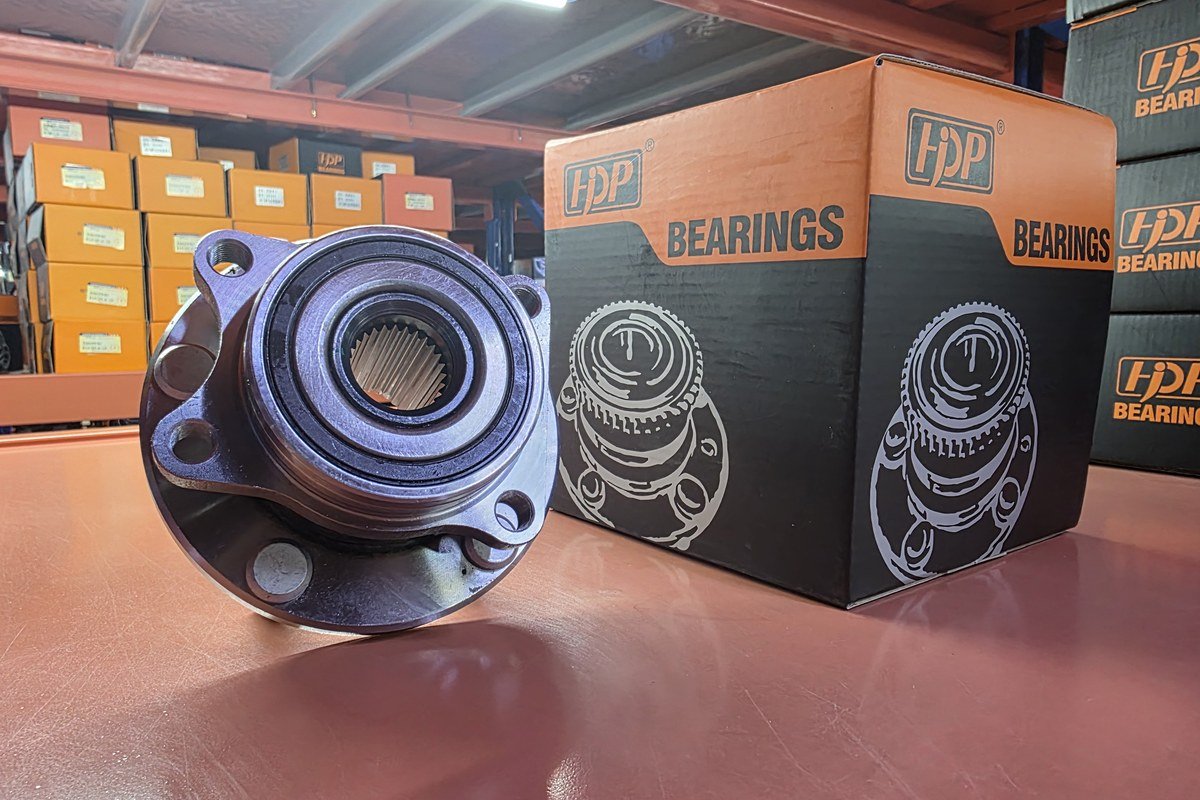
The bearing type follows the vehicle layout rather than the brand: driven passenger axles use sealed double-row units, non-driven and light-commercial axles often use tapered roller pairs, and heavy radial duty uses cylindrical rollers.
First-, second- and third-generation hub units
Generations describe how much of the corner is built into one part, and the number is a fitting instruction as much as a design label. A first-generation unit is a double-row angular contact bearing with integral seals pressed into the hub or knuckle; it needs a press, a mandrel and a separate hub flange. A second-generation unit adds a flange or housing so it bolts on with a separate hub. A third-generation unit combines bearing, flange, studs and encoder and is held by one axle nut. A fourth generation, used on some driven axles, integrates the constant-velocity joint housing. Fitting a first-generation bearing to a car built with a third-generation unit is not a substitution, it is a different repair.
| Hub unit generation | What is built into one part | How it mounts | Fitting method | Bearing adjustable? |
|---|---|---|---|---|
| First (Gen 1) | Double-row angular contact bearing with integral seals; separate hub flange | Pressed into knuckle or hub bore | Press with mandrel on the fitted ring; flange fitted separately | No, sealed for life |
| Second (Gen 2) | Bearing plus flange or housing; encoder on the sealed side | Bolted to knuckle with a separate hub | Bolt-on, retaining bolts or axle nut | No |
| Third (Gen 3) | Bearing, hub flange, studs and encoder in one sealed unit | Bolts to knuckle, held by one axle nut | Bolt-on with a new axle nut at specified torque | No, clearance set at manufacture |
| Fourth (Gen 4) | Hub unit integrated with the CV joint housing | Driven axle | Bolt-on together with the driveshaft | No |
Tapered, cylindrical or ball: which load case fits which
Contact shape decides capacity. Tapered rollers make line contact on angled raceways and carry combined radial and axial load, which is why they appear on non-driven rear hubs and light truck axles where end play can be set at assembly. Cylindrical rollers make line contact on parallel raceways and carry high radial load with no axial capacity, so they need a separate locating feature. Double-row angular contact ball bearings carry moderate radial and axial load in a compact sealed package, which is why they dominate passenger-car hub units.
| Rolling element | Contact | Radial load | Axial load | Typical use in a wheel hub |
|---|---|---|---|---|
| Tapered roller | Line contact, angled raceways | High | High in one direction per row | Non-driven rear hubs, light truck and trailer axles; end play set at assembly |
| Cylindrical roller | Line contact, parallel raceways | Very high | None, needs separate location | Heavy radial duty, commercial vehicle hubs |
| Double-row angular contact ball | Point contact, angled | Moderate | Moderate in both directions | Passenger-car hub units, generations one to three |
How Do Material, Heat Treatment, Clearance and Sealing Affect Hub Life?
Hub life is decided by four specifications a buyer can check on a drawing: steel grade and heat treatment, raceway finish, internal clearance or preload, and the sealing system. None of them can be judged from appearance.
Bearing steel and heat treatment
Rings and rolling elements are normally made from through-hardening bearing steel such as GCr15 (100Cr6), hardened and tempered to roughly 58 to 62 HRC, with the exact window set on the drawing. Hardness that is too low dents under load; too high and the raceway becomes brittle and spalls. Thin-section or heavily loaded parts are sometimes case-hardened instead, giving a hard surface over a tough core. Tempering and stabilising treatment also control how much the rings grow in service, which matters wherever clearance is pre-set at assembly.
Precision grade and internal clearance
Precision grades such as P6 or P5, the ISO equivalents of ABEC 3 and ABEC 5, define tolerance on bore, outside diameter and runout; a passenger-car hub unit is normally specified at P6 or better on running accuracy. Clearance is equally decisive. A first-generation bearing pressed into an aluminium knuckle loses clearance to the interference fit, while a third-generation unit has clearance built in and must not be adjusted. Tapered pairs are set by end play or preload to the figure on the drawing: too loose and the rollers skid, too tight and they run hot. Set from the specification, never from feel.
Sealing, grease and the environment the hub actually sees
Water ingress, not load, ends most hub lives in service. A hub that runs through flooded roads, pressure washing or road salt sees emulsified grease long before its calculated rating is reached. Specify a shielded cassette seal where the duty is wet, protect the encoder face, and never fit a unit whose seal lip was deformed in storage. Humidity control in the warehouse matters as much as the seal, because condensation on an unwrapped unit starts raceway corrosion before installation, a subject covered in this note on warehouse storage and corrosion control for wheel hubs.
Why Does the Hub of a Wheel Fail, and How Do You Confirm It?
Most hub failures fall into a small number of patterns, and the pattern tells you whether the cause was the part, the fitment or the environment.
What the symptom usually means
A hum or drone that rises with road speed and changes when the car is steered left or right is the classic bearing signature, because loading the outer wheel in a turn changes the noise on the failing side. Roughness felt through the steering wheel points to a front unit, a drone from behind points to a rear. Vertical play at the wheel, pedal pulsation with a new disc and a wheel-speed code are later signs. Grinding metal on metal with a burning smell means the unit has already collapsed and the car should not be driven. A structured diagnosis sequence for a failing wheel hub bearing separates bearing noise from tyre, brake and CV joint noise before any parts are ordered.
The failure patterns worth recording
Teardown evidence is the only reliable way to argue a cause. Record the pattern, photograph it and match it to the table below; a claim supported by a raceway photograph and a fitment record is settled quickly, while a claim of 'it was noisy' is not.
| Pattern found on teardown | What it looks like | Most likely cause | Check before claiming |
|---|---|---|---|
| Spalling | Flaking or pitting on a raceway, often the outboard row | Water or grit in the grease, overload, wrong preload | Seal lip condition, fitment torque, vehicle load history |
| False brinelling | Evenly spaced indentations matching roller spacing | Vibration while stationary: transport, storage or long idle periods | Storage and handling record, low-mileage vehicle |
| Corrosion | Reddish or dark staining on raceway and rolling elements | Condensation or water ingress before or after fitting | Packaging integrity, warehouse humidity, seal fit |
| Seal lip wear | Polished lip, dirt tracks under the shield | Abrasive environment, deformed shield, fitting damage | Shield condition, installation method |
| Fretting on the housing | Polished or reddish band around the housing outside diameter | Movement in a worn or undersized knuckle bore | Bore roundness and surface condition |
| Encoder damage | Cracked or contaminated magnetic ring | Press force through the ring, impact, metallic debris | Fitting procedure, sensor air gap |
Fitment faults that look like part faults
An impact wrench on the axle nut, a press applied to the outer ring of a unit that must be pressed on the inner ring, a knuckle bore left with rust scale, or a reused torque-to-yield nut will each produce a failure within a few thousand kilometres that has nothing to do with the bearing. Fretting marks, a polished reddish band on the housing outside diameter, indicate movement in the bore and are a knuckle problem. Confirm the fitting sequence and the torque figures actually used before blaming the part.
How Do You Install or Replace a Wheel Hub Correctly?
Correct installation is a sequence, and every step exists to protect a surface: the knuckle bore, the seal lip, the encoder ring and the mounting faces.
- Confirm the part before the car goes on the lift. Match OE number, drawing and generation; a third-generation unit will not substitute for a first-generation bearing. Where numbers are ambiguous, verify against a sample or the part on the vehicle, as described in this guide to OE number and ABS fitment checks.
- Loosen the axle nut with the car on the ground. Break the stake or crimp and loosen the nut with the wheel fitted and the brakes applied; it is far harder once the car is raised.
- Remove brake components without loading the hose. Hang the caliper rather than letting it hang by the flexible hose, and support the disc so its face is not damaged.
- Clean and inspect the knuckle bore. Remove rust scale and old locking compound, then check for out-of-round, fretting and cracks around the mounting ears. A damaged bore is repaired or replaced, never shimmed.
- Press, do not hammer. Use a puller or press, applying force to the ring that carries the interference fit; on a flanged unit, press on the inner ring or hub face as the drawing specifies. Force must never pass through the cage, the seal or the encoder.
- Protect the seal and encoder during fitting. Tape or sleeve the shaft splines, guide the unit on squarely, and confirm the magnetic ring is clean and undamaged before the sensor goes back.
- Use a new axle nut at the specified torque. Torque-to-yield nuts are single-use. Hold the hub with the correct tool rather than jamming a screwdriver through the studs, and stake or crimp where the workshop manual requires it.
- Refit the brake and sensor, then torque the wheel in a star pattern. The sensor must sit fully home at the designed air gap; a sensor held off by rust reads weakly and sets an intermittent code.
- Road test and record. Drive the car, listen for the original noise and re-check nut torque where the procedure calls for it. Record part number, fitment and torque applied, since that record supports any later warranty discussion, and a checklist of warranty return data for wheel hubs shows the evidence normally needed.
How Do You Read a Hub Drawing and Inspect Incoming Hubs?
A hub drawing is read in a fixed order, and the first eight values decide whether the part will fit at all.
The eight values to read first on a hub drawing
Read bearing bore and outside diameter, overall width or flange offset, flange outside diameter, stud pitch circle diameter and thread, pilot bore, mounting face to bearing centre distance, encoder type and seal arrangement, in that order, before price. These are the values that cause a no-fit; material and cosmetic details cause complaints but rarely returns for fit. Where no drawing exists, a sample plus the OE number is the working basis, and every dimension should be confirmed against both. The RFQ checklist for wheel hub bearings lists the data that shortens a first quotation.
Incoming inspection that catches real defects
Incoming inspection should be quick, repeatable and recorded, so a defect found at the bench can be traced back to a batch. Measure on a surface plate at a stable temperature, rotate every unit by hand, photograph anything that fails and compare it against a visual defect catalogue for wheel hubs so that inspectors describe the same defect the same way.
| Inspection point | Method | What to record |
|---|---|---|
| Part identity | Compare label, marking and packing list with drawing and OE reference | Exact match; any supersession confirmed in writing |
| Bore, outside diameter, width | Micrometer and caliper on a surface plate | Measured values against drawing tolerance |
| Flange diameter, stud circle, thread | Caliper, thread gauge, stud knurl check | Values, plus any loose or spinning stud |
| Mounting face runout | Dial indicator with the unit supported on its bearing bore | Reading against the drawing limit |
| Rotation | Hand rotation in both directions | Smooth and free, no notch or roughness |
| Seal and encoder | Visual under bright angled light | Lip intact, ring present, no metallic debris |
| Surface protection | Visual on machined faces and studs | No corrosion, packaging intact |
What Huayuan Bearing supplies and how to specify it
Jinan Huayuan Bearing Co., Ltd. manufactures wheel hub bearings, hub units, tensioners and CV-joint components in Jinan, Shandong, for aftermarket replacement and OE supply, with most export business going to buyers in the Middle East and Southeast Asia. Development runs from a drawing or a sample, and packaging can be supplied neutral or under the buyer's own brand. The wheel hub bearing product range lists the families available; a quotation is built from drawing, quantity and packaging requirement rather than from a catalogue number alone.
Frequently Asked Questions About the Hub of a Wheel
Is the hub of a wheel the same thing as a wheel bearing?
No. The hub is the flange that carries the studs, wheel and brake disc; the wheel bearing is the rolling element set that lets the hub rotate; a hub assembly is both supplied as one sealed unit with the ABS encoder. On modern passenger cars the three arrive as a single part, which is why catalogues and workshops use the terms interchangeably.
Can you replace only the bearing instead of the whole hub?
It depends on the generation. A first-generation bearing can be pressed out and replaced if the hub flange and knuckle bore are within specification. Second- and third-generation units are sealed, pre-set assemblies and are replaced as a whole. Pressing a sealed unit apart destroys the seal and encoder, so confirm the generation on the drawing first.
How long should a wheel hub last?
No fixed interval applies, because life depends on load, road conditions, sealing and fitting quality rather than on a service schedule. Hubs used on wet, salted roads or driven with damaged seals usually fail earlier than the same part in a dry climate. Replace on evidence such as noise, play, ABS codes or visible raceway damage, not on mileage alone.
What information do I need to quote a wheel hub unit?
Send the OE number, a drawing or a sample, the vehicle or axle application, the required quantity and the packaging requirement, including whether the box carries your own brand. Where an OE number has several supersessions, state which one you are buying against. That data set lets huayuanbearing.com confirm dimensions and encoder type and quote against the correct part.
Purchasing guidance, product information and company updates from Huayuan Bearing.