
What Is a Wheel Hub Bearing for CHEVROLET CAMARO and What Does It Carry?
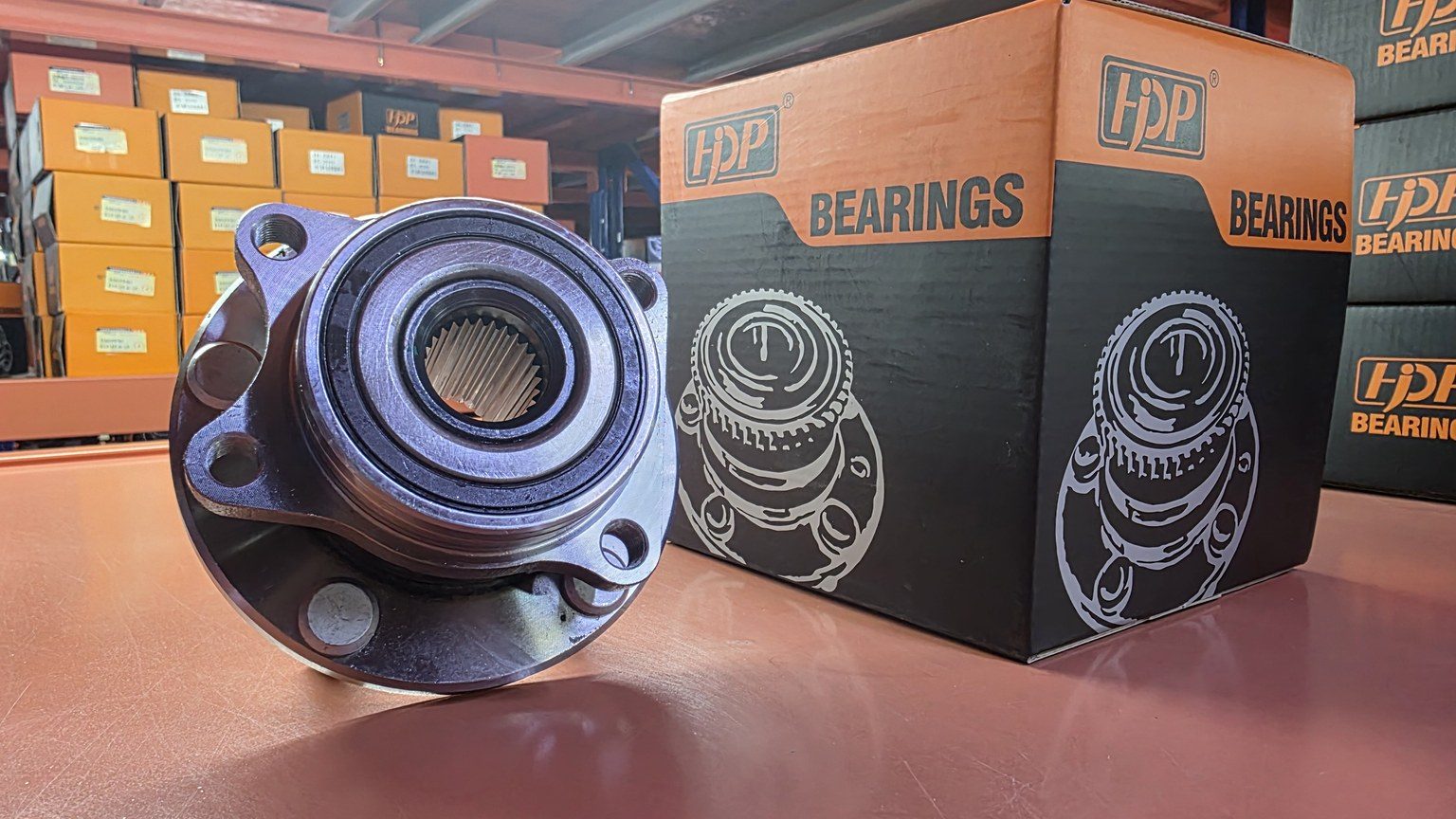
A wheel hub bearing for CHEVROLET CAMARO is a sealed, unitized double-row bearing with an integral flange, pressed wheel studs and, on ABS-equipped cars, a magnetic encoder ring built into the seal. It is installed as one non-serviceable assembly, carries the corner weight plus cornering and braking loads, and locates both the brake disc and the wheel. On a rear-wheel-drive layout the front corners use a non-driven flanged hub with a plain bore, while the rear corners use a splined hub that accepts the halfshaft. Exact fitment is confirmed by drawing and sample, not by model name alone.
What the assembly is actually made of
The part is easier to buy once you can name its components. A typical Camaro-type hub unit contains an outer ring with an integral flange that carries the wheel studs and centres the brake disc; two inner rings in a double-row angular contact arrangement; a ball or roller complement with a cage in each row; a preload set at the factory; lifetime grease; an inboard and an outboard seal, one of which may carry the encoder; and the bolt holes in the housing that fix the unit to the knuckle or axle carrier. Everything except the studs and the sensor connector is non-serviceable by design.
Which loads it has to survive
Three load paths meet at the hub: vertical load from the vehicle mass, lateral load from cornering, and longitudinal load from braking and, at the rear, from drive torque. Because the wheel centre plane sits outboard of the bearing centre line, those forces also generate a tilting moment that the two rows must share. On a performance car with wide tyres and stiff suspension, the lateral and moment components are large relative to the vertical load, which is why flange stiffness, row spacing and preload quality matter more than a headline static load rating.
Front and rear are not the same part
On a rear-wheel-drive platform the front hubs are non-driven: the unit is a flanged hub with a plain bore, and its only rotating input comes from the wheel. The rear hubs are driven: the unit has a splined bore for the halfshaft and is retained by an axle nut. The two look similar in a product photo and behave completely differently in service, which is why a front/rear mix-up is one of the most common ordering errors in this category. The difference between a wheel bearing and a complete hub assembly explains why the assembly, not the bare bearing, is the replaceable unit on this design.
Which Hub Unit Generation and Bearing Type Applies to a Camaro?
ABS-equipped Camaro applications use third-generation hub units, while first- and second-generation designs belong to older or lighter vehicles and are not interchangeable with them. The generation tells you how the part mounts, whether anything can be serviced, and what tooling the workshop needs before the car goes on the lift.
First, second and third generation in plain terms
A first-generation hub bearing is a double-row angular contact bearing with two inner rings and no flange of its own. It is pressed into the knuckle or carrier, retained by a nut or circlip, and sealed separately. A second-generation unit adds a flange to the outer ring so the bearing can be bolted to the knuckle or brake carrier, but the bearing function and the hub function remain partly separate. A third-generation unit integrates flange, rows, seals, encoder and studs into one sealed cartridge that bolts to the knuckle with three or four bolts and is replaced as a whole. The third generation is what most workshops mean when they say hub assembly.
Ball, tapered roller or cylindrical roller
Passenger-car hub units of this type normally use double-row angular contact ball bearings, because they combine low drag with enough capacity for a car's corner loads and tolerate sustained motorway speeds. Double-row tapered roller bearings carry more load and are common on heavier vehicles, pickups and trailer axles, but they require a defined preload and are less forgiving of misassembly. Cylindrical roller bearings carry high radial load but need a separate means of axial location, so they appear in specific commercial-vehicle positions rather than as a bolt-on passenger-car hub. For a Camaro-class car the ball-type third-generation unit is the normal architecture; the exact internal arrangement is confirmed from the drawing.
| Configuration | How it mounts | Serviceable on the car | Where it is normally found | Fitting implication |
|---|---|---|---|---|
| First-generation double-row bearing | Pressed into the knuckle or carrier, retained by a nut or circlip | Bearing element only | Older passenger cars, some light commercial | Needs a press and separate seals; preload set by the retaining nut |
| Second-generation flanged bearing | Outer-ring flange bolted to the knuckle or brake carrier | Bearing cartridge only | Passenger cars and light SUVs | Bolted, but the hub spindle may stay on the vehicle |
| Third-generation hub unit | Housing flange bolted to the knuckle with three or four bolts | Not serviceable | Most ABS-equipped passenger cars, including Camaro-type applications | Replace complete; no press and no preload adjustment |
| Double-row tapered hub | Bolted flange or pressed, depending on design | Not serviceable | Pickups, heavier vehicles, trailer axles | Higher capacity, stricter preload and lubrication control |
Why the generation changes what you order
The mounting method decides whether the workshop needs a press, whether the axle nut is a torque-retaining fastener, and whether the ABS sensor is bolted to the knuckle or clipped to the unit. A quotation that offers a hub bearing for a Camaro without asking for the mounting configuration, the sensor arrangement and the flange offset is guessing at the interface. A structured selection guide for wheel bearings and hub assemblies sets out the sequence of questions that narrows the reference safely.
How Do Material, Heat Treatment, Precision and Clearance Decide Whether Two Hubs Are Equal?
Two hub units that share identical flange geometry can still differ completely in raceway steel, heat treatment, tolerance class, preload and seal quality, and those are the variables that decide service life. Buyers who compare only dimensions and price are comparing the least important half of the specification.
Bearing steel and heat treatment
Races and rolling elements are normally made from through-hardening bearing steel of the GCr15 / 100Cr6 family, hardened and tempered to roughly 58 to 62 HRC, with controlled carbide size and retained austenite. Flanges are usually forged or cold-formed from low- or medium-carbon steel, sometimes induction hardened at the stud seats and seal journals. Studs are commonly grade 10.9 or similar and are pressed and knurled into the flange. A buyer cannot judge any of this by eye, which is why hardness traverse, case depth where hardening is specified, and metallurgical structure belong in the purchase specification rather than in a verbal assurance.
Precision grade and runout
Tolerance classes follow ISO 492, broadly comparable to the ABEC scale. P0 or P6 is normal for automotive hub units; P5 appears where higher speed or lower noise is demanded. What matters most at the wheel is lateral and radial runout of the flange face, because that runout is transmitted to the brake disc and reappears as pedal pulsation or disc thickness variation. A hub inside its grade but with poor flange-face runout will produce a comeback even when the bearing rows themselves are perfect.
Clearance, preload and why hubs are not rebuilt
In a third-generation unit the preload is set during assembly by grinding the inner rings to a matched width, so both rows are loaded correctly for life. There is no adjustment on the car and no legitimate way to re-shim it. That is why re-greasing or re-setting a sealed hub is not a repair. In tapered roller designs the preload is set by the axle nut or a shim and must follow the OEM procedure exactly, since too little preload allows the rollers to skid and too much overheats the assembly.
| Parameter | What it controls | How it is usually specified | What the buyer should confirm |
|---|---|---|---|
| Flange face runout | Brake disc lateral runout and pedal feel | Microns, measured on a mandrel | Measured on the sample, not only stated on a certificate |
| Bore and spigot diameters | Fit, squareness and clamp load on the knuckle | Diameter with tolerance, plus roundness | Gauge the arrival sample against the drawing |
| Stud pattern and thread | Wheel fixing and nut engagement | Pitch circle, thread size, knurl diameter, stud length | Check against the wheel and nut, never against a photo |
| Flange offset | Wheel position and brake clearance | Millimetres from the mounting face | Confirm on the vehicle or against the OE reference |
| Clearance or preload | Noise, heat and fatigue life | Set at assembly, not adjustable in service | Ask how it is set and how it is verified per lot |
| Encoder pole count and air gap | ABS signal quality, especially at low speed | Poles per revolution and gap in millimetres | Confirm compatibility with the sensor on the car |
| Seal construction | Resistance to water, salt and grit | Lip geometry, elastomer, excluder design | Inspect a sectioned sample where available |
How Do Seals, Encoders and Grease Set the Real Service Life?
On passenger-car hub units, sealing quality decides service life more often than load rating does, because most premature failures begin with water or road-salt ingress rather than with simple overload. Grease and encoder design follow the same logic: they are functional parts, not finishing details.
Seal architecture
The outboard seal faces the wheel and takes direct water, salt and grit; the inboard seal faces the knuckle and sees a milder environment. A durable unit uses a contact lip with a garter spring, an additional excluder lip, and a grease-retention lip, running on a ground journal rather than a raw turned surface. Cassette and labyrinth designs add a metal shield that throws off water before it reaches the lip. Two seals that look alike from outside can differ by several times in contamination resistance, and that difference only shows up after a winter of road salt.
The encoder is a working component
On ABS cars the inboard seal carries a magnetised rubber ring with alternating poles. The wheel-speed sensor reads that ring across a small air gap, so pole count, magnetisation strength and ring runout determine signal quality at crawling speed. A hub with the wrong pole count or a distorted ring will set an ABS warning even though the bearing is mechanically perfect, and no diagnostic procedure will correct it because the part itself is wrong. How OE numbers, fitment and ABS hubs interact is worth reading before cross-referencing a reference that was never intended for the car.
Grease and fill quantity
Hub units are greased for life, typically with lithium-complex or polyurea thickeners chosen for the seal elastomer and the operating temperature. Fill is a defined percentage of free space: too little starves the loaded row, too much churns and raises running temperature. A buyer cannot verify grease chemistry from the outside, so process control at the supplier, and the recorded fill weight per unit, are the real assurance.
What Are the Common Failure Modes and How Do You Confirm Them?
Hub unit failures fall into four groups: raceway fatigue, lubricant or seal breakdown, mechanical damage from fitting, and encoder or sensor faults, and each leaves a different signature. Matching the symptom to the group prevents replacing a good hub for a brake or wiring problem.
Raceway fatigue usually starts as a hum or growl that rises with road speed and changes when the car is loaded side to side in a bend. Off the car, the same defect feels like roughness or a notchy point when the flange is rotated slowly by hand. Water ingress produces a dirtier picture: grease weeping past the inboard lip, rust staining on the seal journal, and a rumble that appears long before measurable play.
Fitting damage is often mistaken for a manufacturing fault. Pressing on the flange the wrong way, hammering a unit into a dirty bore, or reusing a stretched axle nut can brinell the raceways within the first few hundred kilometres, and the resulting noise sounds exactly like a worn bearing. Encoder faults are the easiest to misdiagnose, because the hub is silent and only the ABS lamp complains. Telling a failing wheel hub bearing apart from other noises gives a longer symptom list for workshop use.
| Symptom | Most likely cause | How to confirm |
|---|---|---|
| Hum or growl rising with road speed | Raceway spalling or false brinelling | Road test with load transfer left and right, then rotate the hub off the car and feel for roughness |
| Play at the wheel | Worn rows, loose axle nut or damaged knuckle bore | Check nut torque first, then measure flange movement with a dial gauge |
| ABS lamp with no bearing noise | Damaged encoder ring, wrong pole count, incorrect air gap | Compare live wheel speeds on a road test and inspect the ring for distortion |
| Grease weeping at the inboard seal | Lip wear or pressure build-up from a blocked breather | Clean the area and recheck after a road test before condemning the hub |
| Brake pedal pulsation | Flange face runout rather than the bearing rows | Measure disc runout and hub face runout separately |
How Do You Read a Hub Unit Drawing Before You Approve a Sample?
A hub drawing is read in a fixed order, interface dimensions first, then bearing internals, then seals and encoder, then markings and packaging, because an error in the first group cannot be corrected by anything later in the chain. Reading it in that sequence also makes a sample approval decision traceable.
- Mounting interface first. Bolt hole count, pitch circle, hole diameter and flange thickness decide whether the unit sits square on the knuckle. A fraction of a millimetre here becomes runout at the disc.
- Wheel interface second. Stud count, thread, knurl diameter, stud length and flange offset. Compare with the wheel and nut actually used in the field, not with a photograph of a similar part.
- Bearing internals third. Row arrangement, ball or roller size, contact angle, preload or clearance range, steel grade and hardness specification. This is the part of the drawing that cannot be verified by eye on a finished unit.
- Seals and encoder fourth. Lip geometry, elastomer, excluder design, encoder pole count, orientation and the air gap the sensor expects.
- Markings and packaging fifth. Where the reference is laser-marked, what appears on the carton, and whose label is used. Private-label programmes are decided at this step.
- Validation items last. The runout, torque, leak and signal checks the supplier performs, and the records that travel with each lot.
Jinan Huayuan Bearing Co., Ltd., trading as huayuanbearing.com, develops hub units, tensioners and CV joint components from drawings and samples, and supports custom packaging and private-label programmes for aftermarket and OE supply, mainly for buyers in the Middle East and Southeast Asia. The same drawing discipline applies in every case: the interface is agreed on paper before a sample is cut. An RFQ checklist for wheel hub bearings lists the fields that prevent a quotation round-trip. Reference listings such as this front wheel hub assembly reference for Chevrolet applications show the format of a finished unit, and a Camaro wheel hub assembly reference list is useful for orientation, but neither substitutes for confirming the reference against your own OE data and a physical sample.
How Should a Camaro Hub Unit Be Installed and Inspected on Arrival?
Incoming inspection and installation discipline catch different failures: inspection catches a wrong or damaged part before it is fitted, and correct fitting prevents a good part from being destroyed in the first hundred kilometres. Both belong in the same procedure.
Fitting sequence that protects the bearing
- Clean the knuckle mating face and bore. Rust or debris on the face tilts the unit and reappears as disc runout.
- Offer the new unit to the knuckle before fitting and check bolt holes, spigot diameter and sensor position.
- Fit the unit dry, without grease or anti-seize on the mating faces unless the workshop manual states otherwise, and torque the mounting bolts in the specified sequence.
- Use a new axle nut on driven hubs; it is a torque-retaining fastener and is not reused.
- Apply force only where the design intends it, through the flange or the inner ring, never through the rolling elements or the seal.
- Reconnect the wheel-speed sensor, route the harness clear of the disc, and check for a signal before the wheel goes back on.
- Torque the wheel fasteners with the vehicle on the ground, then road test for noise and for warning lights.
What to check when the carton arrives
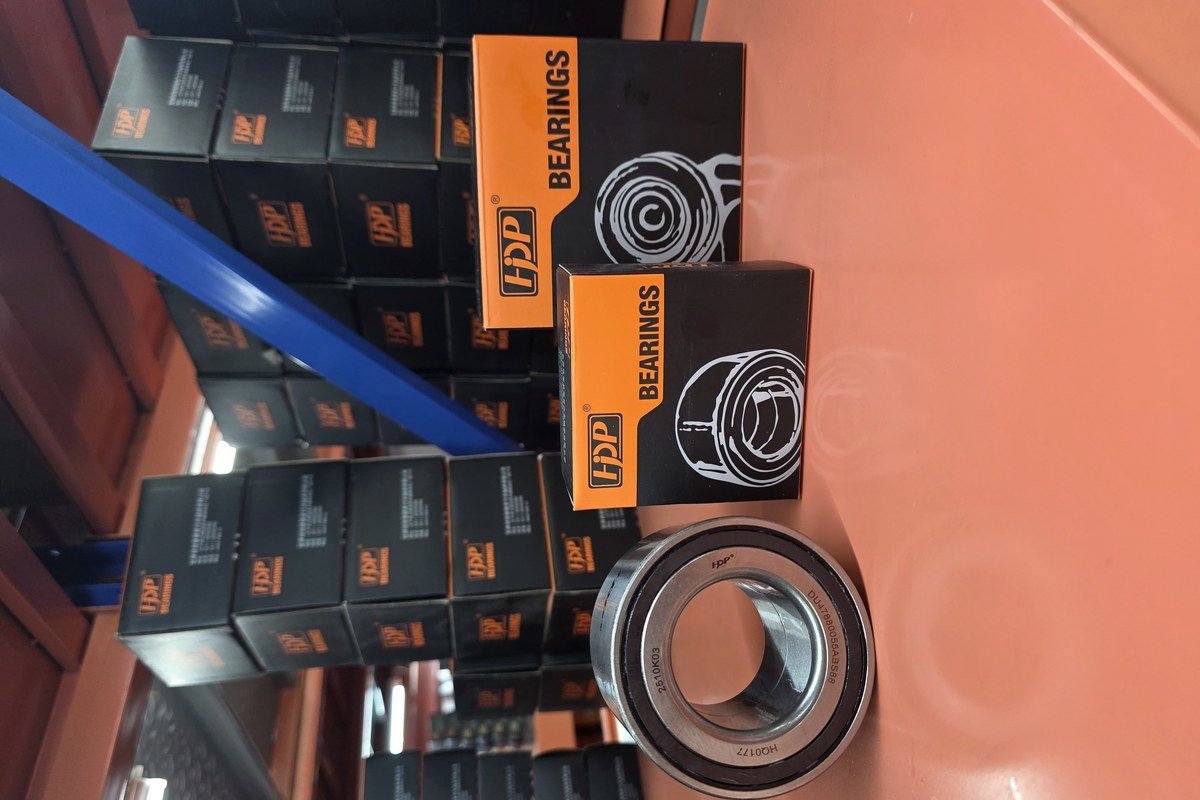
- Carton condition, label reference, quantity and private-label artwork against the purchase order.
- Flange face, stud threads and seal lips free from handling damage.
- Interface dimensions from the drawing measured on a sample per lot, not on a single unit from the first carton.
- Rotational feel: light, even drag with no notch or roughness at any angle.
- Flange face runout on a mandrel where the fixture exists.
- Encoder output on a bench check where test equipment is available.
A unit that passes all six is a unit worth fitting. A unit that fails any of them should be quarantined before it reaches a vehicle, because the cost of a comeback is always higher than the cost of a rejected carton.
Frequently Asked Questions
Is the front hub unit on a Camaro the same as the rear?
No. On a rear-wheel-drive car the front unit is non-driven and has a plain bore, while the rear unit has a splined bore for the halfshaft and is retained by an axle nut. Dimensions, flange offset and sensor position also differ. Confirm both references separately by drawing and sample rather than assuming a symmetric set.
Can the bearing be replaced without replacing the whole hub?
On a third-generation hub unit, no. The rows, seals, encoder and flange are a single sealed cartridge with preload set at assembly, so there is nothing to press out or re-shim. First- and second-generation designs allow partial replacement, but only with the correct press tooling and the specified preload procedure.
How long should a hub unit last?
There is no defensible fixed figure. Life depends on road surface, wheel offset and tyre width, water and salt exposure, brake heat and fitting quality. The practical measure is condition, not distance: roughness when rotated, measurable play, seal leakage or an ABS signal fault all justify replacement regardless of mileage.
What information is needed for an accurate quotation?
A drawing or a physical sample, the vehicle or OE reference you are matching, expected annual quantity, packaging and labelling requirements, and any dimensional or runout limits you intend to inspect against. With those, a supplier can quote a defined part; without them, any quotation is an estimate for something close to it.
Purchasing guidance, product information and company updates from Huayuan Bearing.