
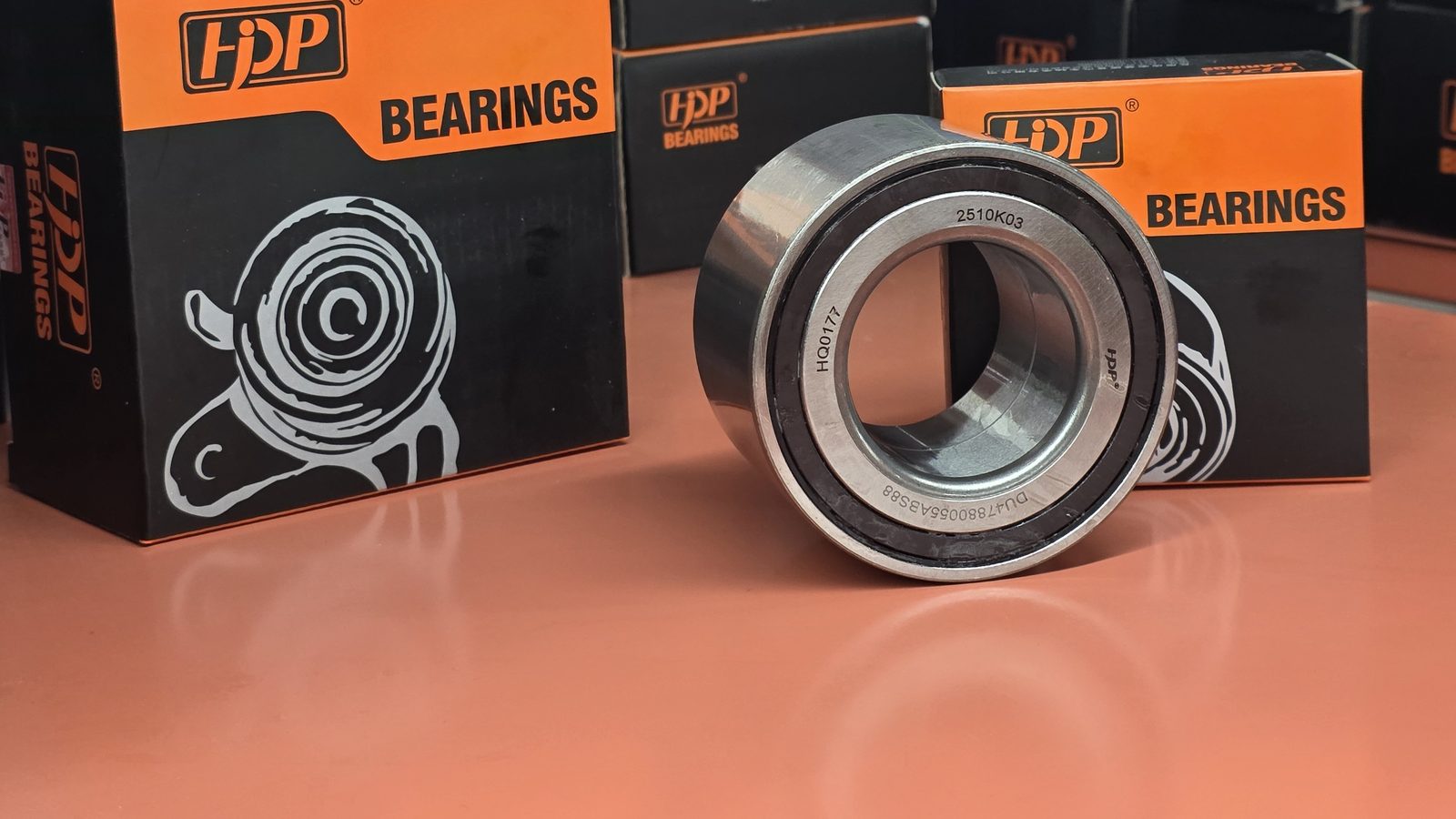
A cylindrical roller bearing is a radial rolling bearing whose rolling elements are cylinders, giving line contact between roller and raceway and therefore a high radial load capacity at moderate speed. It normally carries radial load only; variants such as NJ and NUP also locate the shaft axially in one or both directions. Buyers specify them by design variant, dimension series, bore, radial internal clearance, cage and tolerance grade. Jinan Huayuan Bearing Co., Ltd. (huayuanbearing.com) manufactures and exports wheel-end and chassis components from Jinan, Shandong, and develops parts against drawings and samples.
What Is a Cylindrical Roller Bearing and Where Is It Used?
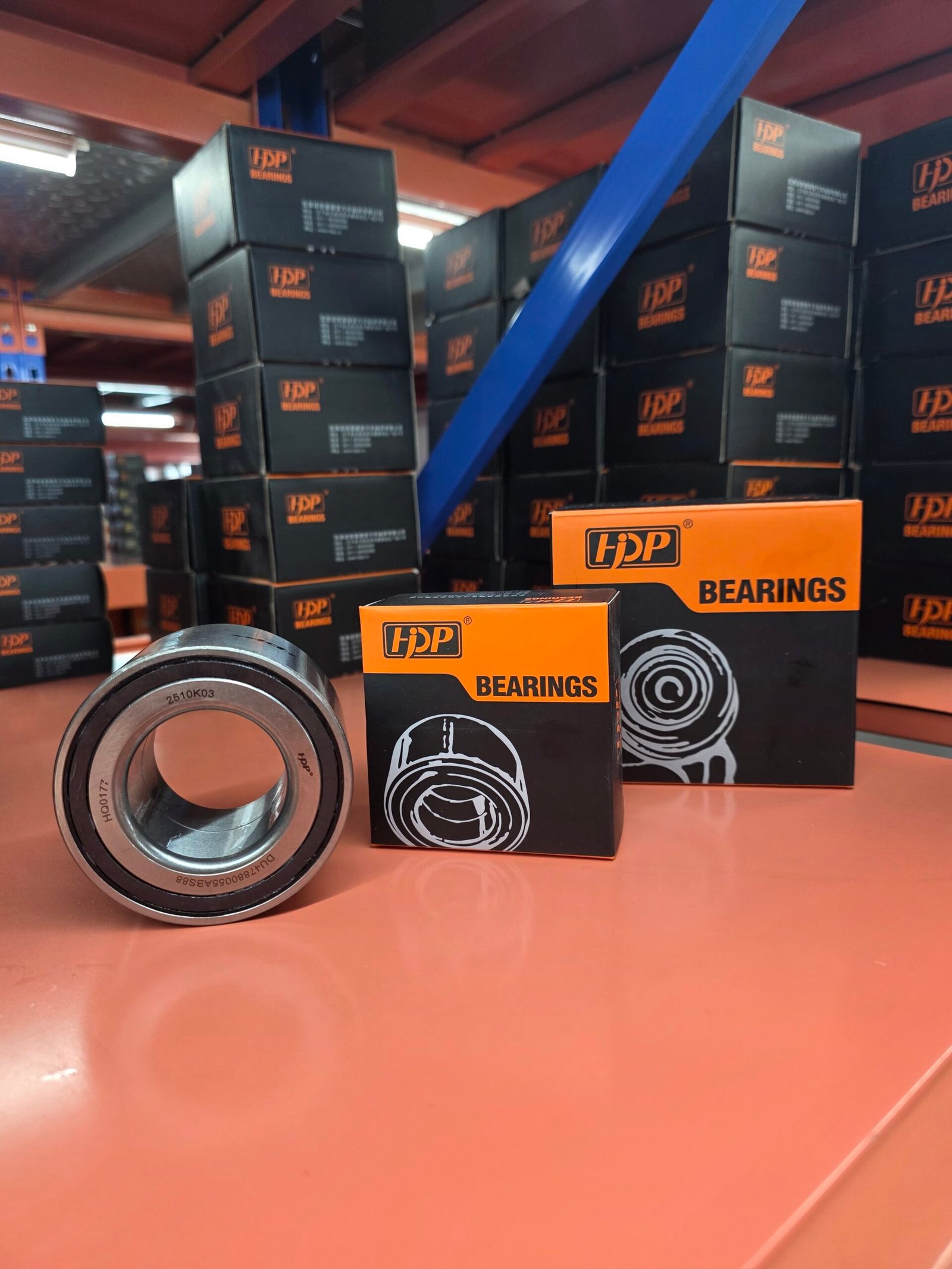
The defining feature of a cylindrical roller bearing is contact geometry: hardened steel cylinders roll between two raceways, and every contact between roller and raceway is a line rather than a point. That single fact explains most of what a buyer cares about - high radial load capacity for the envelope, high radial stiffness, and greater sensitivity to misalignment than a ball bearing of the same size.
The rollers are guided by ribs, also called flanges or shoulders, on the inner ring, the outer ring, or both. Which ring carries the ribs decides whether the shaft can move axially inside the bearing, and that is why identical boundary dimensions are sold in several different designs. A buyer who orders by size alone can receive a bearing that fits the housing but cannot do what the shaft arrangement requires.
How line contact changes capacity, stiffness and alignment tolerance
Line contact spreads load over a longer path than point contact, so a cylindrical roller bearing carries far more radial load than a ball bearing of the same bore and outside diameter, and it deflects less under that load. The trade-off is edge stress: if shaft and housing are not aligned, the roller ends take the load instead of the middle. Rollers with a crowned or logarithmic profile reduce that effect but do not remove it, so these bearings are mounted in arrangements that hold alignment well and are not the first choice where a long, flexible shaft deflects heavily between supports.
Where cylindrical roller bearings appear on a vehicle
In automotive and light commercial applications, cylindrical roller bearings appear mainly in rotating positions that carry heavy radial load with little or no thrust: gearbox and transmission shafts, differential and final drive pinions, transfer cases, electric drive unit rotors, and certain heavy-duty wheel-end positions. On the industrial side they are standard in gearboxes, electric motors, pumps, crushers, rolling mills and precision machine tool spindles, where the double-row NN and NNU designs are used.
Faults in these positions rarely announce themselves as a bearing problem. Radial play, cage wear and lubrication breakdown show up first as noise or vibration, and at the wheel end the same symptom can come from the hub rather than the bearing under investigation. The sequence in this wheel-end noise diagnosis guide is a sensible cross-check before a transmission is opened. Bore and dimension series are set out on the cylindrical roller bearing product page at huayuanbearing.com, which is a useful starting point before a drawing is exchanged.
How Do the Main Cylindrical Roller Bearing Designs Differ?

The design variant of a cylindrical roller bearing is defined by where the ribs sit, and the rib arrangement alone decides whether the bearing can take axial load and in which direction. Two bearings with identical bore, outside diameter and width can behave completely differently in a shaft arrangement because of that one detail.
| Design | Rib arrangement | Axial capability | Typical position |
|---|---|---|---|
| N | Two ribs on the inner ring; outer ring without ribs | Inner ring free to move axially in both directions; no axial load | Floating position where the shaft must be free to expand |
| NU | Two ribs on the outer ring; inner ring without ribs | Inner ring free to move axially in both directions; no axial load | The usual floating bearing in gearboxes and electric motors |
| NJ | One rib on the inner ring; two ribs on the outer ring | Locates the shaft in one direction; limited axial load | Locating position, often paired with an NU or N bearing |
| NUP | NJ arrangement plus a loose inner-ring rib | Locates in both directions; limited axial load | Single bearing that has to do the locating job alone |
| NF | Two ribs on the inner ring; one rib on the outer ring | Locates in one direction, mirroring the NJ | Specific gearbox and industrial arrangements |
| Full complement | Cage removed; maximum number of rollers | Usually radial only; depends on the rib design | Very high radial load at reduced speed |
Single-row, double-row and full-complement versions
Single-row designs such as NU, NJ and NUP cover the majority of gearbox, motor and driveline positions. Double-row designs such as NN and NNU pack two rows of rollers into the same bore, which raises radial capacity and running accuracy and suits machine tool spindles and similar precision work. Full-complement bearings drop the cage so more rollers fit into the ring space; radial capacity rises further, but the limiting speed falls and lubrication and filtration become far more critical. Choosing between them depends on the position, not on a ranking of designs.
Why the rib arrangement decides axial location
Most shaft arrangements follow one rule: one bearing locates the shaft and the other floats. A floating bearing has to allow the inner ring to slide relative to the outer ring as the shaft lengthens with heat, and N and NU designs do exactly that because the ring without ribs lets the rollers travel along the raceway. A locating bearing has to stop that movement, which is the job of NJ, NF and NUP designs, with NUP locating in both directions. Fitting two locating bearings to one shaft usually ends in axial preload, high running temperature and early failure, so the pairing matters as much as the individual part number.
How Do You Read a Cylindrical Roller Bearing Part Number?
A cylindrical roller bearing designation is read in three blocks - design variant, dimension series and bore code - followed by suffixes that describe cage, clearance, tolerance and special features. Reading the blocks in order is what prevents a wrong part number being quoted.
Take NU 210 C3. NU is the design variant, with ribs on the outer ring and a free inner ring. The 2 belongs to the dimension series for the outside diameter, the 10 is the bore code, and the bore code multiplied by five gives the bore in millimetres: 10 x 5 = 50 mm. C3 is a radial internal clearance group larger than Normal. Bore codes 00, 01, 02 and 03 are the four exceptions to the multiplication rule and stand for 10 mm, 12 mm, 15 mm and 17 mm.
Extra digits indicate a different ring section, not simply a wider version of the same item. A designation in series 22 or 23 is not interchangeable in a housing with the plain series for the same bore, because boundary dimensions differ. The same caution applies to double-row and precision variants. Boundary dimensions, chamfer dimensions and the rib arrangement should always be confirmed against a catalogue drawing or a customer drawing rather than inferred from the designation alone.
Suffixes for cage, clearance, tolerance and special features
Suffixes are where ordering errors concentrate. Common examples include M or MB for a machined brass cage, J or TV for a pressed steel cage, TVP for a glass-fibre reinforced polyamide cage, C3 and C4 for increased radial internal clearance, and letter combinations for higher tolerance grades. One widely used suffix, W33, indicates a lubrication groove and three oil holes in the outer ring. Because suffix conventions are not fully standardised between manufacturers, a designation copied from one brand does not transfer automatically to another. The safe practice is to quote the designation together with full boundary dimensions and the clearance group, and to confirm the rest against drawings and samples.
Which Bearing Type Fits the Job: Cylindrical, Tapered or Ball?
Choose a cylindrical roller bearing when the load is mostly radial and heavy, the shaft is well aligned and the position can be allowed to float; choose a tapered roller bearing when the position must carry combined radial and axial load; choose a deep groove ball bearing when loads are light and speed is high. The three overlap less than buyers expect once load direction and alignment are written down.
| Feature | Cylindrical roller | Tapered roller | Deep groove ball | Spherical roller |
|---|---|---|---|---|
| Rolling element and contact | Cylinder, line contact | Truncated cone, line contact | Ball, point contact | Barrel roller, line contact |
| Radial load capacity | Very high | High | Moderate | Very high |
| Axial load capacity | None, or limited to one or both directions depending on rib design | High in one direction per row; sets are adjusted against each other | Limited, in both directions | Limited, in both directions |
| Misalignment tolerance | Low | Low | Moderate | High, self-aligning |
| Friction and speed potential | Low friction; higher speed than tapered designs | Higher friction; speed limited by preload and heat | Low friction; highest speed of the four | Moderate |
| Typical automotive use | Gearbox and motor shaft positions, driveline | Wheel ends, differential pinions, final drive | Auxiliary drives, small motors, light accessories | Heavy industrial and commercial vehicle equipment |
Tapered and cylindrical designs are often confused because both use rollers. The difference lies in the geometry of the rolling element and in what each does about thrust: a tapered roller generates an axial force component that must be resisted, which is why tapered sets are adjusted against each other, while a cylindrical roller stays neutral about thrust unless its ribs are designed to accept some. The choice is set out in more detail in this comparison of tapered versus cylindrical roller bearings.
When a cylindrical roller bearing is the wrong choice
Do not specify a cylindrical roller bearing if the position must carry thrust on its own, if the shaft is flexible enough to misalign under load, if the housing is a thin-walled casting that deforms, or if the machine has to be assembled with the simplest possible mounting procedure. In those cases a tapered or self-aligning design saves more money over the life of the machine than extra radial capacity ever returns. It is also worth checking whether the part is a separable bearing at all, because a sealed hub unit or a pressed assembly is normally replaced as a complete unit rather than as individual bearings.
Two questions settle most of these cases. Is the dominant load radial, or combined radial and axial? Is the shaft rigid and well supported, or long and flexible? If the load is radial and the shaft is stiff, a cylindrical roller bearing usually gives the longest life for a given envelope. If either answer goes the other way, a tapered or self-aligning design is normally the less expensive solution over the life of the assembly.
Which Clearance, Cage and Tolerance Should You Specify?
Clearance, cage and tolerance are the three specification choices most often left blank on a purchase order, and the three that most often cause a complaint. All three belong on the order, because the clearance that matters is the clearance left when the bearing is fitted and hot, not the clearance measured in the box.
Radial internal clearance: CN, C3 and C4
| Clearance group | Relative clearance | Condition it suits | Main risk if wrong |
|---|---|---|---|
| C2 | Smaller than Normal | Light load, low speed, low temperature rise, minimum running noise | Preload and overheating when fits or temperature are underestimated |
| CN (Normal) | Baseline | General purpose; moderate fits and moderate temperature difference between rings | Clearance loss when both rings are a tight fit |
| C3 | Larger than Normal | Interference fits on both rings, or inner ring significantly hotter than outer ring | Looser, noisier running than the application required |
| C4 | Larger than C3 | Heavy interference fits, high thermal gradient, hot-running positions | Increased vibration and reduced roller guiding accuracy |
Two effects reduce internal clearance after mounting. A press fit on the inner ring stretches it and consumes clearance, while a press fit on the outer ring compresses it. Heat makes the effect worse: if the shaft runs hotter than the housing, the inner ring expands more than the outer ring and clearance falls further. If both rings are fitted with interference, a Normal clearance that looks generous on the bench can reach zero in service, and the bearing then runs hot, becomes noisy and fails early. That is the normal reason a C3 or C4 group is specified, and also the reason clearance should not be changed without knowing the fits and the temperature gradient.
Cage material, temperature and limiting speed
Cages keep the rollers evenly spaced and guide them around the raceway. Pressed steel cages are the general-purpose default and suit most aftermarket and OE positions. Machined brass or bronze cages resist higher temperatures and heavier duty cycles and are common in larger sizes and industrial applications. Polyamide cages are light and quiet at moderate temperatures but are less tolerant of high heat and certain lubricants, and full-complement designs have no cage at all. Cage design is part of the internal geometry, so a cage from one brand cannot be assumed to fit the rings of another.
Tolerance grade against cost
Tolerance grade controls bore and outside diameter variation, running accuracy and permissible runout of the assembled bearing. The normal class covers the great majority of replacement and general industrial work. Higher precision grades are needed where the bearing itself sets shaft position or where vibration limits are tight, as in spindle and electric drive applications. Each step up in grade increases manufacturing cost, so the grade should come from the application requirement rather than from habit or from a competitor listing it.
How Do You Qualify a Cylindrical Roller Bearing Supplier?
Qualify a cylindrical roller bearing supplier on documentation and reproducibility rather than on price alone: ask for the drawing, the clearance group, the cage material and an inspection record, then verify a physical sample before committing to a volume order. Five steps cover most of the risk.
- Write the requirement down. Give the designation, boundary dimensions, design variant, clearance group, cage, tolerance class, lubricant or preservative, marking and packaging, plus the operating conditions: speed, load direction, temperature and the intended fits on shaft and housing.
- Ask how the item will be made, not only what it costs. A supplier that can only repeat a catalogue number is passing the requirement to someone else. A supplier that can develop against a drawing or a sample can confirm the rib arrangement, chamfer and clearance before production starts, which is where most misunderstandings originate.
- Request documentation for the actual lot. A dimensional report, a clearance measurement, the cage material and the marking on the bearing are the minimum set. The questions in this supplier audit checklist for wheel hub bearings apply to any rolling bearing programme, not only to hubs.
- Inspect a sample before volume supply. Measure bore, outside diameter and width, check that the clearance group matches the order, rotate the bearing by hand for roughness and cage rattle, and confirm marking and packaging. The incoming routine in this bearing inspection sequence can be run on a normal goods-in bench.
- Agree the reference mapping separately. An OE number, a competitor designation and an internal number are three different references. Ask for the mapping in writing, confirm supersessions before the first shipment, and treat every cross-reference as provisional until drawings and samples agree.
Repeat the sample check whenever a process changes. A different heat treatment batch, a different cage source or a reground raceway can shift clearance, noise and life even when the drawing is unchanged, and a one-off approval does not carry over automatically.
Where Does Jinan Huayuan Bearing Fit in a Cylindrical Roller Bearing Programme?
Jinan Huayuan Bearing Co., Ltd. is a bearing manufacturing and export company based in Jinan, Shandong, focused on wheel-end and chassis components for the automotive aftermarket and for OE supply, and able to develop parts against drawings and samples.
The main product lines are automotive wheel hub bearings, hub units, tensioners and constant velocity (CV) joint components - the parts that carry vehicle weight, steer the vehicle and transmit drive at the wheel end. Cylindrical roller bearings sit in the same family of rolling bearings and raise the same buying questions: design variant, dimension series, bore, clearance, cage, tolerance and packaging. Huayuan Bearing serves overseas buyers, with the Middle East and Southeast Asia as its main markets, alongside other regions.
- Automotive wheel hub bearings and hub units
- Tensioners for belt drive systems
- Constant velocity (CV) joint components
- Development against drawings and samples
- Custom packaging and private label supply
Two capabilities matter most to an importer. The first is development from drawings and samples: a buyer holding a worn original part, a measured sample or an OEM drawing can ask for a comparable part rather than accept whatever item happens to be in a catalogue. The second is custom packaging and private label supply: bearings and hub units can be packed and marked for the buyer's own brand, which matters to distributors who sell under their own name rather than the manufacturer's.
Every technical detail is confirmed against drawings and samples before supply, and the same rule applies to cylindrical roller bearings: designation, rib arrangement, clearance group and marking are agreed from a drawing or a physical sample rather than from a description in a message. Product pages are published in several languages, and an importer whose buying team is split across markets may find the Vietnamese version of the cylindrical roller bearing page or the Indonesian version easier to circulate internally.
Commercial and compliance details - the capacity available for a given order, the delivery schedule, and the quality documents a buyer's own system requires - are agreed per order and per market. Importers should request those documents directly and validate them before placing a volume order rather than relying on a general article.
Frequently Asked Questions About Cylindrical Roller Bearings
What is the difference between NU and NJ cylindrical roller bearings?
In an NU bearing the ribs are on the outer ring and the inner ring is free, so it can move axially in both directions and the bearing carries radial load only. In an NJ bearing the inner ring also has one rib, so it locates the shaft in one direction and takes limited axial load. NU is therefore the usual floating bearing and NJ a locating bearing. Confirm the rib arrangement on the drawing or sample.
Can a cylindrical roller bearing carry axial load?
Only to a limited extent, and only in specific designs. The plain N and NU variants carry no axial load at all; NJ, NF and NUP designs accept limited thrust in one or both directions because of their ribs. Where an application needs real thrust capacity, a tapered roller bearing or a separate thrust bearing is the correct choice. Radial capacity should not be traded for axial load the design was never meant to take.
How do I cross-reference an OE cylindrical roller bearing number?
Treat every number as a reference to be verified, not as an interchange. Collect the OE number, the designation stamped on the part, the boundary dimensions (bore, outside diameter, width) and, if possible, a photo of the markings. Then ask the supplier to confirm the mapping against the drawing or sample. Manufacturers change suffixes between production runs, so a superseded number may point to the same envelope with a different cage or clearance.
What should I include in a request for a cylindrical roller bearing quotation?
Send the designation if you have it, the boundary dimensions, the design variant, the clearance group, the cage and tolerance class, the quantity, the marking and packaging requirement, and the operating conditions: speed, load direction, temperature and the fits on shaft and housing. A drawing or a clear photo of the existing part removes most ambiguity. Where the part is for a wheel end or driveline position, add the vehicle application so the surrounding assembly can be checked.
Purchasing guidance, product information and company updates from Huayuan Bearing.