
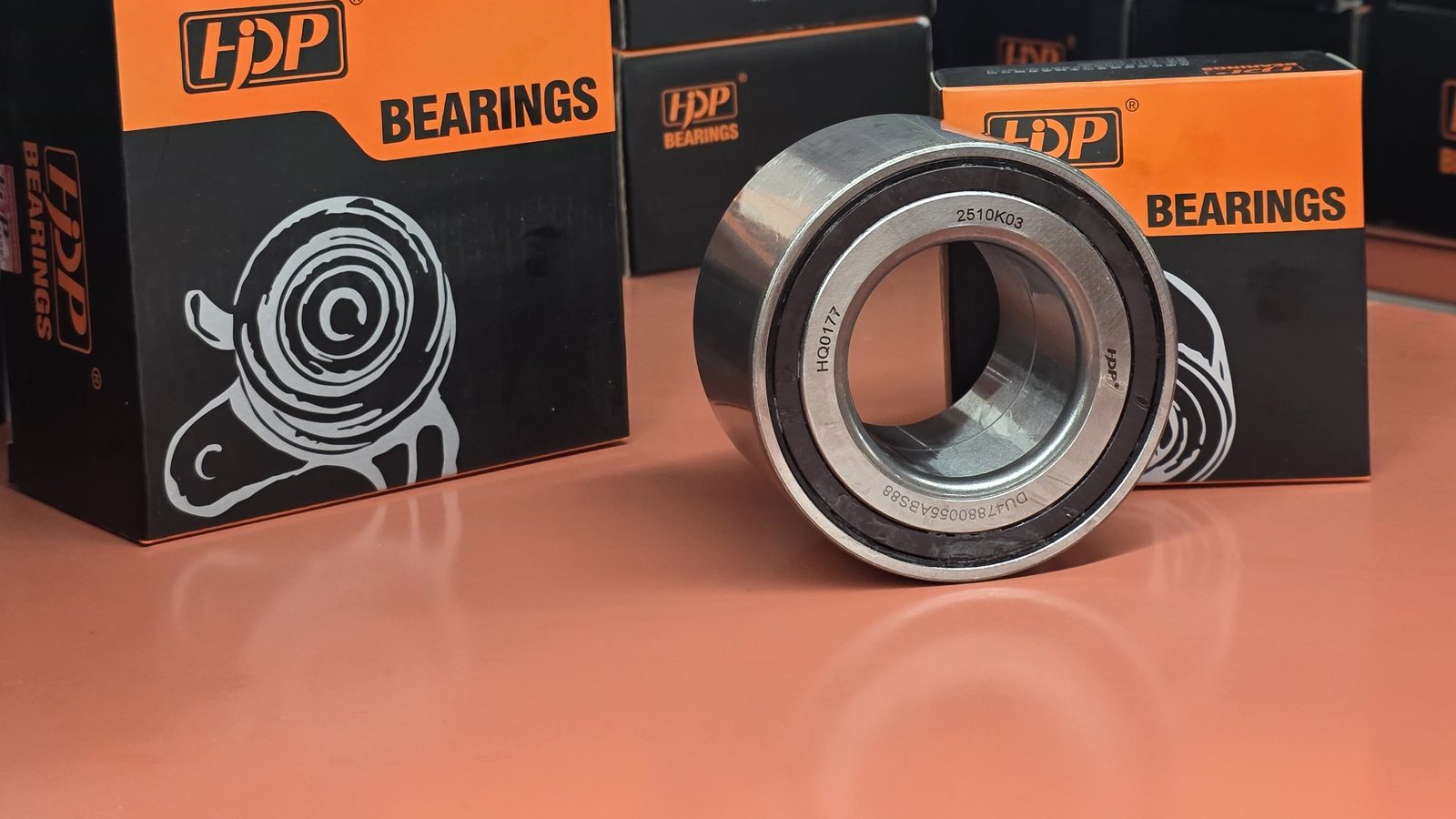
What Is a Wheel Hub Bearing ABS Sensor Ring?

A wheel hub bearing ABS sensor ring is the rotating target that an ABS (anti-lock braking system) wheel speed sensor reads to measure how fast the wheel is turning. On a wheel hub bearing or hub unit it is either a ferrous toothed ring mounted on a rotating part of the assembly or a magnetic encoder ring bonded into the bearing seal; its design, tooth or pole count, diameter and axial position have to match both the sensor and the vehicle control module, which is why it is confirmed against the drawing and sample rather than judged from a photograph.
Importers meet the same component under several trade names: reluctor ring, tone ring, pulse ring, trigger ring, encoder ring, magnetic ring and sensor ring. All of them describe a target that produces a changing signal as the wheel rotates. What differs is the material, the way the signal is generated, and the sensor technology the ring is built to work with.
Why the Speed Target Sits at the Hub
Wheel speed is measured most reliably when the target turns with the wheel and the sensor stays at a small, fixed distance from it. Building the ring into the hub bearing or hub unit keeps that gap short and shields the target behind the brake disc or drum, and in many axle designs it removes the need for a separate tone wheel elsewhere on the vehicle. The bearing then performs two jobs at once: it carries the wheel load and it provides the reference surface for the speed signal.
Passive and Active Systems Read Different Rings
A passive sensor, technically a variable-reluctance (VR) sensor, generates its own alternating voltage from a ferrous toothed ring, so the signal amplitude grows with speed and becomes unreliable at very low speed. An active sensor, either Hall effect or magnetoresistive, is powered by the control module and reads a magnetic encoder ring whose track is magnetised in alternating north and south poles; it returns a digital square-wave signal that can be read almost down to standstill. That difference is why magnetised encoder rings support functions such as electronic stability control (ESC) and low-speed ABS operation that a toothed ring on its own cannot serve.
Table 1 summarises the ring designs most often quoted on hub bearing enquiries.
| Ring design | Construction | Sensor it works with | Signal | Usual position | Confirm before ordering |
|---|---|---|---|---|---|
| Ferrous toothed tone ring | Stamped or machined steel with discrete teeth | Passive variable-reluctance sensor | AC sine wave; amplitude rises with speed | Pressed on the hub flange, hub outside diameter, or the axle and CV joint | Tooth count, ring diameter and height, tooth condition |
| Multipole magnetic encoder ring | Bonded magnet track on an elastomer or plastic carrier | Active Hall-effect or magnetoresistive sensor | Digital square wave, readable near standstill | Normally bonded into the bearing seal on the inboard side | Pole count, ring diameter, seal type, condition of the pole track |
| Encoder seal assembly | Magnetised track carried by the seal itself | Active sensor | Digital square wave | Inboard face of the hub unit | Whether the ring comes with the bearing or must be transferred from the old part |
| Loose tone ring supplied separately | Steel ring, sometimes stainless steel | Passive sensor | AC sine wave | Fitted to the hub flange or to the driveshaft and CV joint | Fit diameter, tooth count, and correct orientation towards the sensor |
How Do You Identify Which ABS Sensor Ring a Hub Bearing Uses?

Identification is a short, ordered check that starts on the vehicle side and ends with the part in your hand, because working from appearance alone is what produces wrong-part returns. The steps below cover the checks that decide whether a ring will read correctly, and every count and measurement should be confirmed against the drawing and sample.
- Start with the OE or interchange number and the sensor type. The original equipment (OE) reference narrows the assembly to a family, then two or three wires at the sensor connector separate a passive system from a powered active one.
- Look at the inboard face of the bearing or hub unit. A visible ring of teeth is a passive target. A thin, smooth, usually dark track sitting in or on the seal is a magnetic encoder ring.
- Test whether the track is magnetised. A clean steel paper clip will cling to a magnetic encoder ring and will not cling to an unmagnetised steel tone ring. Test a known part alongside the suspect one, and do not press a strong magnet onto a pole track, because that can disturb the pole pattern.
- Count the teeth or poles. The module expects a defined number of pulses per revolution, so count on the old part and compare with the new one; a mismatch can trigger a wheel speed code even when the bearing itself fits perfectly.
- Measure the ring geometry. Record outside diameter and width, then the axial distance from the ring surface to the hub mounting face or the sensor bore. That distance sets the air gap, and it is the measurement most often missed when a delivered part is compared with a drawing.
- Check whether the unit is side-specific. Some hub units differ between left and right in ring position or sensor bore angle, which is why two visually similar parts can carry different OE references.
- Record everything before the part is fitted. Photograph the ring face next to a rule, note the count and measurements, and keep the old part until the new assembly is verified. The same discipline applies when you are confirming a hub bearing by OE number for a repeat order.
What If the Ring Is Missing From the Bearing You Received?
Some bearings are supplied without a tone ring or without an encoder seal, usually in lower-cost lines. Three options exist: transfer an undamaged ring from the old part, buy the ring as a separate item, or specify the encoder version of the bearing. Transferring requires the correct press adapters and the right orientation, and heat should not be applied to a magnetised track, because both shortcuts damage the target that the sensor depends on.
Which ABS Sensor Ring Variant Should You Stock or Specify?
The correct variant follows the sensor system and the axle layout, not the price tier: match the ring technology first, then decide whether the target should be integrated into the bearing, supplied loose, or left on the axle. The hub assembly selection guide covers the same decision from the part-type angle.
Driven and Non-Driven Axles Place the Ring Differently
On a non-driven axle the target is almost always on the hub bearing or hub unit. On a driven axle the speed reference is sometimes on the outer CV (constant velocity) joint or the driveshaft instead, which means the correct bearing may have no ring at all. Ordering an encoder version just in case in that situation produces a part that cannot be read where the sensor is mounted, so the axle layout belongs in the enquiry, as set out in this comparison of a wheel bearing versus a hub assembly.
Integrated Encoder Seal or Exposed Toothed Ring?
An integrated encoder seal keeps the magnetised track inside the seal, where road debris, salt and pressure washing cannot reach it, and that protection is the main reason the design dominates newer applications. An exposed toothed ring is easy to inspect and to renew, but the teeth corrode, chip and bend, and the ring can be knocked out of true during handling. Neither design tolerates being used as a pressing surface or a striking point.
When a Loose Ring Is the Right Purchase
A separate ring suits rebuilders who are reusing a sound hub and only need to renew the target. Fit diameter, tooth count and orientation still have to be verified, and interchange from an older toothed design to a newer encoder design is not automatic. Where an OE number has been replaced several times, how supersession is managed matters more than a visual match, so it is worth checking the succession chain before committing to a large order.
Why Active and Passive Rings Cannot Be Substituted
A hub with a toothed ring will not drive an active sensor, and a hub with a magnetised encoder track will not drive a passive sensor: the first gives no switching signal, the second generates no voltage. Both errors usually appear as an ABS warning lamp and an intermittent fault rather than a mechanical failure, and both are caught during part selection rather than during diagnosis. The same logic is why ring position, pole count and left or right fit are treated as fitment data, not as options.
What to Confirm in Writing Before an Order Is Released
Table 2 lists the fields that decide whether a hub bearing with an ABS sensor ring will work on the vehicle.
| Parameter | Why it decides fit | How to confirm it |
|---|---|---|
| OE or interchange reference | Places the assembly in the correct family and reveals later supersessions | Old part marking, catalogue lookup, or the customer's vehicle identification number (VIN) data |
| Sensor technology | A passive ring cannot serve an active sensor, or the reverse | Two-wire passive sensor compared with a powered active sensor; sensor part number |
| Tooth or pole count | Sets the pulses per revolution the module expects | Count on the old part and compare with the drawing |
| Ring position and axial height | Sets the air gap between sensor tip and target | Measure from the ring surface to the hub mounting face or sensor bore |
| Left or right hand | Some units differ in ring position or sensor bore angle | Compare the old part on both sides before ordering a pair |
| Bearing or hub unit type and dimensions | Distinguishes a bearing from a complete hub assembly | Flange, stud pattern and mounting dimensions against the drawing |
| Ring included or not | Prevents a missing-component claim on arrival | State the requirement on the purchase order, not only in conversation |
| Packaging and labelling | Private-label cartons need agreed artwork and label data | Artwork, label text and carton specification approved before production |
How Should You Inspect an ABS Sensor Ring Before Installation?

A short inspection before fitting prevents the most common no-signal comebacks, because it checks the target, the air gap and the bearing play while the hub is still on the bench.
Visual and Tactile Checks
- Look for cracked, bent or missing teeth, rust scale and deep scoring on a steel tone ring.
- On a magnetic encoder track, look for a smooth, even, continuous band; dark patches, embedded steel grit or a wiped-out section mean the ring has to be replaced.
- Run a fingernail across the surface, because raised burrs change the air gap and can scrape the sensor tip.
- Check the seal that carries the track for cuts, distortion or grease weep, since contamination reaching the pole track is a signal fault waiting to happen.
Air Gap, Runout and Bearing Play
The air gap is fixed by the hub, knuckle and sensor bore, so the practical check is that a new unit places the ring at the same axial height as the old one and that the sensor seats fully in its bore. Excess bearing play tilts the ring as the wheel turns, and the result is an intermittent signal at low speed rather than a hard fault. A structured pre-installation inspection routine keeps those three checks in a fixed order so that nothing is skipped under time pressure.
Handling and Pressing Rules for Magnetised Rings
Magnetic encoder rings are damaged more often by handling than by road use. Keep units in their packaging on a non-magnetic surface rather than stacking them face to face on a steel bench, never press or hammer on the seal or the ring, and support the hub correctly so the press load travels through the intended rings. Where the ring is a separate part, use a flat adapter of the correct diameter rather than a socket that touches the teeth.
What Causes ABS Sensor Ring Problems on Wheel Hub Bearings?
Ring faults are usually mechanical or environmental, which is why the sensor often gets replaced while the real cause stays on the vehicle. Table 3 maps common workshop reports to the parts that should be checked first.
| Symptom | Likely cause at the ring or hub | Check first |
|---|---|---|
| ABS lamp on, wheel speed code for one wheel | Damaged or missing teeth, corroded tone ring, damaged encoder track | Ring surface and tooth or pole count; compare wheel speeds across all four wheels |
| Lamp appears at low speed or during turns | Bearing play tilting the ring, or an air gap outside the specified range | Bearing play and axial ring height |
| Intermittent signal or speedometer flutter | Steel debris clinging to a magnetised track, or grease passing a worn seal | Pole track condition and inboard seal |
| Fault appears in wet or dusty conditions only | Contamination entering past a damaged seal | Seal condition and housing bore |
| Fault returns shortly after sensor replacement | Ring or bearing not replaced together with the sensor | The target itself, then the bearing as an assembly |
Symptoms That Point to the Ring Rather Than the Sensor
A fault that repeats at a fixed wheel position, disappears above a certain speed, or changes with load usually points at the target rather than the wiring. If a sensor from a known-good wheel reads correctly when swapped across, the electronics are not the problem; the ring, the air gap or bearing play is.
Symptoms That Point to Bearing Wear Instead
Rumble or drone that changes with cornering load, and a speed signal that breaks up only at low speed, are typical of raceway wear rather than a damaged target, and the procedure for how to tell whether a wheel hub bearing is failing separates the acoustic complaint from the electrical one.
Cornering load, road speed and the presence or absence of a wheel speed code are the three observations that decide the next step; where the complaint is purely audible, a wheel bearing noise diagnosis sequence keeps the checks in order instead of guessing at parts.
How Does Huayuan Bearing Supply Hub Bearings With ABS Sensor Rings?
Jinan Huayuan Bearing Co., Ltd., the company behind huayuanbearing.com, is a bearing manufacturer and exporter based in Jinan, Shandong, China, working in automotive running-gear components for the replacement aftermarket and for OE supply.
The product range covers wheel hub bearings, hub units, tensioners and CV joints, including hub units that carry a magnetic encoder ring or a toothed tone ring. Where a customer needs a part outside the current range, the company develops to drawings and samples, and it supports custom packaging and private-label branding for overseas customers, mainly in the Middle East and Southeast Asia.
Because ring type, count and position are fitment data rather than preferences, a hub bearing enquiry is treated as a technical question first: the more of the part identity the buyer supplies, the fewer clarifications are needed before a part can be quoted or developed. A wheel hub bearing RFQ checklist covers the same fields from the buyer's side of the table.
What to Include in an Inquiry for a Hub Bearing With an ABS Sensor Ring
- The OE or interchange numbers, and any later supersession the customer already knows.
- Whether the vehicle uses a passive or an active wheel speed sensor.
- Tooth or pole count if it is known; where it is not known, say so rather than estimating.
- Photographs of both faces of the old part, with a rule in frame for scale.
- The side of the vehicle, and whether left and right units are identical.
- Whether the ring or encoder seal must be included with the bearing.
- Packaging, labelling and destination market requirements.
Where any number is uncertain, the drawing and sample govern, and the part is developed or verified against them rather than against a written description.
Where Huayuan Bearing Fits in a Buyer's Supply Chain
The company sits between a catalogue buyer who needs a defined reference and a buyer who needs a part built to a sample, and both conversations start with the same questions about ring type, count and position. That is why the wheel hub bearing, hub unit, tensioner and CV joint range is presented as a specification discussion rather than a catalogue shortcut, and why every reference to a model or OE number is qualified by the same rule: confirmation against the drawing and the sample.
FAQ: Wheel Hub Bearing ABS Sensor Rings
What is a wheel hub bearing ABS sensor ring?
It is the rotating target that the wheel speed sensor reads to give the ABS and stability systems a wheel speed signal. On a hub bearing it is either a ferrous toothed ring mounted on a rotating part or a magnetic encoder ring bonded into the bearing seal. Its type, count, diameter and position must match the sensor and control module, so it is confirmed against the drawing and sample.
Can a toothed tone ring be replaced with a magnetic encoder ring?
No, not as a direct swap. A toothed ring works with a passive variable-reluctance sensor that generates its own voltage, while a magnetic encoder ring works with a powered active sensor. Fitting the wrong type leaves the module without a usable signal, and the fault normally appears as an ABS warning lamp rather than as a mechanical problem.
How can I tell whether a hub bearing includes the ABS ring?
Look at the inboard face: a ring of teeth is a passive target, and a thin smooth track inside or on the seal is a magnetic encoder ring. A steel paper clip will cling to a magnetised encoder track and will not cling to plain steel. Where the part is not in hand, the ring is confirmed from the OE reference, the drawing and the sample.
Why does an ABS fault appear right after a hub bearing replacement?
The usual causes are a ring type or count that does not match the module, damage to the ring or encoder seal during pressing, a ring sitting at a different axial height, or a sensor that is not fully seated in its bore. Checking the target, the air gap and the sensor seating explains most post-installation faults before the sensor is condemned.
Purchasing guidance, product information and company updates from Huayuan Bearing.