
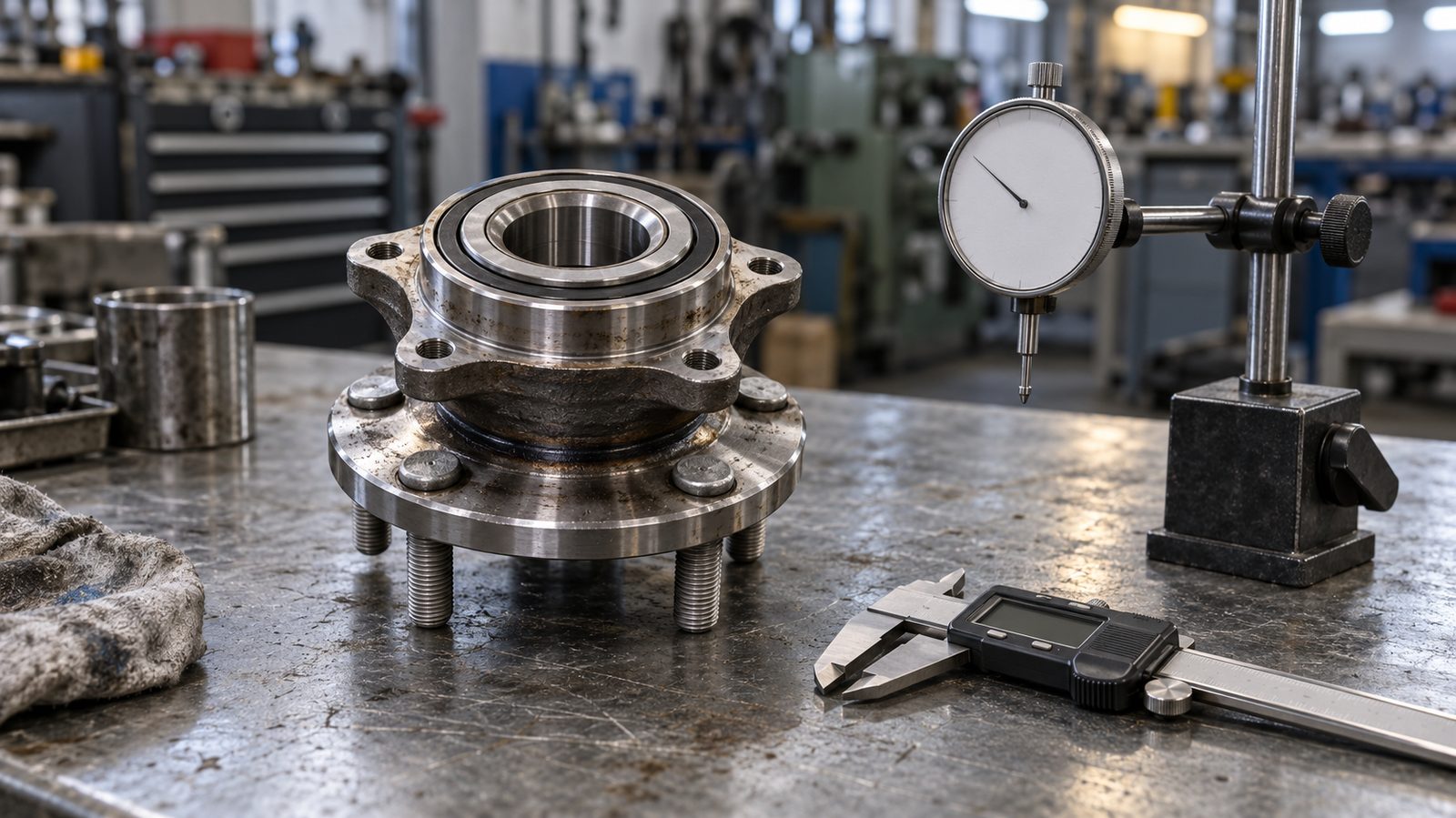
Wheel hub bearing failure modes are the damage patterns that end a hub unit's working life: raceway fatigue spalling, water or grit past the seal lip, false brinelling from vibration in storage, clamp-load and installation damage, grease breakdown from overheating, and magnetic encoder or ABS faults. Inspection is the discipline of matching the visible or measurable pattern to its cause, then deciding whether a part is fit to sell, fit to install, or scrap. This guide explains each mode, the checks a distributor or workshop can run with basic tools, and the drawing details to confirm before ordering from huayuanbearing.com, the site of Jinan Huayuan Bearing Co., Ltd.
What Are the Most Common Wheel Hub Bearing Failure Modes?
Six failure modes account for most hub bearing returns and warranty claims in replacement-market distribution, and each one leaves a different fingerprint on the part. Reading that fingerprint correctly is the difference between scrapping a sound batch and shipping a bad one.
Raceway fatigue spalling
Spalling is the end state of rolling-contact fatigue and appears as dark, matte or flaking patches on a raceway, normally starting in the loaded zone. A single spall with clean metal around it suggests a part that reached its design life or ran overloaded. Spalling spread across both rows, or on the unloaded side, points to lubrication starvation, water contamination or a fit that distorted the rings.
Seal and grease failure with contamination ingress
The lip seal decides service life in wet or dusty markets. Water turns grease into a milky emulsion and leaves rust trails from the lip inward; grit produces a grey, polished lapping-paste look on the raceway and a wear step on the lip. A hardened, cracked or displaced lip, or a missing garter spring, is an immediate rejection criterion rather than a cosmetic note. Seal condition is worth a dedicated inspection routine of its own, because it predicts far more field failures than steel quality does.
False brinelling
False brinelling happens while the bearing is not rotating: vibration in transit or long storage frets rollers against the raceway and leaves evenly spaced marks at roller or ball pitch. The surface looks dull and fretted rather than dented, which separates it from impact brinelling. It is a packaging and storage problem, most often seen on parts shipped loose or stored on vibrating racking.
Installation and clamp-load damage
Fitting damage shows up immediately: a cracked or brinelled inner ring, a scored bore, a distorted flange, a stretched thread. Pressing on the wrong ring, hammering the flange, reusing a yielded axle nut or clamping onto a dirty knuckle face all destroy the internal clearance the unit was set with. In replacement markets this is the most frequent cause of a part failing within the first few thousand kilometres.
Overheating and lubricant breakdown
Overheating leaves carbonised, hard, dark grease, blued rings and sometimes a deformed cage. Causes include a dragging brake, a seized mating component, or a unit running with lost clearance. Burnt grease has a distinct acrid smell, and bluing on the inner ring becomes obvious once the seal is removed.
Magnetic encoder and ABS-related failure
On ABS-equipped hub units the encoder ring often fails before the steel does. Cracks, scoring, rust bloom or metal debris corrupt the signal and set a wheel-speed fault with no mechanical noise at all. Inspect the encoder as a separate component, keep magnetic tools away from it, and never condemn a bearing purely on an ABS code.
Several of these modes produce overlapping symptoms, so the visible evidence matters more than the customer complaint. A structured look at what actually causes wheel bearing failure helps separate a manufacturing question from an application question before any claim is raised.
| Failure mode | Visible or measurable signature | Most likely root cause | Where to look first |
|---|---|---|---|
| Raceway fatigue spalling | Matte, dark or flaking patches, usually one loaded zone | Design life reached, overloading, poor lubrication | Inner ring raceway under the seal |
| Contamination ingress | Milky or rusty grease, grey lapping-paste film, wear step on the lip | Damaged lip, missing garter spring, pressure washing, flooded roads | Seal lip and the grease directly behind it |
| False brinelling | Evenly spaced axial marks at roller pitch, dull fretted surface | Vibration during transport or long storage | Raceway at the top of the stored unit |
| Installation damage | Cracked inner ring, scored bore, distorted flange, damaged thread | Pressing the wrong ring, hammer blows, reused axle nut, dirty knuckle face | Inner-ring bore and mounting flange |
| Overheating | Carbonised black grease, blued rings, deformed cage | Dragging brake, seized mating part, lost clearance | Grease colour and inner-ring face |
| Encoder or ABS fault | Cracked, scored or rust-bloomed encoder track, embedded debris | Impact during fitting, magnetic contamination, corrosion | Encoder ring face and air gap |
Which Wheel Hub Bearing Generation Are You Inspecting?
The generation of a hub bearing unit sets how it mounts and where the load path runs, and therefore which surfaces carry the evidence of failure. Inspecting a first-generation bearing like a third-generation unit wastes time on the wrong features.
First-generation hub bearings
A first-generation unit is a sealed double-row angular-contact bearing with no flange, pressed into the knuckle, trailing arm or housing. The hub flange and drive pinion are separate parts, and preload usually comes from the axle nut. Inspection therefore centres on the outer-ring seats and the housing bore, because a worn bore will ruin a new bearing quickly.
Second-generation hub units
A second-generation unit integrates a flange on the outer ring and bolts to the knuckle or brake carrier, carrying the disc or drum. The bearing itself is a sealed, factory-set assembly with no field adjustment. Because the flange is the mounting datum, check flange flatness and bolt-hole condition first — a bent or corroded flange transmits runout straight into the raceways.
Third-generation hub units
A third-generation unit is the familiar bolt-on assembly: outer-ring flange to the knuckle, inner-ring flange carrying the wheel studs, a factory-set bearing pair and, on ABS applications, an integrated magnetic encoder. It carries the full wheel load and cornering moment, so it is the most highly stressed of the three, and stud, seal and encoder condition matter as much as raceway condition.
Ball, tapered roller and cylindrical roller designs
Most passenger-car hub units use double-row angular-contact ball bearings: light, low friction and adequate for car axle loads. Double-row tapered roller sets take much higher radial and axial loads and appear on light commercial vehicles, pickups and SUVs; they tolerate misalignment less and depend on correct clamp load. Cylindrical roller variants favour high radial capacity with limited axial location. The type is fixed by the vehicle design, so match the drawing rather than a guessed equivalent.
| Generation | Structure | Load path and typical use | Inspection focus |
|---|---|---|---|
| First generation | Sealed double-row bearing, no flange, pressed into housing | Bearing carries wheel load; hub flange and pinion separate; older cars, trailers | Outer-ring seats and housing bore |
| Second generation | Outer-ring flange bolted to knuckle or brake carrier | Flange carries disc or drum; mid-age passenger cars | Flange flatness, bolt holes, both seals |
| Third generation | Outer-ring flange plus studded inner-ring flange, integrated encoder | Full wheel load and cornering moment; current cars and light SUVs | Studs, encoder, seal, wheel-face runout |
| Tapered roller unit | Double-row tapered set in a flanged housing | High radial and axial capacity; vans, pickups, SUVs | Clamp load, adjustment, roller end wear |
How Do You Inspect a Wheel Hub Bearing Step by Step?
A dependable hub bearing inspection is a fixed sequence — identity, then cleaning, then feel, then measurement, then seal, grease and encoder — and it stops as soon as a rejection criterion is met. Working in that order keeps results comparable between operators, batches and shipments, which is exactly what a claim or a repeat order depends on. The same logic underpins the wheel hub bearing inspection procedure used for batch verification.
- Confirm identity. Check part number, marking, OE reference and batch code against the drawing and the approved sample; treat every cross-reference as 以图纸和样品确认为准.
- Photograph before cleaning. Record packaging, rust, oil marks and transit damage, because cleaning destroys the evidence you may need later.
- Clean and dry the exterior. Wipe rather than blast the seal area with compressed air, which can drive grit past the lip.
- Check the mounting interfaces. Flange flatness on a surface plate, stud thread and knurl, bolt holes, circlip groove, spline condition.
- Feel the rotation. Turn slowly by hand in both directions; roughness, catching or a rhythmic knock indicates raceway or ball damage, while free spinning with almost no drag can indicate lost grease.
- Measure clearance and runout. Mount the unit as the drawing specifies, indicate the flange face and pilot diameter, and record axial play with a dial gauge under the stated load.
- Inspect seal, grease and encoder. Lip flexibility, garter spring seating, rust trails, grease colour and texture under the lip, then the encoder track for cracks, scoring and debris.
- Teardown a sample. For any doubtful batch, cut one unit open, degrease it, examine raceways under magnification and photograph the result for the supplier file.
On-vehicle diagnosis follows a shorter path, and the symptoms are usually audible before they are measurable:
- A rumble or hum that rises with road speed and changes when steering left or right.
- Play when rocking the wheel at 12 and 6 o'clock, or at 3 and 9 o'clock.
- Heat at the hub centre after a normal drive, compared with the opposite corner.
- A wheel-speed or ABS warning that appears without mechanical noise.
These signs narrow the corner but rarely name the mode, which is why telling whether a wheel hub bearing is failing should always end in a physical check rather than a road-test guess.
Which Inspection Results Mean Pass, Hold, or Reject?
Acceptance limits must come from the drawing, the approved sample or the customer's specification — never from a generic table — but the decision logic is the same for every part number. Anything that affects load capacity, sealing or signal output is a reject; anything that affects only appearance is a hold at most.
| Check | Accept | Hold for review | Reject |
|---|---|---|---|
| Rotation feel | Smooth, light drag, no catch | Slight uniform stiffness after long storage | Roughness, knocking, notchy points, spin with no drag |
| Axial clearance | Within drawing limit at specified load | At limit, single sample only | Beyond limit, or measurable rock by hand |
| Seal lip and spring | Flexible lip, spring seated, no rust trail | Dry lip with no cracking | Cracked, hardened or displaced lip, missing spring |
| Grease | Correct colour and texture throughout | Slight base-oil separation | Milky, rusty, gritty or carbonised grease |
| Encoder ring | Continuous, clean, undamaged track | Surface rust that wipes off completely | Cracks, scoring, embedded metal, missing segments |
| Flange and studs | Flat within drawing, threads clean | Cosmetic marks on non-functional faces | Bent flange, damaged thread, loose or spun stud |
Defects are easier to classify when the vocabulary is shared across the inspection team, and a documented visual defect catalogue with controlled lighting removes most of the argument about borderline surface marks.
How Do Load, Fitment and Installation Turn a Good Bearing into a Failed One?
Most hub bearings that fail early were sound when they left the box, and the damage was introduced at the vehicle. Four mechanisms cover the majority of those cases.
Clamp load and mounting-face condition
The axle nut or mounting bolts hold the inner rings together and set the working clearance. A yielded nut, a burr on the knuckle face or paint trapped under a flange reduces clamp load, and the unit then moves on its seat under cornering load. That movement frets the bore, distorts the rings and ends in spalling that looks like a bearing fault.
Pressing and impact-tool damage
Force must pass through the ring being fitted, never through the rolling elements. Pressing on the flange, hammering a hub into place or driving on a stud transmits load through the balls and leaves brinelling that becomes a noise source within a few thousand kilometres.
Contamination introduced at installation
Grit, metal swarf and cleaning solvent that reach the lip during fitting bypass the whole sealing system. Wiping the spindle, keeping the unit bagged until the last moment and avoiding direct pressure-washer blasts at the seal all extend life more than any change of lubricant.
Heat from brakes and mismatched mating parts
A dragging caliper, a worn stub axle or a mismatch between hub and disc heights raises running temperature and changes the load path. When a replacement fails quickly, the mating parts deserve as much attention as the bearing, and a full hub bearing failure analysis should record them alongside the part itself.
How Do You Read a Hub Bearing Drawing Before Ordering?
The drawing is the only reliable specification for a hub unit, because catalogue descriptions rarely capture the details that decide whether a part fits and lasts. Jinan Huayuan Bearing Co., Ltd. develops wheel hub bearings, hub units, tensioners and CV joint components from drawings and samples exactly because those details differ between vehicle programmes.
Boundary dimensions and fits
Check bore and outer diameter with their tolerance classes, flange diameter, stud pattern, pilot diameter and overall height. A dimension that matches nominally but differs in tolerance class can still produce a loose or over-tight fit once the housing is at operating temperature.
Clearance, preload and precision grade
Hub units are supplied with clearance or preload set at manufacture, so the drawing should state the target and the measuring load. Where a precision grade is called out, confirm the standard it refers to and the gauging method, since grade alone says nothing about the seal or the grease.
Seals, grease and fill quantity
Seal type, lip material, Grease fill quantity and base-oil viscosity determine performance in dust, water and heat. Two suppliers can meet the same dimensions and still differ here, and this is where the seal inspection routine pays for itself at goods-in.
Material, heat treatment and encoder interface
Confirm the through-hardened or case-hardened specification of rings and the roller grade, then the encoder type, pole count and connector or harness detail for ABS versions. A hub unit that is dimensionally correct but carries the wrong encoder will fit perfectly and set a fault code on the first test drive; the OE number and ABS fitment checks explain how those references are cross-checked.
Before any of this reaches a purchase order, it is worth aligning the specification with the questions a supplier will actually answer; the wheel hub bearing RFQ checklist covers the fields that prevent most re-quotes.
Which Other Running-Gear Parts Fail in Similar Ways?
Tensioners and CV joint components share the same physics as hub bearings — a sealed rolling element set, a defined preload and a lip seal that decides life — so the inspection habits transfer directly.
A tensioner fails first at its pulley bearing or its damping element: grease weeping from the seal, a chirp or rattle at idle, belt flutter, or a tensioner arm that no longer returns smoothly. A split boot is the usual entry point for CV joint failure: grease is thrown out, water and grit enter, and the cage and balls wear until the joint clicks on full lock under load. Both are worth checking whenever a hub unit is replaced on the same corner, since a worn adjacent component will often finish off the new part.
Huayuan supplies these running-gear components alongside its hub bearing range for aftermarket replacement and OE programmes, with development from drawings and samples, custom packaging and private-label options for importers in the Middle East and Southeast Asia.
Frequently Asked Questions About Wheel Hub Bearing Failure and Inspection
What are the first signs of a failing wheel hub bearing?
A rumble or hum that rises with road speed and changes when steering left or right is the classic early sign, because loading and unloading the corner shifts the noise. Workshops also find play when rocking the wheel at 12 and 6 o'clock, heat at the hub after a drive, uneven brake pad wear and a wheel-speed warning. Any two of these together justify removal and inspection.
Can a sealed wheel hub bearing be regreased or repaired?
No. A modern hub unit is a sealed assembly with clearance or preload set at manufacture and, on ABS versions, an encoder ring fixed in position. Opening it destroys the seal, admits contamination and removes a setting that cannot be restored without the original tooling. Replacement with a part confirmed against drawing and sample — 以图纸和样品确认为准 — is the only sound repair.
Does a bad wheel hub bearing always trigger an ABS light?
No. Bearing steel can be badly spalled while the encoder ring stays intact, giving noise and play but no electrical fault. The reverse also occurs: a cracked or contaminated encoder sets a wheel-speed code with no mechanical symptom at all. Mechanical and ABS diagnosis are two separate checks, and a hub unit should never be replaced on a fault code alone.
What should an importer check when hub bearings arrive?
Check packaging and markings against the purchase order, record rust or transit damage before cleaning, then sample for rotation feel, axial clearance against the drawing, seal lip and spring condition, grease appearance and encoder surface. Keep photographed records per batch, and cut one unit open from any batch that feels doubtful. That record makes both claims and repeat orders much easier to handle.
Purchasing guidance, product information and company updates from Huayuan Bearing.