
Wheel bearings can reach an end of service for different reasons, and “bad bearing” is not a root-cause finding. Common contributors discussed in bearing engineering include fatigue under repeated loading, contamination, lubrication conditions, corrosion, unsuitable application assumptions, and damage associated with handling or mounting. Which factor matters in a particular case must be established from the exact part, duty, records, and inspection evidence.
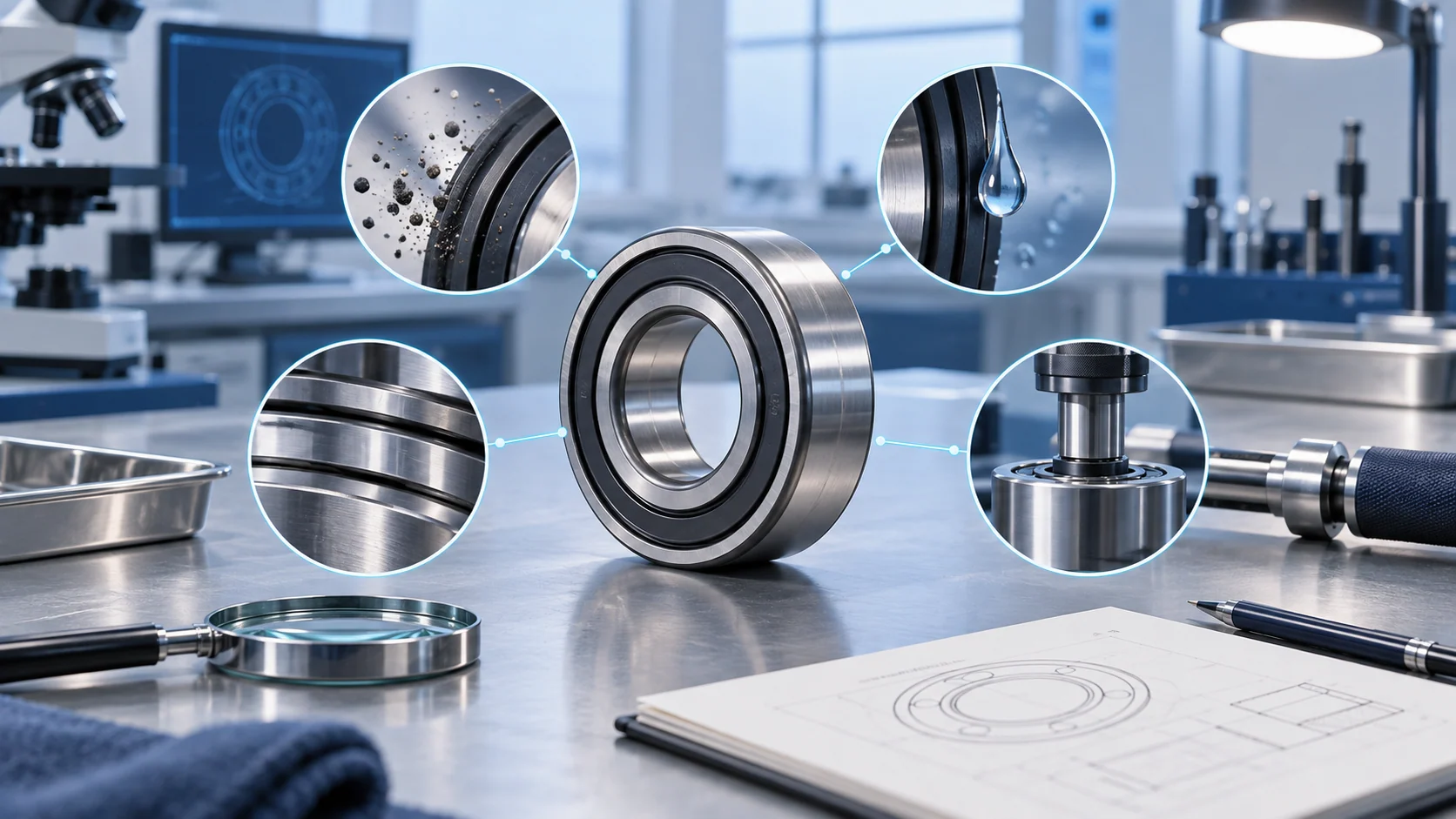
Conceptual illustration only. It does not show a Huayuan laboratory, an actual failed part, or a specific test result.
Start by separating a symptom, a damage mode, and a cause
A noise, temperature change, vibration, or looseness may prompt an investigation, but these observations are not proof of why a bearing changed. A damage mode describes what occurred at a component or surface. A root cause explains the conditions that produced that mode. A business return code such as “bearing failure” may record the complaint without identifying either.
SKF’s technical explanation of ISO 15243 groups rolling-bearing damage into categories such as rolling-contact fatigue, wear, corrosion, electrical erosion, plastic deformation, and cracking or fracture. It also explains that the classification concerns bearings installed in operation and does not itself cover manufacturing-type defects such as missing parts. Use such a framework to describe observed evidence before drawing a conclusion. Read SKF’s overview of ISO 15243 damage analysis.
For automotive wheel ends, a complete investigation may involve the bearing, hub, seals, sensor-related features, fasteners, adjacent components, vehicle configuration, and installation history. A general industrial bearing example can explain a mechanism, but it should not be assumed to prove the same cause for every wheel-hub design. Keep the application-specific limits visible.
Repeated load and fatigue
Rolling bearings are designed to carry defined loads through rolling contact. Repeated stress over time can contribute to rolling-contact fatigue. The relationship depends on bearing geometry, material and manufacturing assumptions, load, speed, lubrication, cleanliness, and the calculation method. A damaged raceway or rolling element can be evidence for a trained examiner, but a photograph alone usually cannot establish the full chain of events.
Temporary overloads or shocks may also be relevant. A vehicle’s normal operating data, road conditions, payload, wheel configuration, and incident history can help a technical team understand whether the load assumptions match the actual application. This is a reason to preserve the part reference and the use conditions instead of attributing every early return to a single generic defect.
A rating-life calculation is not a complete root-cause analysis. ISO 281 defines rating-life calculations for rolling bearings within its scope, while ISO 15243 helps classify damage modes. Neither standard can identify the cause of a specific returned automotive hub without evidence and application review. For a basic explanation of rating life and its limits, see Huayuan’s wheel-bearing service-life guide.
Contamination and sealing conditions
Solid particles, moisture, or other foreign material can interfere with the bearing’s internal operating environment. SKF notes that particles can damage rolling surfaces, and that moisture can degrade lubricant performance or contribute to corrosion. Contamination may enter during handling, storage, assembly, maintenance, or through an ineffective sealing arrangement, depending on the design and circumstances.
The presence of contamination does not by itself identify when or how it entered. A returned bearing may have been opened, cleaned, repacked, exposed to weather, or handled after removal. Preserve the chain of custody and record whether the part was sealed, how it was packaged, and who inspected it. If the bearing is sealed and not designed for field opening, do not pry it apart to look for a cause; ask the responsible technical party for the approved failure-analysis process.
External seal evidence can help guide follow-up questions, but it is not conclusive. A seal edge that appears displaced, cut, contaminated, or wet should be documented with photographs and lot/application details. A qualified examiner should determine whether the observation is relevant to the internal bearing condition. Huayuan’s wheel-bearing seal inspection guide sets out a non-destructive buyer review.
Lubrication conditions and heat
Lubrication helps separate rolling surfaces under the intended design conditions. The wrong lubricant, an unsuitable amount, degradation, contamination, or a mismatch with the application may affect the lubricant film and operating temperature. These factors are connected: excessive friction can create heat, while heat can influence the lubricant and materials. The sequence must be established for the product rather than assumed from a generic article.
The correct grease or lubrication arrangement is design-specific. Buyers should not add, remove, mix, or substitute lubricant based on an internet checklist. A sealed unit may not be intended for user service. Request the supplier’s exact specification and follow the relevant product and vehicle documentation.
A temperature reading is useful only when its context is known. Record how and where it was measured, which wheel end was compared, the vehicle load and route, ambient conditions, brake state, and measurement timing. A single high reading or a dark lubricant sample may justify further review, but neither alone proves the root cause.
Application, fit, and alignment
A bearing or hub unit needs to match the application and its interfaces. Incorrect dimensions, fit, clearance or preload assumptions where applicable, alignment, flange geometry, or an adjacent component may change how load is carried. These questions require the controlled specification for the exact part and vehicle variant.
An OE reference is a starting point, not permission to overlook the application record. Confirm make, model, model year, engine or trim when relevant, driven or non-driven wheel, axle and position, ABS/encoder arrangement, and market. Record the source for each cross-reference. If catalogue, vehicle, and sample details conflict, hold the record for confirmation. Huayuan’s OE number, fitment, and ABS verification guide describes this matching process.
A name such as “front hub bearing” is not enough to infer that two products have the same geometry. The wheel mounting flange, pilot, stud pattern, sensor connector, encoder arrangement, and supplied hardware may differ. Never infer torque, preload, press direction, or installation steps from a generic discussion of failure causes. Those instructions belong to the applicable manufacturer documentation and qualified service process.
Handling and mounting damage
Bearings and assemblies can be affected by impacts, contamination, incorrect handling, or a mounting process that transfers force through an unintended component. SKF’s damage-analysis materials discuss plastic deformation and indentations from overload or particles as possible damage modes. The appearance must be evaluated against the product design and handling record; it does not establish who caused the condition.
For a supplier or distributor, packaging and receiving records help separate transit issues from product or application issues. Record carton condition, seals, labels, lot marks, quantity, and whether the package was opened before a concern was found. If a sample is being evaluated, define who may handle it, what tests are authorized, and whether a destructive examination is permitted.
Installation details are equally specific. A technician should use the vehicle maker’s and component supplier’s current instructions, correct tools, and an approved procedure. This article is not a repair guide. Do not use the wheel bearing as a training example for hammering, heating, or improvised extraction. When a unit has already been mounted, record the service history and the procedure source for qualified analysis.
Corrosion, vibration, and storage
Moisture or corrosive exposure can contribute to corrosion conditions, while small movement or vibration during transport or storage can be relevant to some bearing arrangements. Whether either mechanism occurred depends on the material, protection, load, time, packaging, and environment. The same red-brown residue can have different meanings on different surfaces and should not be labeled as a root cause from a casual photo.
For stocked product, keep the supplier’s packaging and storage instructions with the lot record. Avoid repacking that removes product or lot identity. Record storage duration and any events such as water exposure, damaged cartons, or prolonged vibration. See Huayuan’s bearing storage and handling checklist for procurement-level recordkeeping.
Build a fact-based investigation file
A useful investigation begins before the part is opened or cleaned. Keep these records together:
- Exact part number, OE reference, revision, lot or date code, and supplier shipment record.
- Vehicle make, model, year, engine or trim where relevant, drive type, axle, position, and market.
- The complaint as reported, date, mileage or service hours if known, route or duty, payload, and relevant event history.
- Photos of the package, labels, installed context when available, and the part as received. Record who took each image and when.
- Purchase order, approved drawing or catalogue source, application decision, and any agreed exclusions.
- Installation or removal records from the qualified service provider, using the applicable controlled instructions.
- The inspection or analysis method, sample handling, measured results, acceptance limits, and examiner.
- Any changes made to the vehicle, adjacent parts, lubricant, seals, or packaging since the approved baseline.
Preserve unknowns as unknown. “Not observed” is not the same as “did not occur,” and a missing record should not be filled in with a guess. If the part has been altered, cleaned, or disassembled, state that fact because it can limit later analysis.
Compare supplier evidence fairly
A buyer evaluating suppliers can ask how the product is defined, what documents apply to the exact part, and how a nonconformity is investigated. Ask for the inspection plan, drawing revision, lot identification, applicable test report, acceptance criteria, and record-retention process only where those items apply to the contract. Clarify which entity or site is responsible for the work and what evidence covers the shipment.
Do not treat a management-system certificate, a marketing statement, or a factory image as proof that a particular returned unit passed a particular test. A test report should identify the sample, method, date, relevant limits, result, and product or lot scope. A certificate has its own holder and scope; it does not automatically certify every product in a catalogue. Huayuan’s quality documents and packaging checklist explains how buyers can distinguish organization-level documents from order- or product-level evidence.
For a broader comparison, use Huayuan’s supplier evaluation guide and keep open questions visible in the RFQ record. An evidence-based supplier review supports decisions without promising a particular failure rate or service life.
Common questions about wheel-bearing failure causes
What causes wheel bearings to go bad?
Possible contributors include repeated loading, contamination, lubrication conditions, corrosion, application mismatch, and handling or mounting damage. The relevant cause varies by design and case. A symptom or returned part needs a documented technical review before a root cause is assigned.
Can a seal problem cause bearing damage?
A sealing problem may allow contaminants to affect the bearing environment, depending on the design and exposure. It should be evaluated with the exact seal arrangement and the part’s history. A damaged-looking outer edge alone does not prove the complete failure chain.
Does early failure prove a defective bearing?
Not by itself. Early removal is a reason to collect the product, application, installation, lot, and duty evidence. A qualified investigation should identify the observed damage mode and evaluate plausible causes against the records.
Can the same failure appearance have more than one cause?
Yes. Similar surface observations can be associated with different mechanisms or multiple contributing conditions. Use a recognized damage classification and a qualified examiner; do not treat a single photo as a complete laboratory finding.
Should a distributor open a sealed wheel-bearing unit to inspect it?
Do not open or damage a sealed unit unless the manufacturer or qualified investigation process authorizes it. Document the condition as received and request instructions for preserving evidence.
Treat causes as questions to verify
“Why did this wheel bearing fail?” is answered by evidence, not a generic list. Engineering sources describe mechanisms such as fatigue, wear, corrosion, contamination, and deformation, but a specific returned product needs application-specific review. Keep the observed damage, candidate mechanisms, and confirmed root cause as separate records.
For purchasing, prevent avoidable ambiguity by identifying the exact part and vehicle variant, preserving lot and packaging records, and requiring traceable documents for any important performance or test claim. For a new order, start with the wheel hub bearing RFQ checklist and state what evidence is required before approval.
Authoritative references
Purchasing guidance, product information and company updates from Huayuan Bearing.