
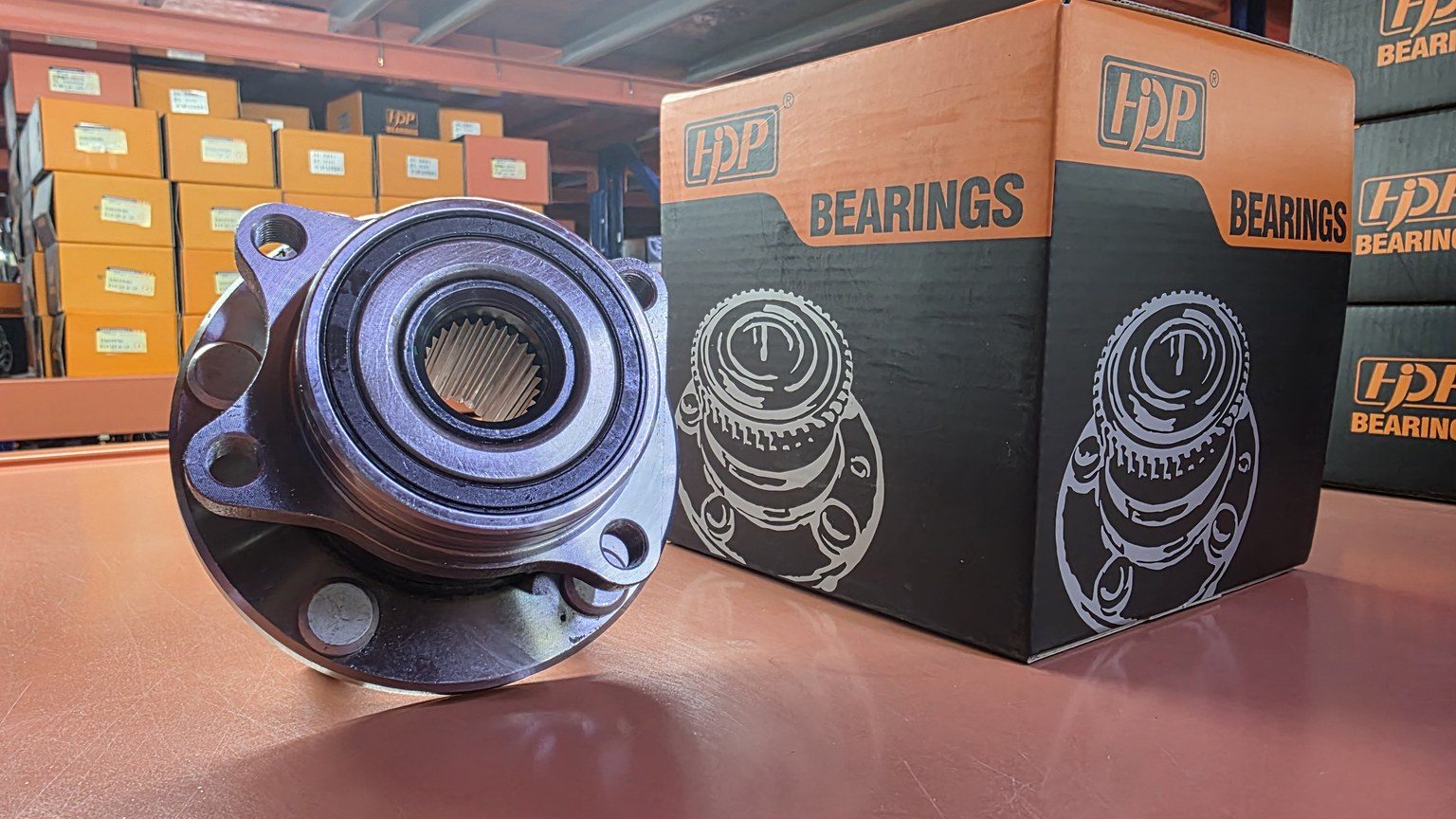
A wheel hub bearing for the HYUNDAI i30 is a sealed, pre-set hub unit that supports the vehicle's weight, fixes the wheel's axis of rotation and, on ABS-equipped cars, provides the magnetic track the wheel-speed sensor reads. Rings, rolling elements, seals, grease and mounting flange are matched at the factory, so no preload is adjusted on the car. The i30 nameplate covers several platform generations, so the correct part is fixed by OE number, flange geometry, bore and sensor type, confirmed against drawings and samples rather than by model name alone.
What Is a Wheel Hub Bearing for HYUNDAI i30 and What Does It Do?

A wheel hub bearing for the HYUNDAI i30 is a load-carrying assembly that replaces the older combination of a loose bearing plus a separate hub. Because the unit arrives pre-set and pre-greased, the workshop does not measure clearance or pack grease, and the vehicle manufacturer controls the bearing setting instead of the installer. That is also why the part is bought as a complete unit rather than as a bearing plus a hub.
The difference between renewing a bare bearing and renewing a complete assembly changes both the price of the repair and the tools required, and it is set out in this comparison of a wheel bearing versus a hub assembly.
Which loads does a front hub unit carry?
A front hub unit carries a radial load from the vehicle's weight, an axial load generated in cornering, and a bending moment created by wheel offset — the distance between the tyre contact patch and the bearing centreline. On a driven axle it also transmits drive torque through a splined hub. The bending moment is the load most often underestimated: a wider wheel, a spacer or a stickier tyre raises it without any change in vehicle weight, which is one reason a hub that coped with the original wheel can become marginal with a wider one.
Where is the hub bearing mounted on an i30-type car?
The front position on an i30-class car is normally a bolt-on flanged hub unit on the steering knuckle; the rear is usually a flanged unit on a stub axle or trailing-arm carrier, and on some versions a press-in bearing retained in the arm. Front units carry the greater share of the load because they steer, brake and, on driven versions, transmit torque. Rear units on non-driven axles run lighter but see the same water and grit, so they are not automatically the longer-lived part.
Which components make up a sealed hub unit?
A sealed hub unit contains five functional groups that are matched to each other and cannot be mixed across part numbers.
- An outer ring with the mounting flange and bolt holes, or a housing on a third-generation unit.
- Two rows of rolling elements, balls or tapered rollers, each held in its own cage.
- An inner ring or hub flange carrying the wheel studs and, on driven axles, an internal spline.
- A seal at each side, at least one of which carries the magnetic encoder track for the ABS sensor.
- A measured grease fill and an assembled clearance or light preload that is not adjustable in service.
Which Generation of Hub Bearing Does Your i30 Application Need?
Generation — first, second or third — is the first filter in any hub bearing lookup, because it decides whether you renew a bearing, a bearing with one flange, or a complete bolt-on assembly. Buying by vehicle name alone skips this filter and is the most common source of wrong-part returns.
| Generation | What the unit includes | How it mounts | ABS interface | Effect on replacement |
|---|---|---|---|---|
| First | Double-row bearing with seals, no flange | Pressed into the knuckle or housing, retained by circlip or shoulder | Separate toothed ring or encoder on the shaft | Press and circlip required; bore and groove must be checked |
| Second | Bearing plus one flanged ring, unitized | Flange bolted to the knuckle face or stub axle carrier | Encoder usually integrated in the seal | Bolts on; mating flange and stub axle are reused and inspected |
| Third | Complete assembly: bearing, hub flange with studs, housing, seals | Three or four bolts to the knuckle; splined to the driveshaft on driven axles | Magnetic encoder in the seal, sensor in the knuckle or housing | Bolt-on, no press; bolt pattern, spigot and sensor position must match exactly |
What is the practical difference between a second- and third-generation unit?
A second-generation unit still locates on the vehicle's knuckle and bolts a flanged ring to a carrier, while a third-generation unit replaces that interface with a sealed housing that bolts straight to the knuckle. In repair terms, generation two reuses more of the car and demands closer inspection of mating surfaces; generation three is faster to fit but must match the knuckle bolt pattern, spigot diameter and sensor position exactly. Comparison listings such as a bolted front hub assembly reference for a Hyundai application are useful for seeing how those interfaces are drawn, but the dimensions still have to be verified.
Ball, tapered roller or cylindrical roller — which does a passenger-car hub use?
Most passenger-car hub units in the i30 class use double-row angular contact ball bearings, because they carry combined radial and axial load with low drag and fit inside a compact flange. Tapered roller units appear where load and stiffness dominate, such as larger vehicles, light commercial use and some rear axles, while cylindrical roller bearings are chosen where radial capacity is the priority and axial location is handled elsewhere.
| Bearing type | Load behaviour | Stiffness and drag | Typical position | Watch-outs |
|---|---|---|---|---|
| Double-row angular contact ball | Radial and axial load in both directions | Moderate stiffness, low drag | Most passenger-car front and rear hub units | Axial capacity drops quickly if setting is lost through seal or housing damage |
| Double-row tapered roller | High radial and axial capacity | High stiffness, higher drag | Larger cars, light commercial vehicles, some rear axles | Setting is critical; older designs are adjusted during assembly |
| Cylindrical roller | High radial capacity, little axial capacity | High radial stiffness | Axles where axial location is provided separately | Cannot be used alone where axial load must be carried |
Does the ABS encoder change the part number?
Yes. A hub unit with a magnetic encoder seal, a hub with a toothed ABS ring, and a hub with no encoder at all are three different parts even when the bearing bore and diameter are identical. The encoder is also easily damaged by pressing on the wrong ring or by knocks during handling, so the sensor interface belongs in the part number, not in a footnote.
Generation, bearing type and sensor interface are the three filters that decide the part, and they are examined in more depth in this wheel bearing and hub assembly selection guide.
How Is a Hub Unit Built — Steel, Heat Treatment, Clearance and Sealing?

Material and process decisions inside a hub unit are invisible after assembly, yet they determine whether a unit lasts the life of the vehicle or starts rumbling within a year. A buyer cannot test them on arrival, so they have to be specified, documented and verified instead.
Which steels and heat treatments carry the load?
Raceways and rolling elements are made from through-hardening bearing steel, designated 100Cr6 under EN, GCr15 under GB and SUJ2 under JIS — the same family under three naming systems. Rings are hardened and tempered to a martensitic structure in the high fifties to low sixties on the Rockwell C scale, then ground and honed to their final geometry. Flanges and housings are usually forged or machined from medium-carbon steel, with studs and threads rolled rather than cut so that the grain flow follows the thread root. Case-hardening appears in designs where impact resistance matters more than uniform hardness.
What do precision grade and internal clearance mean in a sealed unit?
Precision grade describes form and running accuracy — bore and outside diameter tolerance, roundness and runout — and is classified under ISO 492, with ABEC notation as the equivalent American expression. Hub units are commonly built to P6 or better, because runout appears directly as wheel and brake vibration. Internal clearance is set at assembly, often to a light preload, and cannot be adjusted on the car; clearance classes such as C2 to C5 describe open bearings, so on a sealed unit the assembled setting, not a class code, is the specification that matters.
How do seals and grease decide service life?
In service, most hub units fail from contamination rather than from fatigue. A two- or three-lip cassette seal with a labyrinth path keeps water, grit and de-icing salt away from the raceway; a single lip, a cut lip or a seal fitted dry lets them in, and the grease becomes an abrasive paste. Grease is filled for life and matched to the seal and to the expected temperature range, so a unit should never be topped up or flushed with solvent.
Which Loads and Operating Conditions Decide the Specification?
Specification is set by the loads the hub actually sees and by the environment it works in, not by model year or by catalogue tier. Two cars of the same model can legitimately need different hub specifications when their axle loads, brake packages or wheel offsets differ.
How do mass, offset and grip translate into bearing load?
Vertical load scales with axle mass, cornering load scales with tyre grip and the height of the centre of gravity, and the bending moment scales with wheel offset. Fitting a wider wheel, a spacer or a high-grip tyre raises the moment and the cornering load without any change to the bearing's nominal rating, which is why the same part can be adequate on one vehicle and marginal on another.
Which duty cycles shorten hub life?
Frequent hard cornering, sustained brake heat, repeated kerb strikes and long periods of standstill matter more than total distance in many fleets. Heat degrades grease, vibration during long storage produces false brinelling marks in the raceway, and kerb impacts leave indentations that later become spalling origins.
Which environmental conditions should drive seal and grease choice?
Water, fine dust, road salt and coastal humidity are the four conditions that separate a long-lived hub from a short-lived one. Vehicles that wade, are steam-cleaned regularly or work in dust should be specified with the higher grade of cassette seal available for the part, and a hub that has ingested water shows it as emulsified grease and reddish-brown staining on the raceway during inspection.
How Do You Read the Drawing and Confirm the Part Number Before Ordering?
A hub unit is confirmed by dimensions and interfaces, not by the model name printed on the box. The sequence below turns an OE number into a verified part and catches the errors that a catalogue lookup alone will miss.
- Start from the OE number. Take it from the old part, the vehicle documentation or a VIN-based lookup, and treat every cross-reference as a candidate rather than a confirmation.
- Identify the generation and mounting. Bolt-on three- or four-bolt housing, bolted flange, or press-in bearing with a circlip — this decides the whole part family.
- Measure the wheel-side interface. Flange outside diameter, bolt circle, number and size of studs or bolt holes, spigot diameter and flange offset height.
- Measure the axle-side interface. Bore or spline count, shaft diameter, and the position of any retaining shoulder or groove.
- Record the sensor interface. Encoder type and its position on the seal, sensor mounting hole in the housing, and whether the vehicle runs an active or a passive sensor.
- Check the detail features. ABS ring diameter, brake disc pilot, dust shield mounting, thread type and handedness — left and right units are not always identical.
- Confirm against drawing and sample. Compare the drawing dimension by dimension and, for a new application, check a physical sample on the vehicle before committing to a batch.
Any fitment statement, including a printed cross-reference list, stays provisional until it is confirmed against drawings and samples; the method for reading OE numbers and sensor interfaces is set out in this guide to OE number fitment for ABS hub bearings. Public listings such as another front hub assembly reference for a Hyundai application show the shape of the data a supplier should be able to supply: flange drawing, sensor position and thread detail.
The same discipline applies on the supply side. Jinan Huayuan Bearing Co., Ltd., the manufacturer behind huayuanbearing.com, produces wheel hub bearings, hub units, tensioners and CV joints for replacement and OE-matched programmes, develops parts from drawings and samples, and supplies importers in the Middle East and Southeast Asia with custom packaging and private-label options. A supplier that can work from a drawing is easier to hold to a dimension than one that only quotes a number.
How Does a Wheel Hub Bearing Fail, and What Evidence Confirms It?
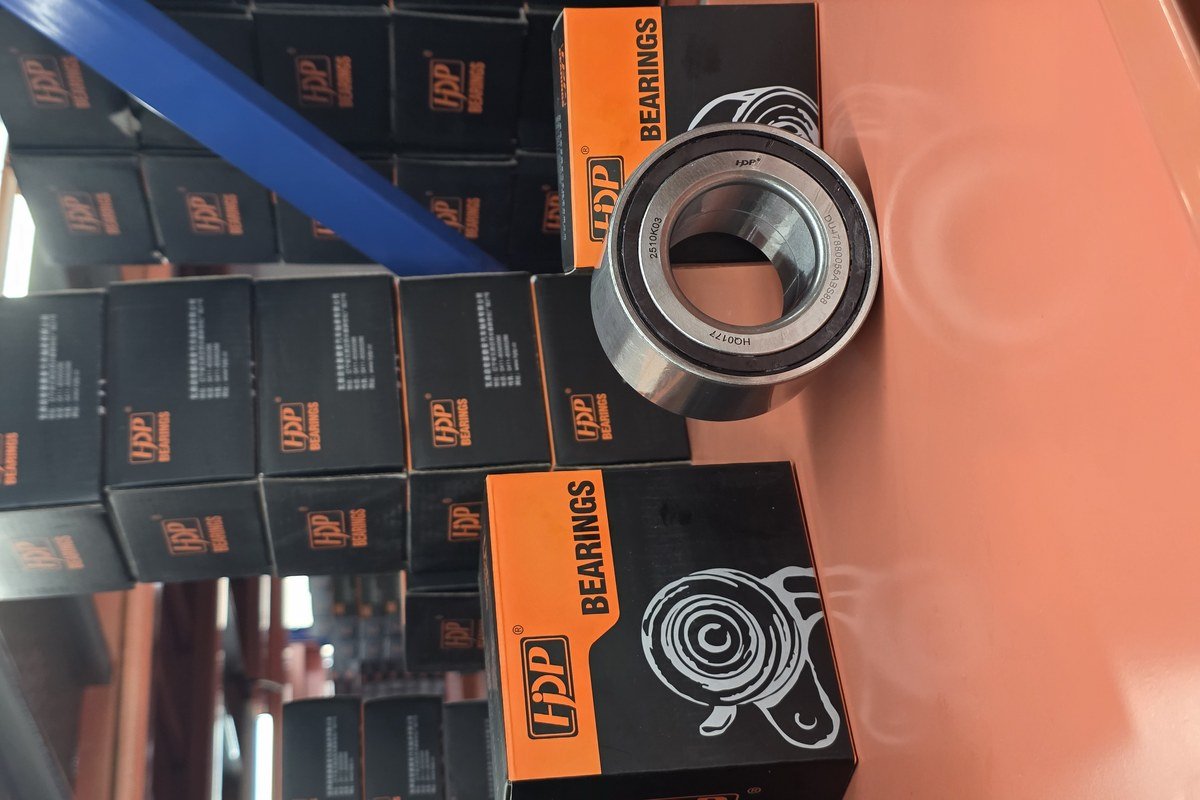
Hub bearing failure leaves physical evidence, and the evidence usually identifies the cause. Reading it correctly prevents the common mistake of renewing a part that failed because of something else — a distorted knuckle, a seal damaged at fitting, or an impact that dented the raceway.
| Symptom | What inspection shows | Usual cause | Check before refitting |
|---|---|---|---|
| Hum or rumble rising with road speed | Raceway spalling or pitting, discoloured grease | Fatigue at end of life, or water ingress | Seal condition, grease colour, knuckle bore |
| Noise that changes in a swerve | Localised damage on the loaded side of the raceway | Load-dependent spalling | Compare both sides before condemning a unit |
| Grease seepage at the seal | Wet dust ring around the seal lip | Lip wear, over-filling, excessive brake heat | Seal seat, brake temperature, alignment |
| Evenly spaced indentations in the raceway | False brinelling marks across the ball path | Long standstill with vibration, storage practice | Stock rotation and transport conditions |
| Wheel play and vibration | Movement at the flange, uneven tyre wear | Loose fastener, worn spline, incorrect torque | Torque procedure, spline condition, face flatness |
| ABS light with a wheel-speed code | Scored encoder track, debris on the sensor face | Handling damage, corrosion, wrong part | Encoder type, sensor gap, part number |
Which noises point to the hub rather than the tyre?
Hub noise follows road speed and changes with load transfer, while tyre noise follows surface texture and stays similar in a straight line and in a swerve. A steady-speed swerve is the practical test: noise that rises when one side is loaded and falls when the load comes off points to a wheel-end bearing rather than to the tyre.
How do you confirm the diagnosis before replacing?
Check for play with the car raised, feel hub temperature after a run, look for grease seepage, and read live wheel-speed data for a stable signal on each corner. A hub that is noisy but has no play is still failing; a hub with play but no noise is more often an installation or fastener problem. A structured symptom check is set out in this guide to the signs of a failing wheel hub bearing.
How Should a Hub Unit Be Fitted and What Should You Check on Delivery?
Most early hub failures are installation failures rather than bearing failures. A dirty knuckle face, press force applied through the wrong ring or an uncontrolled torque explains far more short-life returns than raceway quality does, so the fitting sequence deserves the same attention as the part specification.
- Clean the knuckle or carrier face to bare metal and remove corrosion, burrs and old thread-locking residue.
- Check the mating face for flatness and the bore for scoring before offering up the new unit.
- Support the knuckle or the housing, never the inner ring or the encoder seal, whenever press force is required.
- Fit new mounting bolts where the vehicle manufacturer specifies them, since reused torque-to-yield fasteners do not hold clamping load.
- Tighten in a cross pattern in stages to the vehicle manufacturer's figure, not to a generic value.
- Keep magnetic tools and steel swarf away from the encoder ring, and never pull the hub into place by the flange.
- Verify the ABS signal and road-test for noise before the vehicle leaves the workshop.
What should a delivery inspection cover?
Incoming inspection should confirm identity, geometry and condition before parts reach a shelf, because a batch that fails any line below is cheaper to quarantine than to sort out of stock later.
| Check | Method | What to record |
|---|---|---|
| Identity | Compare marking, part number and batch code with the purchase order | Any mismatch between label, carton and part |
| Dimensions | Measure flange diameter, bolt circle, bore, spline and offset against the drawing | Measured values against drawing tolerance |
| Rotation | Turn each unit by hand and listen for roughness or a catch | Roughness, noise or free-play feel |
| Seals and encoder | Inspect lips for cuts and the encoder track for scoring or embedded metal | Condition of every seal face |
| Fasteners | Check studs for straightness, thread damage and correct length | Any rolled or crossed thread |
| Cleanliness | Check for swarf, moisture or crushed packaging | Batch number and quantity affected |
How do packaging and labelling affect wholesale supply?
For an importer, packaging is part of the product: a carton carrying the correct part number, application note and batch reference reduces counter errors, and private-label cartons let a distributor present a consistent range. Jinan Huayuan Bearing Co., Ltd. supports custom packaging and own-brand labelling alongside standard cartons, which keeps the part number readable at the counter and the batch traceable in the warehouse. The data a supplier needs in order to quote and confirm accurately is listed in this wheel hub bearing RFQ checklist.
Frequently Asked Questions About Wheel Hub Bearings for the HYUNDAI i30
Can one wheel hub bearing fit every HYUNDAI i30 model year?
No. The i30 nameplate covers several platform generations, and hub hardware changes with generation, brake package and driven or non-driven axle, so two cars of the same model year can still differ. The part has to be confirmed by OE number plus flange, bore and sensor dimensions, and finally against drawings and samples.
Do I need a complete hub assembly or only the bearing?
It depends on the generation fitted to the car. A third-generation unit is a complete bolt-on assembly and is renewed as one part; a first-generation installation uses a separate bearing pressed into the knuckle, so only the bearing is replaced and the hub is reused after inspection. Identify the mounting type before ordering anything.
Why did a new hub unit fail within a few thousand kilometres?
The usual causes are installation-related: a contaminated or burred knuckle face, press force through the inner ring, incorrect torque, or a seal damaged during fitting. Less often the unit was the wrong specification for the axle load or wheel offset. Inspect the failed part for seal damage and raceway marks before fitting a replacement.
Does the ABS light reset by itself after a hub replacement?
Not always. Some systems clear the code once a valid wheel-speed signal is seen through a full drive cycle; others store a hard fault until it is cleared with a scan tool. If the light stays on, check encoder condition, sensor seating and gap before assuming the new unit is faulty.
Purchasing guidance, product information and company updates from Huayuan Bearing.