
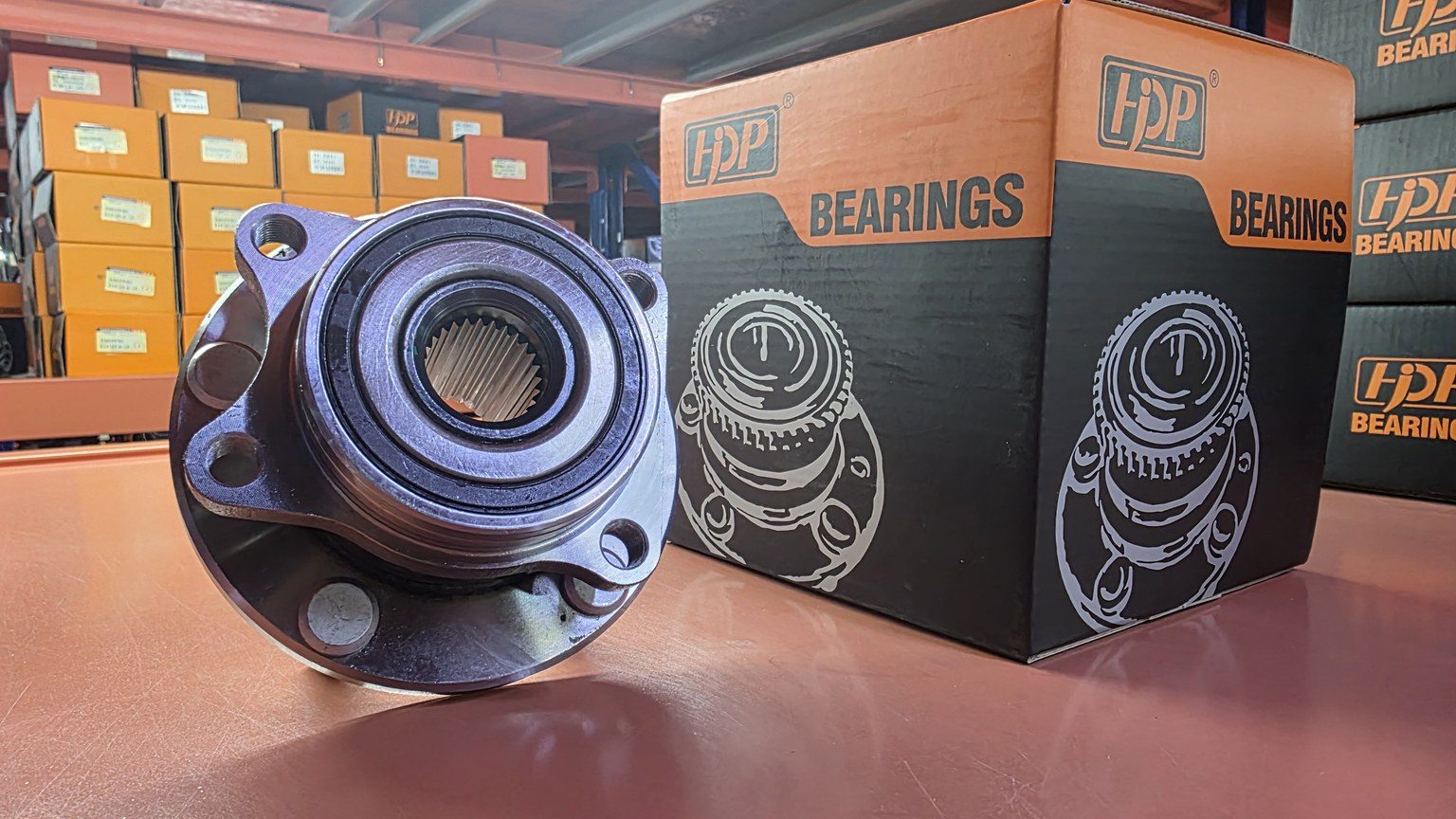
A wheel hub bearing for the MAZDA 323 S VI Saloon is a sealed, grease-for-life hub unit that carries the front driven wheel in a double-row bearing, while the rear axle runs a non-driven hub. Four details decide whether a reference fits: flange and pilot diameter, bolt circle and offset, spline or plain bore, and the anti-lock braking system (ABS) sensor interface. Mazda varied hub and ABS layouts by market and trim, so the correct part is confirmed against drawing and sample. Huayuan Bearing, at huayuanbearing.com, manufactures hub units, tensioners and CV joints in Jinan, Shandong.
What Is the Wheel Hub Bearing for a MAZDA 323 S VI Saloon and Where Does It Sit?
A hub bearing on this platform is a unitized assembly that combines the hub flange, the double-row rolling bearing, the seals and, where fitted, the ABS encoder into one non-serviceable part. Nothing inside it is adjustable or re-greasable in service; the unit is replaced as a whole. That is the practical difference between a modern hub unit and the separate bearing-and-spindle arrangement on older cars, and it is the first thing to settle before a reference is quoted — the difference between a wheel bearing and a hub assembly is set out in detail in that guide.
Front axle: a driven hub that carries weight, cornering force and drive torque
At the front of a transverse-engine, front-wheel-drive saloon the hub does three jobs at once. It carries the vertical wheel load and the cornering moment through the double-row bearing, it transmits drive torque from the splined constant-velocity (CV) joint stub to the wheel, and it reacts brake torque through the flange face and wheel bolts. Because the outer CV stub passes through the bearing bore and is held by a stake nut, the spline and the nut torque sit inside the bearing load path rather than beside it.
Rear axle: a non-driven hub that carries load only
The rear hubs on the same car are non-driven, so they carry vertical load, cornering moment and brake torque but no drive torque. The bore is usually plain and the seal package simpler. Rear ABS provision varies by market and trim, and on some versions the rear hub carries no encoder at all. A front reference and a rear reference are therefore never interchangeable, even when the flanges look alike.
| Attribute | Front hub (driven) | Rear hub (non-driven) |
|---|---|---|
| Drive torque path | Through the splined CV joint stub and stake nut | None |
| Dominant loads | Radial wheel load, cornering moment, drive torque, brake torque | Radial wheel load, cornering moment, brake torque |
| Internal spline | Normally present | Normally absent |
| Common bearing design | Double-row angular contact ball, sometimes double-row roller | Double-row ball or double-row tapered roller |
| Sealing duty | High on the inboard side: brake heat, road spray, CV grease | High on the inboard side: brake heat and road spray |
| ABS interface | Encoded seal or separate sensor, market and trim dependent | Encoded seal or separate sensor, market and trim dependent |
| Typical failure trigger | Water ingress at the inboard seal, nut loosening, boot grease loss | Water ingress, sustained brake heat, impact damage |
Which Hub Unit Generation Fits This Platform?

Hub unit generation describes how much of the wheel corner the bearing integrates, not how large or expensive the car is. A first-generation unit is a bearing cartridge with a separate hub flange pressed into it; a second-generation unit integrates bearing and flange and usually bolts to the knuckle; a third-generation unit is a complete hub with flange, encoder and brake mounting face. On cars of this class and era the front more often uses a bolted second- or third-generation unit, while the rear may use a press-fit cartridge or a bolted unit depending on brake and suspension layout, so the generation has to be read from the part, not assumed from the model name.
Generation 1, 2 and 3 in structural terms
| Feature | Generation 1 | Generation 2 | Generation 3 |
|---|---|---|---|
| Structure | Double-row bearing cartridge plus a separate hub flange | Bearing and flange unitized, flanged outer ring or hub body | Fully unitized hub with flange, encoder and brake mounting face |
| Rolling element | Double-row angular contact ball or tapered roller | Double-row angular contact ball | Double-row angular contact ball or double-row roller |
| ABS provision | Separate toothed ring on shaft or flange | Encoder integrated in the seal | Encoder in the seal or on the flange |
| Mounting | Press fit into knuckle, secured by a nut | Bolted to knuckle or brake drum | Bolted to knuckle; disc or drum mounts on the hub face |
| Clearance setting | Set at assembly; nut torque is critical | Sealed for life | Sealed for life |
| Service action | Bearing and flange replaced together or separately | Unit replaced | Unit replaced |
A published catalogue entry, such as this rear hub assembly reference for Mazda applications, shows the fields a buyer can compare — axle position, flange data and sensor provision — before a sample is requested.
Tapered roller, cylindrical roller or ball: which load path fits this duty?
Bearing type sets the load path, and the load path decides which duty a unit tolerates. Tapered roller bearings take combined radial and axial load through line contact and carry high capacity in a small envelope, which is why they appear in older driven hubs and in light commercial applications; a non-unitized tapered design needs a defined preload or end-float, set by an adjusting nut during assembly. Cylindrical roller bearings give high radial capacity with limited axial capability and normally need a separate axial location, so they are paired with thrust faces or a second bearing. Double-row angular contact ball bearings, the usual choice for passenger-car hub units, carry radial load plus axial load in both directions with pre-set clearance and low drag — the reason they dominate second- and third-generation designs.
Why generation matters more than the part number
Two references can share a flange bolt pattern and still differ in generation, overall height and ABS interface. A first-generation cartridge cannot stand in for a third-generation unit, because the knuckle, the brake mounting face and the sensor position are all designed around the unit overall height. When a catalogue lists several references for one vehicle, generation and offset are the fields that separate them.
Which Drawing Dimensions Decide Whether the Part Fits?
Five dimensions decide fitment before any part number is compared: flange and pilot diameter, bolt circle, overall offset, bore or spline, and the ABS sensor interface. A sixth, the knuckle bore, applies to pressed first-generation units. Checking them in this order catches nearly every mismatch a catalogue lookup misses.
- Flange and pilot diameter. The pilot spigot centres the wheel or brake disc; a pilot slightly undersize will not seat and one oversize will not centre the disc.
- Bolt circle and hole count. Pitch circle diameter (PCD), number of holes and thread size must all match; a correct PCD with the wrong thread still fails at the first torque check.
- Overall height and offset. These set the wheel plane relative to the knuckle. Bolts will line up with an offset error and the tyre will sit in the wrong place, so offset is measured, never estimated.
- Bore and spline. Tooth count, major diameter and whether the bore is plain or splined; the stake nut thread is part of the same interface.
- ABS interface. Passive toothed ring or active sensor, pole count, connector orientation and air gap. A hub that fits mechanically can still leave the ABS lamp on.
- Knuckle bore and seating face. For pressed units, bore diameter, shoulder depth and chamfer must match the cartridge, or the bearing will not seat square.
How to read a hub drawing
The section view gives offset, bearing centre distance and seal positions; the end view gives pitch circle and hole count; the notes carry material, heat treatment, grease fill, clearance and nut torque. Read the views together, because a flange with the correct PCD and too much offset will bolt up and misplace the wheel. An OE number on a drawing is a cross-reference, not a dimension: supersessions and market variants mean one number can cover more than one physical part. That is why OE number and ABS fitment checks belong beside the drawing rather than instead of it.
Why a sample still beats a catalogue
Measuring the part removed from the car resolves variants no catalogue covers, and it is the fastest way to confirm a reference. Published listings show the level of detail worth expecting: a front wheel hub assembly reference for Mazda applications carries position, flange and sensor data that can be checked line by line against the drawing before an order is placed.
Compare that with an alternative front hub assembly reference for the same family and the differences in offset and encoder type become visible. Whether any given reference covers a MAZDA 323 S VI Saloon is then confirmed against drawing and sample, not by the model name alone. Huayuan Bearing develops wheel hub bearings, hub units, belt tensioners and CV joints to drawing and sample, and supports custom packaging and own-brand labelling for importers, wholesalers and repair-chain buyers, mainly in the Middle East and Southeast Asia; the hub and bearing selection guide covers how a shortlist is narrowed before a sample is cut.
How Do Seals, Grease, Precision and Clearance Affect Service Life?
In a sealed hub unit, service life is decided by seal integrity and grease retention long before the steel reaches its fatigue limit. Contamination and grease loss account for most early hub failures on road cars, which is why the seal package deserves closer reading on a drawing than the nominal load rating.
Sealing: where water actually gets in
Water reaches a hub bearing through the inboard seal, not through the flange. A typical unit uses a multi-lip cassette seal with a labyrinth path, sometimes backed by a V-ring or an additional dust lip, because the inboard side faces road spray, brake heat and, on a driven hub, the grease thrown from the CV boot. The encoder is often moulded into the seal, so a damaged seal lip can present as an ABS fault rather than as a noise complaint. Handling damage at installation — a seal lip rolled over on the stub axle, or a unit drawn in crooked — is a common cause of premature failure.
Grease: fill volume, type and compatibility
Hub units are filled for life, with fill volume and thickener type fixed at assembly, so there is no service top-up. Lithium-complex and polyurea thickeners are both used and are not interchangeable; mixing them can soften the grease and attack the seal elastomer. A unit that has thrown grease past the seal has already lost the margin it was built with, which is why the correct action is replacement rather than re-greasing.
Precision, clearance and runout
Hub units leave the assembly line with internal clearance already set, usually as a light preload, so nothing is adjusted on the car. Dimensional and running accuracy are quoted to established tolerance classes — ISO 492 defines normal, P6, P5 and tighter grades for rolling bearings — and a supplier states the class on the drawing instead of leaving it to inference. Flange runout deserves equal attention: lateral runout at the flange face shows up as brake pulsation and as an uneven ABS signal long before the bearing itself becomes audible.
How Do You Confirm a Hub Bearing Is Failing and Replace It Correctly?

A failing hub bearing is confirmed by noise that changes with load and steering direction, together with measurable play and flange runout; noise alone is not enough. Tyre roar, a worn CV joint and brake judder all present similarly from the driver seat, so the checks have to separate them before a part is ordered. The symptom patterns below are the usual starting point.
| Symptom | Likely mechanism | How to confirm |
|---|---|---|
| Hum or drone that rises with road speed and changes when steering left or right | Raceway spalling or brinelling; load transfer alters the contact | Steady-speed road test with gentle swerves; noise that changes as one side is loaded points to that hub |
| Click or knock on take-up from standstill | Worn spline, or a loose or unstaked nut on a driven hub | Check nut torque and stake, then inspect the spline for fretting |
| ABS lamp with a wheel-speed code | Encoder damage, contamination or air gap drift | Read live wheel speeds on a scan tool and inspect the encoder through the sensor bore |
| Grease visible on the knuckle or backplate | Seal lip damage, water ingress or pressure build-up | Clean the area and inspect the seal; replace rather than re-grease |
| Brake pulsation or uneven pad wear | Flange face runout or a distorted flange | Dial gauge on the flange face with the wheel removed |
| Play felt by hand at the wheel | Bearing wear, a loose unit, or worn suspension joints | Rock the wheel at 12 and 6, then 3 and 9 o clock, and compare both sides |
Road test and workshop checks, in order
The sequence below follows the same order as this guide to telling whether a wheel hub bearing is failing, and it separates bearing noise from the other sources before any part is ordered.
- Road test at steady speed, swerving gently left and right, then a slow full-lock turn to separate CV noise from bearing noise.
- Lift the car and spin each wheel by hand, listening at the knuckle and feeling for roughness through the spring.
- Rock the wheel at 12 and 6 o clock, then 3 and 9 o clock, to separate bearing play from track-rod and ball-joint play.
- Mount a dial gauge on the flange face and rotate the hub to measure lateral runout.
- Inspect the inboard seal, the encoder and the CV boot for grease loss, rust streaks or splits.
- Check the stake nut for movement and the knuckle for cracks or a worn bore before the parts order is placed.
Installation points that decide how long the new unit lasts
Clean the knuckle bore and seating face to bare metal, and never drive a unit in by its flange or inner ring. Cartridge bearings are pressed on the outer ring; bolted units are drawn in squarely and tightened against a clean face. Fit a new stake nut, torque to the figure on the drawing and stake it, and never use the CV nut to pull the joint into the hub. After assembly, spin the wheel, confirm a stable ABS signal at both wheels and road test before the car leaves the bay.
Which Other Running-Gear Parts Wear Alongside the Hub?
Two further running-gear parts often come up for inspection in the same service window as the hub: the outboard CV joint and the belt tensioner bearing. Huayuan Bearing produces both alongside hub units, and each fails for reasons a buyer can check at goods-in.
CV joint structure and what fails first
A ball-type constant-velocity joint is a six-ball cage assembly: an inner race, an outer race, a cage that keeps the balls evenly spaced, and a boot that holds the grease in and the road grit out. The boot fails first, usually by cracking at the folds or losing a clamp, and the joint then knocks on full lock and clicks on take-up. Grease loss and water ingress, not wear of the balls, are the usual root cause, which is why boot condition matters more than mileage when a joint is assessed.
Tensioner and idler bearings: a different duty cycle
A belt tensioner carries its pulley on a small double-sealed ball bearing, running continuously at high speed under low load and loaded by belt tension rather than by road input. Failure shows as a chirp or squeal at idle, pulley wobble, belt dust or a belt tracking off-centre, and it is confirmed with the belt released by spinning and rocking the pulley. Because the duty is continuous and light, a tensioner bearing usually degrades through grease loss and seal wear rather than through fatigue spalling.
Frequently Asked Questions
Can a first-generation bearing replace a third-generation hub unit on this car?
No. The two are not interchangeable, because the knuckle, brake mounting face and ABS sensor position are designed around the overall height and flange of one specific design. A first-generation cartridge also needs a separate hub flange and a stake nut. Confirm the generation from the part removed from the car, then match it on drawing and sample before ordering.
How do I identify the correct wheel hub bearing for a MAZDA 323 S VI Saloon?
Start from the vehicle identification number and the part removed from the car, then measure flange diameter, pitch circle, offset, bore or spline and the ABS interface. Compare those figures with the drawing rather than with a model-name listing. Market and trim variations mean the reference is only settled once the drawing and a physical sample agree.
Is the ABS sensor supplied with the hub unit?
It depends on the design. Where the encoder is integrated into the seal, the hub unit carries the signal generator and the existing sensor stays on the car; where an active sensor is used, the sensor may be a separate item. Connector orientation and air gap must match, so confirm the arrangement on the drawing before ordering.
What should a buyer check when a hub unit shipment arrives?
Check part marking against the order, measure the critical dimensions on a sample, and inspect seal lips, encoder rings and flange faces for handling damage. Look for rust prevention on machined surfaces and for packaging that holds units square. The RFQ checklist for hub bearings lists the fields worth recording before the goods go into stock.
Purchasing guidance, product information and company updates from Huayuan Bearing.