
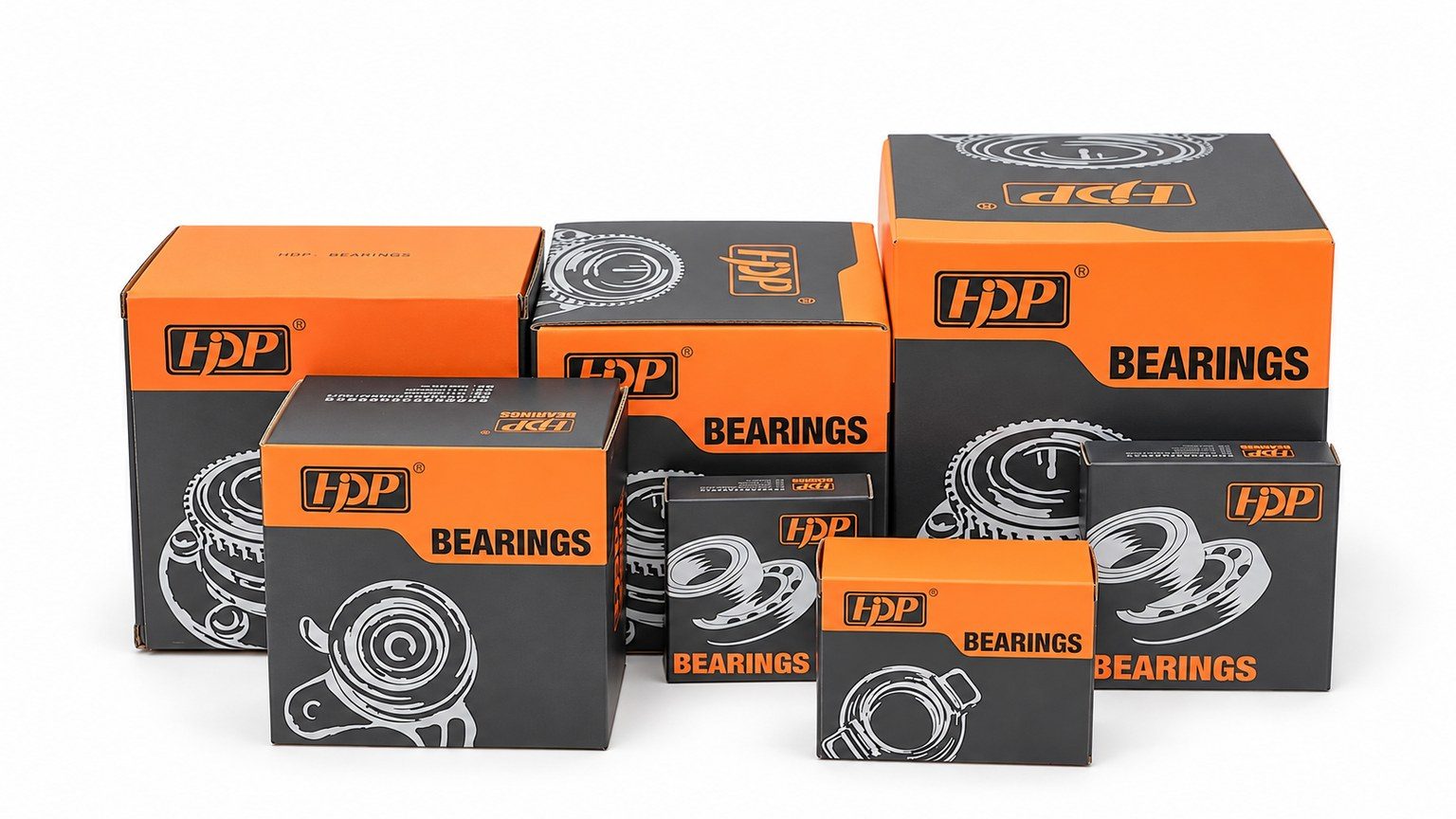
A wheel hub bearing for the MAZDA 323 F VI Hatchback is the rotating element that lets each wheel turn while carrying vehicle weight, cornering forces and brake loads. On this front-wheel-drive fastback the front units sit in the strut knuckles and are driven through the outer CV joint, while the rear units sit in the rear suspension assembly. Fitment is defined by dimensions, flange geometry, ABS configuration and sealing, not by model name, so every part should be confirmed against a drawing and a sample. huayuanbearing.com, the site of Jinan Huayuan Bearing Co., Ltd., manufactures and exports this class of hub bearing and hub unit.
What Does a Wheel Hub Bearing for MAZDA 323 F VI Hatchback Do?
A hub bearing has to do two things that pull against each other: let the wheel spin with almost no friction, and hold it rigid enough that the tyre stays square to the road under load. On the 323 F VI, the fastback body of the BJ-generation 323, that job is split between a front unit that also steers and transmits drive, and a rear unit that mainly carries cornering thrust and brake torque.
Vertical load from the corner weight reaches the bearing as radial load on the rolling rows. Cornering, kerb strikes and potholes arrive as axial load plus a bending moment, because the tyre contact patch sits outboard of the bearing centre line; a lower wheel offset or a wider spacer increases that moment and shortens life. Braking adds a fore-aft force at the same offset, and brake heat soaks into the flange after the car stops.
How the load path runs from tyre to body
Load travels from the tyre through the hub flange, the rolling elements, the outer ring, the knuckle, and finally the struts and body. Every interface in that chain has to be clamped, not merely tightened. A knuckle bore worn oval, a flange face carrying rust scale, or a stud hole stretched by impact will flex under load and ruin a new bearing quickly, even when the bearing itself was correct.
Why the front position is more demanding than the rear
The front hubs carry the engine and gearbox mass, steer with the wheels, absorb most of the brake heat and transmit drive through the outer CV joint. The result is a higher radial load, an oscillating tilt every time the wheel is turned, and a temperature cycle after every stop. Rear hubs carry a smaller share of the weight but a large share of cornering thrust, and their brake and handbrake arrangement differs between build variants.
Bearing, hub and hub unit are three different purchases
A bearing is a pair of rings with rolling elements; a hub is the flange the wheel studs sit in; a hub unit is both, assembled, greased and sealed as one non-serviceable part. Some 323 F VI builds are serviced with a press-in bearing and a separate flange, others with a complete bolt-on unit that carries an integrated encoder ring, and the two are not interchangeable. Because catalogue titles rarely make that distinction clear, our comparison of a wheel bearing versus a hub assembly is worth reading before the first order.
| Hub design | What the part contains | ABS arrangement | Service consequence |
|---|---|---|---|
| Generation 1 | Double-row bearing pressed into the knuckle or flange, with a separate hub flange and axle nut | Tone ring on the CV joint or on a separate ring | Needs a press and the correct axle-nut torque to set preload |
| Generation 2 | Sealed bearing cartridge with its own flange, bolted to the knuckle with three or four bolts | Encoder usually integrated in the seal | Replaced as a unit; the knuckle face must be clean and flat |
| Generation 3 | Bearing, flange and housing integrated, bolting directly to the knuckle | Magnetic encoder ring on most versions | Replaced as a complete unit; sensor gap is fixed by the design |
| Generation 3 with encoder | As above, with a defined pole count and a matched sensor position | Active or passive sensor feed, depending on vehicle wiring | Wrong pole count or a damaged ring produces ABS faults, not bearing noise |
Which Rolling Element Type Is Used in a Hub Bearing of This Size?
Passenger-car hub bearings in the 323 F VI class are almost always double-row angular contact ball bearings, because two ball rows give low friction and enough capacity for a car of this size and weight. Tapered and cylindrical roller bearings exist in the same envelope but answer different load cases, and the type should follow the original design rather than be upgraded by guesswork.
Double-row angular contact ball: the default for passenger hubs
Two rows of balls run on raceways ground at a contact angle, so the unit takes radial load and axial load in both directions. The rows are matched at the factory, which means internal clearance is fixed and the buyer does not set preload during installation. This is why a ball hub unit can be sealed for life and fitted with a single torque value.
Tapered roller bearings: line contact and adjustable preload
A tapered roller bearing carries load along a line rather than at a point, so it handles heavier combined radial and axial loads in a smaller space, which is why it dominates light commercial and older rear-drive hubs. The trade-off is that two cones must be set against each other with a defined preload or end float. Set too loose, the bearing frets and the flange moves; set too tight, it runs hot and spalls within a short distance.
Cylindrical roller bearings: radial capacity without axial location
Cylindrical rollers give the highest radial capacity of the three, but they locate the shaft radially only; axial position has to come from a separate thrust face or a second bearing. In passenger car hubs this arrangement is uncommon, but it appears in commercial and trailer hubs and on gearbox shafts where radial load dominates.
What this means for an order for this car
Order by the unit drawing rather than by bearing type, because the same model can be supplied with a press-in bearing and separate flange in one market and a bolt-on hub unit in another, depending on brake and ABS specification. State dimensions, ABS type and brake configuration in the enquiry, and treat rolling element type as a consequence of the design. Listings such as the HY3615131PR front wheel hub assembly for Mazda show how flange, stud pattern and sensor arrangement are presented together for exactly this reason.
How Is a Wheel Hub Unit Built? Steel, Heat Treatment, Clearance and Sealing
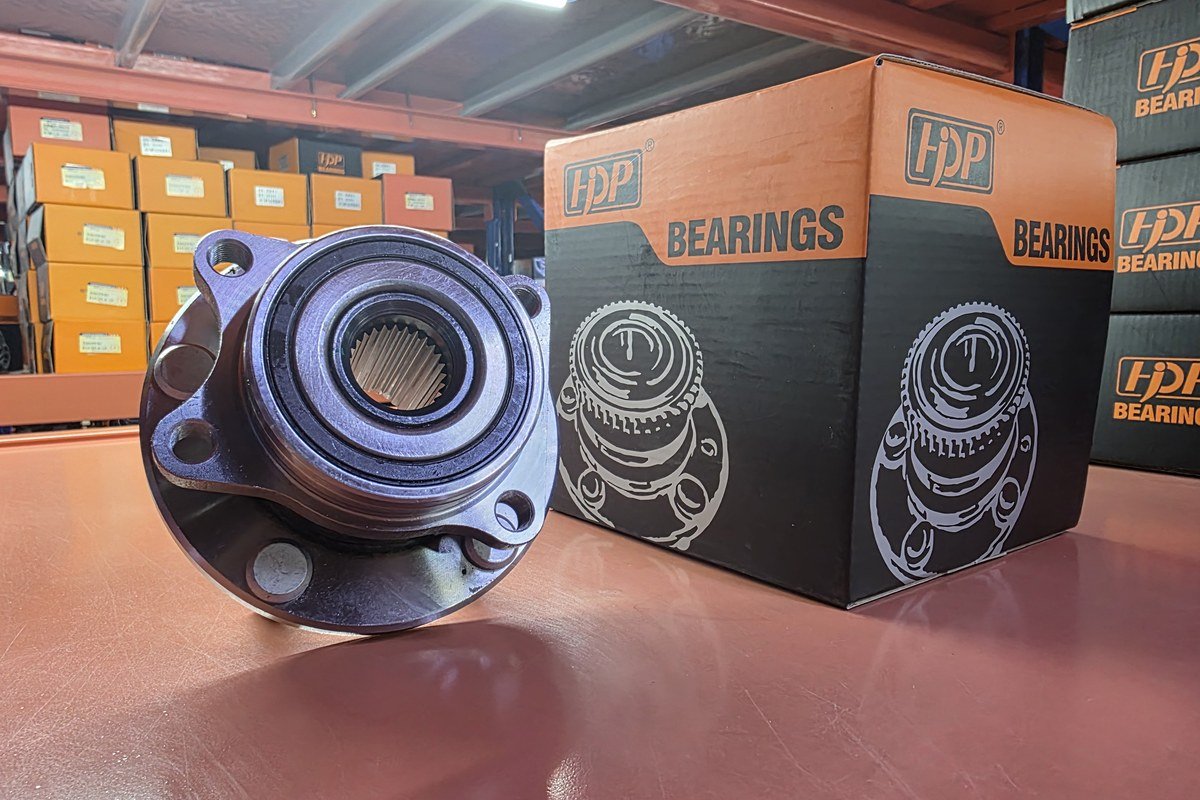
A durable hub unit is defined less by its catalogue grade than by four hidden decisions: steel cleanliness, heat treatment stability, clearance group and seal system. Buyers who ask about those four items get a more reliable part than buyers who ask only for a hardness figure.
Bearing steel and raceway quality
Rings and balls are made from through-hardening bearing steel of the 100Cr6, GCr15 or SAE 52100 family, chosen for a clean microstructure and uniform hardness. What separates a long-lived unit from a short-lived one is largely what the steel does not contain: oxide inclusions and coarse carbides act as stress raisers and start fatigue cracks right under the raceway.
Heat treatment and dimensional stability
Hardening and tempering bring the raceway to roughly 58 to 62 HRC while leaving a tough core. Two details matter in service. Retained austenite has to be controlled, because it transforms slowly under load and changes ring dimensions over time. The tempering temperature also has to sit above the hottest condition the hub will meet, so the part does not soften next to the brake.
Clearance groups and precision class
Internal clearance is the total gap between rolling elements and raceways before load is applied, and it is grouped (C2, CN or normal, C3, C4) rather than quoted as one number. A hub unit is normally built to normal clearance, because the interference fit in the knuckle and on the flange closes part of that gap once installed. Precision class (ISO P0, P6, P5 and equivalents) controls runout and raceway geometry, and on an ABS hub runout matters twice, affecting both bearing life and signal quality.
Sealing and grease: where most aftermarket failures begin
Hub units are sealed for life, with a multi-lip seal inboard and often a cassette or labyrinth seal outboard; grease fill is set at the factory, typically around a third of the free space. Water and grit are the two things that shorten life fastest, so lip material, lip interference and the finish of the seal counterface belong on the drawing review and on the sample check, not assumed from the mere presence of a seal.
The encoder ring and the ABS signal
On ABS versions a magnetised rubber or plastic encoder ring is bonded to the seal or flange and read by a sensor fixed to the knuckle. The ring carries alternating poles and the sensor counts the changes as the wheel turns. Ring damage, magnetic debris, or a wrong pole count on a hub that looks correct will produce an ABS fault that no amount of bearing replacement will cure.
How Do You Read a Hub Bearing Drawing and Confirm Fitment?

Fitment is decided by roughly eight dimensions plus the brake and ABS interfaces, so a drawing check is faster and more reliable than a catalogue lookup. A model year or an OE reference is a starting point, never proof.
The dimensions that actually decide whether it fits
- Inner bore or spline form, which pilots on the CV joint stub or spindle.
- Flange PCD, stud thread and knurl diameter, which set the wheel bolt pattern and clamp load.
- Flange offset, measured from the mounting face to the wheel face.
- Housing outside diameter and width, which set the press fit or bolt pattern in the knuckle.
- Knuckle spigot diameter and brake disc pilot, which centre the disc.
- Encoder pole count, sensor type and air gap on ABS versions.
One mismatch is enough to make a part unusable, and catalogue titles rarely carry all of these values. That is why an OE number alone does not settle fitment, as set out in our note on OE numbers and ABS wheel hub bearing fitment.
| Dimension or feature | What it controls | How to verify |
|---|---|---|
| Inner bore or spline | Pilot on the CV joint stub or spindle | Caliper across the bore; compare spline form with the sample |
| Flange PCD and stud thread | Wheel bolt pattern and clamp load | Measure centre to centre of adjacent studs; check thread pitch and knurl |
| Flange offset | Disc and wheel position relative to the knuckle | Height gauge from the mounting face to the flange face |
| Housing diameter and width | Press fit or bolt pattern in the knuckle | Micrometer on the housing; check the knuckle bore for ovality |
| Encoder pole count and air gap | ABS signal quality | Compare ring type and pole count with the old part; measure sensor gap |
| Seal profile and lip material | Water and dust exclusion | Compare seal section on the drawing and on the sample |
| Axle nut thread and washer | Preload on driven hubs | Check thread, integrated washer and the figure specified for the vehicle |
Step-by-step confirmation before you place an order
- Identify the exact build: body variant, front and rear brake type, and whether the car has ABS on that axle.
- Read the removed part: casting marks, seal colour, ring type and any numbers stamped on the flange.
- Measure the old part with a caliper and a height gauge at every point listed above, and record the values.
- Compare each measurement with the supplier drawing, item by item, and mark any dimension that is not stated.
- Confirm the ABS interface: sensor type, pole count, connector and air gap, and whether the ring sits on the seal or the flange.
- Approve a sample, fit it dry to a spare knuckle, torque to specification, then check runout and sensor signal before ordering volume.
A structured enquiry shortens this cycle considerably; the fields worth sending are listed in our wheel hub bearing RFQ checklist. Any part number, OE reference or application list should be treated as provisional until confirmed against drawing and sample.
Which Specification Suits Which Operating Condition?
Specification should follow the duty the car actually sees, not the highest specification available. Heat, dust, water and load profile decide which seal, grease and housing version is the sensible choice.
Heat, dust and water decide the seal and grease choice
In hot, dusty markets the limiting factors are grease oxidation and abrasive ingress rather than fatigue load. A grease with higher base-oil viscosity and a higher dropping point, together with a more protective inboard seal, is a reasonable request for those conditions. In humid or flood-prone markets the priority shifts to lip interference and counterface finish, because a single ingestion of water turns the grease into an abrasive paste.
Duty cycle and load case
Fleet, taxi and ride-hailing use changes the picture, because the same bearing completes many more revolutions per year and sees more brake heat cycles. Heavier wheels, wider tracks and larger brake conversions raise the bending moment on the flange, and the hub then becomes the weakest link unless the knuckle and disc are matched to it. State the duty in the enquiry, since it influences seal choice and clearance group.
Aftermarket programmes, private label and packaging
For distributors building a private label line, custom packaging and own-brand marking can be arranged as part of an order, while the internal geometry and seal system should stay exactly as drawn. Where a range covers several Mazda applications, for example a rear unit such as the HY3612553PR rear wheel hub assembly, keeping one drawing revision per item is what prevents cross-fitment errors later. The wider criteria for choosing such a range are covered in our wheel bearing and hub assembly selection guide.
What Makes a Hub Bearing Fail, and How Do You Identify the Cause?
Most hub bearing failures in this vehicle class are not manufacturing defects; they follow from installation damage, water ingress or a mismatched mating part, and the wear pattern usually identifies which.
| What the driver or technician notices | Most likely cause | What to check before replacing |
|---|---|---|
| Hum or drone that rises with road speed and changes when swerving left or right | Raceway spalling on the loaded side | Flange runout, axle-nut torque, tyre noise from the opposite corner |
| Rust-coloured grease weeping from the seal | Water ingress past a damaged or hardened lip | Seal counterface, knuckle shield, history of flood driving |
| Play at 12 and 6 o'clock with a pulsing brake pedal | Loose axle nut or a knuckle bore worn oval | Bore roundness, nut torque, disc runout |
| ABS warning lamp with no bearing noise | Damaged encoder ring or metal debris on the ring | Ring surface, sensor gap, wiring continuity |
| Blue or discoloured flange with hardened grease | Brake heat soak from a dragging caliper | Caliper slide pins, disc thickness, matching hub on that corner |
Reading the wear pattern before you replace the part
Spin the removed unit by hand and listen, then look at the raceways. A single deep dent points to impact during fitting; a broad matt band points to water; a narrow bright band at one position indicates false brinelling from long standing; a rough, flaked track on one side only suggests incorrect preload or a bent flange. Each pattern implies a different corrective action, and fitting a new unit without correcting the cause repeats the failure.
The symptom sequence that separates bearing noise from tyre, brake and CV joint noise is described in our guide to telling when a wheel hub bearing is failing.
Installation errors that look like bearing defects
Pressing on the outer ring instead of the inner ring, driving a unit in with a hammer, reusing a stretched axle nut, torquing with the wheel hanging in the air, or fitting onto a knuckle that was cleaned with a wire brush only, all produce failures that are blamed on the bearing. On a driven front hub the axle nut sets preload, so an impact gun without a torque wrench removes any control over that value.
How Should You Inspect and Install a Hub Bearing on the 323 F VI?
Inspection and installation discipline decide more of the service life than any single specification on the data sheet. Two short routines cover most of the risk.
Incoming inspection on arrival
- Check the carton, label and part reference against the order and the approved drawing revision; a mismatch at this point is cheapest to fix.
- Confirm the flange PCD, offset and stud thread with a caliper on one piece per batch, not on the sample only.
- Inspect the seal lip and the encoder ring surface for nicks, moulding flash or embedded metal particles.
- Rotate the unit by hand and listen for roughness; a sealed unit should turn smoothly with light drag and no clicking.
- Check that the studs are pressed square, that threads are undamaged, and that the mounting face is free of burrs.
A listing that carries this level of detail, such as the HY3613356PR front wheel hub assembly, is easier to verify against a delivery than one that shows a single photograph.
Installation sequence
- Clean the knuckle bore and mounting face to bare metal and check roundness and flatness before anything is fitted.
- Fit the unit dry, without grease on the mating faces, and seat it squarely by hand before applying force.
- Torque fasteners in a cross pattern in two stages to the figure specified for the vehicle, using a calibrated wrench.
- Fit the brake disc and caliper, then check disc runout with a dial gauge.
- Torque the axle nut with the vehicle on the ground and the brake applied, never with the wheel hanging free.
- Check wheel-end play at 12 and 6 o'clock, then confirm the ABS signal and road-test for noise.
Points that decide how long the part lasts
Keep the encoder ring clean and away from magnetic tools, replace the axle nut rather than reusing it, and never press or hammer on the flange face. After any kerb impact, check flange runout before assuming the bearing is at fault, because a bent flange destroys a correct unit within a short distance.
FAQ: Wheel Hub Bearing for MAZDA 323 F VI Hatchback
Can I replace just the bearing instead of the whole hub?
Only if the vehicle was built with a press-in bearing and a separate flange. Where the original part is a sealed hub unit with an integrated flange and encoder ring, the unit is replaced as one assembly, because the bearing is not serviceable and the sensor gap is set by the housing. Confirm the original configuration from the removed part and the drawing.
How do I know whether my car has ABS rings on the hubs?
Check for a wheel speed sensor and wiring at each corner, and inspect the removed hub for a magnetised ring bonded to the seal or flange. Build variants differ by market and year, so the reliable answer comes from the vehicle itself and from the old part, confirmed against a drawing and sample rather than from a model name.
How long should a hub bearing last?
Service life depends on load, road surface, water exposure, brake heat and installation quality, so no fixed interval applies. A correctly fitted unit on a clean knuckle with the right axle-nut torque normally outlasts the surrounding brake components; repeated early failures usually point to a mating-part or installation problem rather than the bearing.
Can Huayuan supply a private-label hub bearing for this model?
Jinan Huayuan Bearing Co., Ltd. develops wheel hub bearings and hub units from drawings and samples, and supports custom packaging and own-brand marking for distributors. Because the 323 F VI was built in several configurations, the drawing and a physical sample are the basis for any quotation or programme discussion at huayuanbearing.com, not a model-year list.
Purchasing guidance, product information and company updates from Huayuan Bearing.