
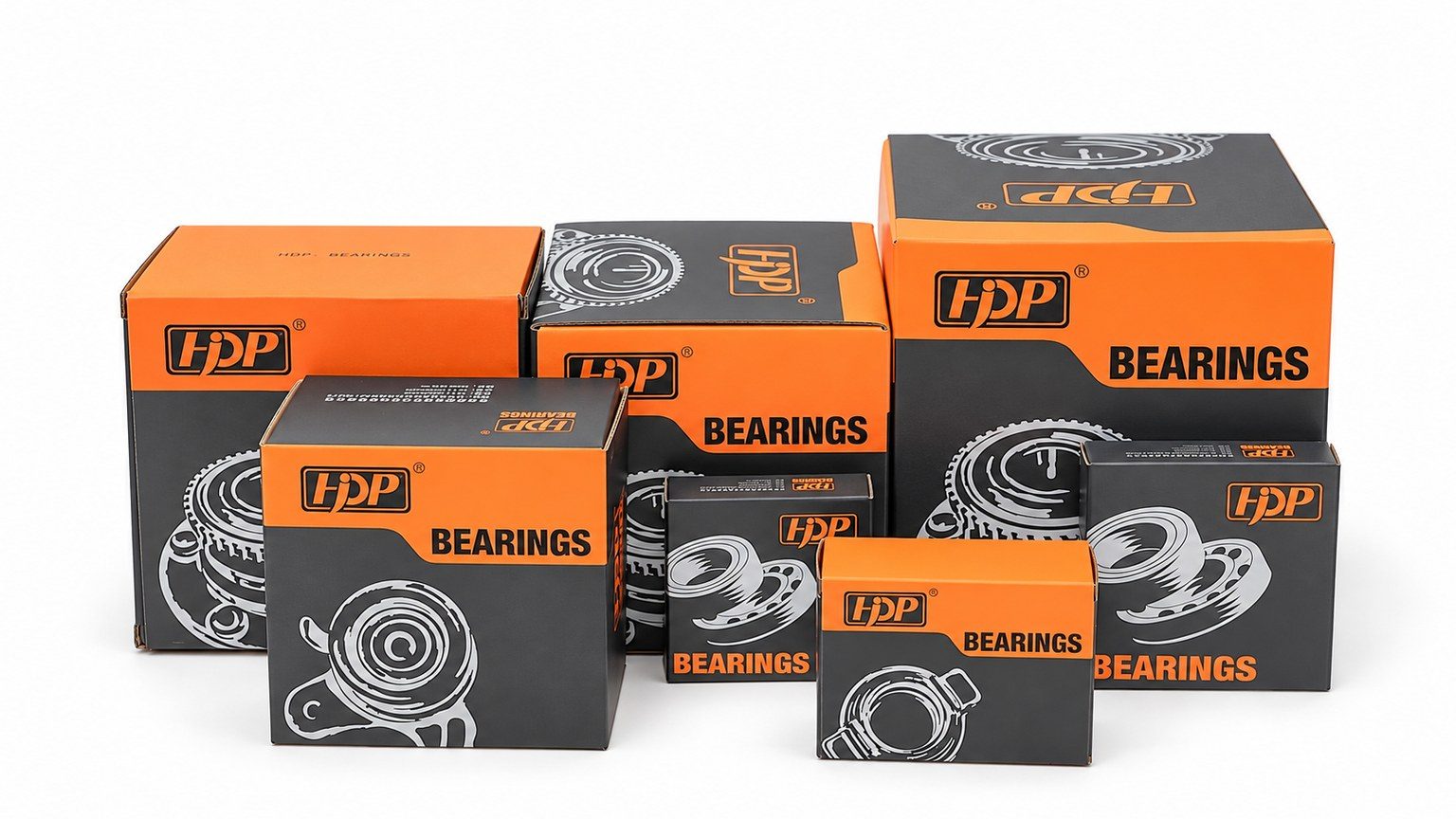
A wheel hub bearing for the HYUNDAI ix35 is a sealed, pre-greased hub unit that carries the wheel on the knuckle, locates the brake disc and rim, and gives the ABS sensor a rotating signal to read. Whether a given part fits and lasts depends on five things: the unit generation, the flange and pilot dimensions, the ABS encoder interface, the preload built in at assembly, and the quality of the sealing. The model name never confirms a match on its own; the OE number, a drawing and a physical sample do.
What Is a Wheel Hub Bearing for the HYUNDAI ix35?
A wheel hub bearing for the HYUNDAI ix35 is best understood as a wheel-end module rather than a bearing in the traditional sense: the rolling bearing, the flange that carries the wheel, the seal package and, on ABS cars, the encoder ring are supplied as one pre-greased assembly. The ix35 is a compact SUV, so each front corner carries a comparatively high static load and the suspension geometry keeps the bearing under continuous bending load. Both factors push the specification toward a stiff double-row unit with a robust outboard seal.
In the replacement market the part is normally sold as a complete hub assembly, and that is the right way to think about it: the bearing cannot be adjusted or re-greased, and it is replaced as a unit. Jinan Huayuan Bearing Co., Ltd. (huayuanbearing.com), a bearing manufacturer and exporter based in Jinan, Shandong, produces hub bearings and hub units of this type for aftermarket and assembly customers, alongside tensioners, CV joints and other running-gear parts.
Which components make up the assembly?
Every element in the list below is a potential source of a fitment or durability complaint, so each should be visible on a drawing or measurable on a sample:
- Outer ring with mounting flange — carries the bolt holes that fix the unit to the knuckle; bolt count, pitch circle diameter and flange offset must match the vehicle.
- Double-row rolling set — balls or rollers in two rows with converging contact angles, so the unit takes radial and axial load at the same time.
- Inner ring with wheel flange — the machined face that centres the brake disc and rim; face runout and stud pattern are set here.
- Seals on both sides — the outboard seal faces road splash, the inboard seal faces the knuckle; both are usually multi-lip cassette designs.
- Magnetic encoder — on ABS versions a rubber-bonded or sintered ring fixed to the rotating inner ring, read by a stationary sensor.
- Wheel studs or threaded holes — thread size, length and knurl diameter differ between applications even when the flange looks identical.
How does a hub unit differ from a press-in wheel bearing?
A press-in wheel bearing carries only the races and rolling elements; the vehicle's own stub axle and hub flange provide the locating surfaces, and an interference fit plus a circlip hold the part in the knuckle. Preload in that design depends on the press fit and the axle nut torque, so installation quality changes the outcome directly. A hub unit moves those variables into the factory: flange, races, encoder and seals are matched and preloaded on the production line, and the workshop only has to bolt it on and torque it correctly. The trade-off is that nothing inside can be serviced — a damaged seal or raceway means a new unit. The differences are set out in more detail in this comparison of a wheel bearing versus a complete hub assembly.
Which Hub Unit Generation Fits: Gen 1, Gen 2 or Gen 3?
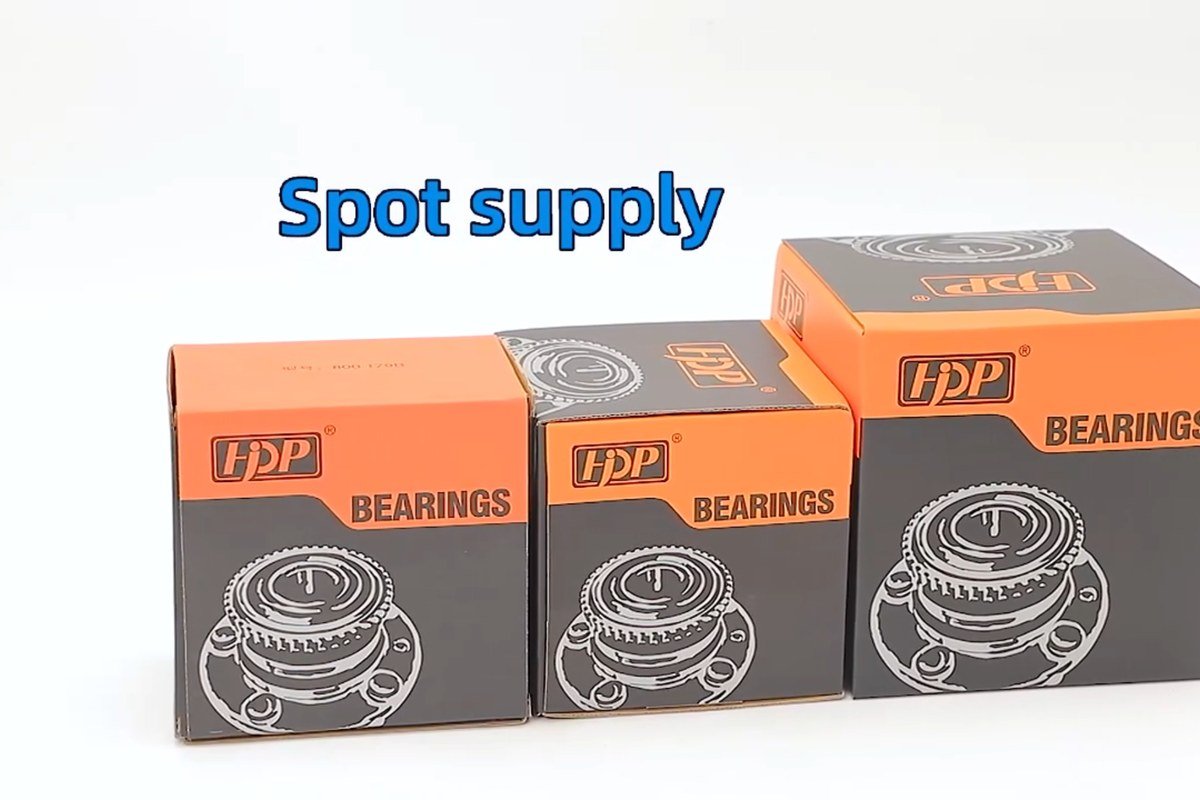
Generation numbers describe construction, not quality, and they decide how much of the fitment risk sits with the supplier rather than the installer. On ix35-class compact SUVs the front axle is typically a third-generation flanged hub unit bolted to the knuckle, while the rear can be a third-generation unit or a press-in bearing depending on brake type and whether the axle is driven — which is exactly why two parts that look similar are not interchangeable.
| Generation | How it is built | Preload set by | ABS provision | What it means for the buyer |
|---|---|---|---|---|
| Gen 1 | Separate double-row bearing with two inner rings, mounted between a stub axle and a hub flange | Axle nut torque during installation | Encoder fitted separately to the hub or bearing | Lowest cost, highest installation risk; preload changes if the nut is over- or under-torqued |
| Gen 2 | Bearing with a flange on the outer ring, bolted to the knuckle or brake drum; inner rings still ride on a stub axle | Partly at assembly, finalised by the axle nut | Encoder integrated into the seal | Fewer installation variables, but nut torque still matters |
| Gen 3 | Fully integrated: outer ring flange bolts to the knuckle, inner ring flange carries the studs and the disc | Fully preset and sealed at the factory | Encoder ring on the inner ring, read through the seal | Non-serviceable drop-in fitment; preload and sealing become the supplier's responsibility |
The practical consequence for a distributor is that one vehicle can need two different constructions front and rear, and a catalogue line that says only "fits ix35" — without generation, flange pitch circle and ABS type — is not enough to release stock against. Where a platform was built over many model years, the front corner itself may change, so the confirmed combination should be treated as a part number in its own right.
Which rolling element suits SUV duty: ball, tapered roller or cylindrical?
Double-row ball units cover the majority of passenger-car and compact-SUV corners; tapered roller units are specified where axial load, stiffness or durability under heavy payload dominate; cylindrical roller bearings appear where radial capacity is the priority and axial location is handled by a separate face. The choice changes load rating, friction and sensitivity to misalignment, so it should be read from the drawing rather than assumed from the vehicle class.
| Rolling element | Radial capacity | Axial capacity | Stiffness | Typical use | Watch out for |
|---|---|---|---|---|---|
| Double-row ball, angular contact | Good | Good in both directions | Moderate | Most passenger-car and compact-SUV corners | Seal damage; false brinelling during long storage |
| Tapered roller, single or double row | High | High in one or both directions | High | Heavier vehicles, towing duty, commercial use | Preload setting and lubrication quality |
| Cylindrical roller | High | Low | High radial | Applications with separate axial location | Misalignment and edge loading on the raceway |
A tapered roller hub unit is not simply stronger than a ball unit: it is stiffer and better at carrying combined load, but it needs correct preload and tighter lubrication control, and it is less forgiving of the seal damage that lets water into the grease.
How Is a Hub Unit Built: Materials, Heat Treatment, Seals and Preload?

Service life is decided inside the unit by four things a buyer cannot see from the outside: the steel and its heat treatment, the preload, the grease fill and the sealing. Heat treatment can be checked on a certificate and by metallography; the other three are set by the manufacturing process and can only be judged from the drawing, the sample and the field record.
Which steel and heat treatment are used, and why does it matter?
Rings and rolling elements are normally made from through-hardening bearing steel of the 100Cr6 or GCr15 family, hardened and tempered to roughly 58 to 64 HRC, then ground and superfinished so raceway roughness stays in the low tenths of a micrometre. Flanges and hubs are usually medium-carbon or micro-alloyed steel, forged or machined, with induction-hardened seats where a ring is mounted. Case-carburising appears where shock loading is expected, because a hard case over a tough core resists wear and cracking at the same time. The useful question for a buyer is not the grade name but whether hardness and case depth are verified per batch and recorded.
How are the seals and the grease specified?
Sealing is the weakest link in most wheel-end failures in wet or dusty markets. A durable hub unit uses a cassette-type seal with several lips, a labyrinth path and a steel slinger, so water has to change direction repeatedly before it reaches the grease; lip material is usually nitrile for general use and FKM where brake heat and coastal humidity combine. Grease is typically a lithium-complex or polyurea NLGI 2 with EP additives, filled for life in a quantity matched to the internal volume — too little starves the outboard row, too much churns and overheats. Because the fill is set at assembly, the seal is the only barrier in service, which is why a torn seal found during installation should end the job rather than be taped over.
What do precision class, clearance and preload mean on a sealed hub?
Precision covers dimensional and running accuracy, and on hub units it is usually quoted against ISO 492 classes — normal, 6 or 5, broadly comparable to ABEC 1, 3 and 5. Clearance is the internal gap between rolling elements and raceways before load; on a sealed hub unit it is preset at assembly, so a drawing normally specifies axial play, often a few hundredths of a millimetre, and starting torque rather than a CN or C3 clearance class. Preload is the negative clearance that keeps both rows loaded, stiffens the corner and prevents skidding: too little produces noise and raceway skid marks, too much produces heat and short grease life. Flange perpendicularity and mounting-face runout belong in the same conversation, because hub runout is transferred into brake disc lateral runout and reappears later as pedal pulsation.
What Loads Does the Hub Bearing Carry on a Compact SUV?
A front hub unit carries four loads at once: the corner weight of the vehicle, the lateral force generated in a corner, the longitudinal force from braking and driving, and the bending moment created by rim offset — the distance between the wheel centre plane and the bearing centre line. All four pass through two rows of rolling elements separated by a few tens of millimetres, which is why contact angle and preload matter as much as the basic load rating.
Which loads act at the front corner?
- Vertical load — static corner weight plus dynamic transfer under braking, cornering and road input; the dominant term for bearing fatigue.
- Lateral load — generated at the contact patch in a turn and reacted at the knuckle; it loads the two rows unevenly.
- Longitudinal load — braking and traction forces that alternate direction and load the cage and flange face.
- Moment from rim offset — a wider track or lower offset wheel increases the lever arm and the moment on the unit, even when vertical load is unchanged.
- Thermal load — heat conducted from the brake disc during repeated heavy braking, which ages grease and hardens seal lips.
What does the rear axle demand, and where do the CV joint and tensioner fit?
Rear hub units on a compact SUV usually carry less vertical load than the front but face the same water, salt and dust exposure, so seal quality dominates their service life. On a driven axle the outer CV joint passes through the hub, and its spline and nut take over part of the wheel location — which means hub and joint replacement interact, and a worn joint spline can produce play that looks like bearing play. The accessory drive tensioner sits in a different system but belongs to the same wear package on a high-mileage vehicle, and Huayuan Bearing supplies tensioners and CV joints alongside its hub bearings and hub units for that reason: a workshop buying a wheel-end repair usually needs the adjacent parts from the same source.
Which operating conditions change the specification?
- Larger diameter wheels with lower offset — higher bending moment and more seal articulation.
- Rough or unpaved roads — impact loads, dust ingress and damaged seals.
- Coastal humidity and winter salt — corrosion of the encoder and the seal counterface.
- Frequent heavy payload or towing — higher and more continuous vertical load, mainly at the rear.
- Long storage or infrequent use — false brinelling from vibration while the vehicle stands.
- Stop-and-go urban duty — repeated brake heat cycles, which are harder on grease than steady cruising.
How Do You Read a Hub Unit Drawing and Confirm Fitment?
Fitment is decided by a handful of dimensions and two interfaces — the bolt pattern and the ABS encoder — and never by the vehicle name. A drawing that is complete for production purposes states all of the parameters below, and a quotation that omits them is a quotation for a part that has not yet been fully defined.
| Drawing parameter | What to check | Why it decides fitment |
|---|---|---|
| Flange bolt pitch circle and count | Centre distance of holes, hole diameter, thread | Wrong pitch circle means the unit cannot be bolted to the knuckle |
| Pilot (spigot) diameter | Wheel-centring diameter on the flange face | Wrong pilot gives wheel eccentricity, vibration and stud loading |
| Overall height and flange offset | Face-to-face distance, bearing centre line position | Changes disc and wheel position and can foul the caliper |
| Stud thread and knurl | Thread size and pitch, stud length, knurl diameter | Wrong studs prevent wheel fitment or crack the flange |
| ABS encoder type | Encoder on hub or on seal, magnetic or inductive, pole count | Wrong encoder triggers ABS faults with no mechanical symptom |
| Press-in outer diameter | Bore diameter and tolerance, where a press fit applies | Wrong interference causes spin-out or a cracked knuckle |
An OE number is a starting point, not a proof: supersessions, market variants and mid-cycle changes mean one number can cover several constructions. Combine the number with measurement, as described in this guide to OE number fitment and ABS encoder matching.
- Record the OE number from the removed part, plus the axle position and the exact vehicle variant.
- Measure the removed part: flange pitch circle and bolt count, pilot diameter, overall height, stud thread, press-in diameter.
- Identify the ABS interface: encoder on the hub or on the seal, pole type, sensor air gap.
- Compare against the drawing dimension by dimension and mark every deviation, however small.
- Request a sample and trial-fit one piece on the vehicle before committing to a batch.
- Keep the confirmed measurements as the reference for repeat orders, so the next shipment is checked against data rather than memory.
For cross-checking a front corner before sampling, a vehicle-specific listing such as this Hyundai ix35 wheel hub assembly reference shows how flange, stud and encoder details are presented for one application, and a front wheel hub assembly for Hyundai applications shows the same data in single-unit form. Huayuan Bearing can develop hub units from drawings and samples and supports custom packaging and private-label programmes, which is the practical route when a vehicle variant falls outside a standard catalogue line.
How Should a Hub Unit Be Installed and Inspected on Arrival?
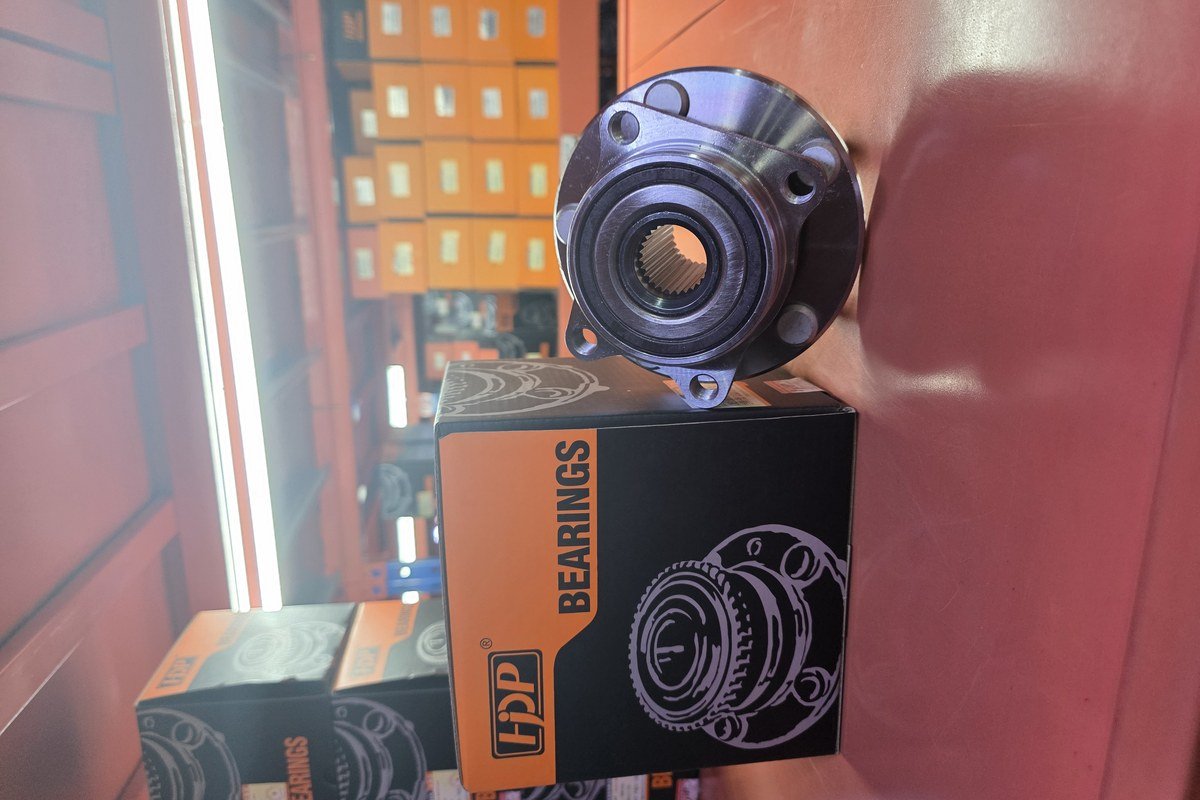
Most hub units that fail within the first few thousand kilometres were damaged before the wheel touched the ground — by pulling on the studs, hammering the flange, reusing a stretched axle nut, or bolting to a knuckle face that still carried rust scale. Installation discipline and goods-in inspection therefore matter as much as the specification.
Which installation steps decide service life?
- Clean the knuckle bore and mounting face back to bare metal; rust scale and old thread-locker change clamp load and squareness.
- Support the knuckle or trailing arm — never the ball joint boot or the brake hose — and never let the assembly hang on the brake line.
- Draw the unit in with a puller acting on the flange, or press on the outer ring only for a press-in bearing; never transmit force through the balls or the studs.
- Fit new mounting bolts where the vehicle specification calls for torque-to-yield fasteners, and clean the threads first.
- Torque in a cross pattern in two stages to the figure in the vehicle data, not to a guessed value.
- Replace the axle nut and stake or crimp it as specified; a reused nut can lose clamp load and let the spline fret.
- Check hub face runout with a dial gauge after final torque, then recheck brake disc lateral runout.
- Test drive and confirm ABS lamp behaviour and the absence of noise at low speed in both directions.
What should incoming inspection cover on a delivery?
- Packaging and rust preventive — no condensation, no crushed cartons, no parts rubbing against each other.
- Seal condition — no lifted lips, no cuts, no grease weeping at the seal or on the encoder side.
- Rotation — smooth, light and free of notchiness; a rough spot suggests a brinelled or contaminated raceway.
- Encoder — clean, undamaged, correct type, with no metal particles clinging to the surface.
- Dimensions — pitch circle, pilot diameter, overall height, stud thread and press-in diameter against the drawing.
- Marking and traceability — batch identification that lets a complaint be traced back to production.
A short sampling routine at goods-in catches most supplier problems before they reach a workshop; the checks that matter commercially are listed in this supplier evaluation framework for wheel bearings and hub assemblies.
What Are the Common Failure Modes and What Do They Indicate?
Hub failures fall into a small number of recognisable patterns, and each pattern points to a different root cause — which is why a returned part should be read before it is scrapped. Reading the part is also the only reliable way to separate a manufacturing defect from installation error or road damage.
| Failure pattern | What the part shows | Most likely cause | What it means for a claim |
|---|---|---|---|
| Grease leakage at the outboard seal | Wet, dusty track on the flange, low grease level | Lip damage at installation or a kerb impact | Usually installation or road damage rather than material |
| Raceway corrosion | Red-brown staining and pitting along the ball path | Water ingress past a worn or damaged seal | Moisture exposure; check the vehicle side sealing too |
| Spalling on one side | Flaking or a rough patch on a single loaded zone | Contamination, or overload from a misaligned knuckle | Check knuckle squareness and mounting-face condition |
| False brinelling | Evenly spaced indentations matching ball spacing | Long storage with vibration, transport without support | Storage and transport practice, not service wear |
| Fretting at the mounting flange | Polished, worn bolt holes and movement marks | Under-torque or reused fasteners | Assembly error rather than a part defect |
| ABS fault without noise | Damaged or contaminated encoder, debris on the ring | Handling damage or metal particles from brake work | Inspect the encoder before condemning the sensor |
How do symptoms map to a diagnosis?
- Hum or growl that rises with road speed and changes when steering is loaded left or right — typically a front hub raceway.
- Play felt at 12 and 6 o'clock on the wheel — bearing wear or a loose axle nut; play at 3 and 9 o'clock more often points to steering or suspension parts.
- ABS lamp with no mechanical noise — encoder condition or sensor air gap, not necessarily the bearing.
- Vibration under braking without pedal pulsation — disc runout originating at the hub face.
- Grease streaks on the inner wheel face — seal failure, often after a kerb strike.
The complete symptom list, including how to separate tyre noise from bearing noise, is covered in how to tell a wheel hub bearing is failing.
What Else Do Buyers Ask About ix35 Hub Bearings?
Will a wheel hub bearing listed for the HYUNDAI ix35 fit other Hyundai or Kia models?
Sometimes, but that cannot be confirmed from the model name. Shared platforms and facelifts often reuse a corner, yet flange offset, stud pattern and encoder type can still differ. Confirm by OE number, flange pitch circle, pilot diameter and ABS encoder type, and treat any cross-reference as a lead that must be verified against a drawing or a physical sample, with the final match confirmed by drawing and sample.
Can I replace only the bearing instead of the complete hub unit?
On a third-generation hub unit, no. The races, flange and encoder are matched, preloaded and sealed at the factory, so pressing the assembly apart destroys the preload and the seal. Where a vehicle was originally built with a press-in bearing and a separate hub flange, that bearing can be replaced on its own, provided the knuckle bore and flange face are within tolerance.
How can I tell whether the noise comes from the hub bearing or the tyre?
Rotate or swap the wheels first. Tyre noise usually follows the wheel and changes with road surface, while bearing noise stays with the corner and changes with load transfer in a turn. Bearing rumble typically appears above walking pace, becomes a growl at higher speed and is louder on the loaded side. Confirm with the wheel raised and the hub turned by hand.
What information should I send to get a matching part quoted?
Send the OE number, the axle position, the exact vehicle variant, measurements or photos of the removed part, and the quantity plus packaging requirement. A drawing is better than a description. The wheel hub bearing RFQ checklist lists the fields that prevent a second round of questions and a wrong sample order.
Purchasing guidance, product information and company updates from Huayuan Bearing.