
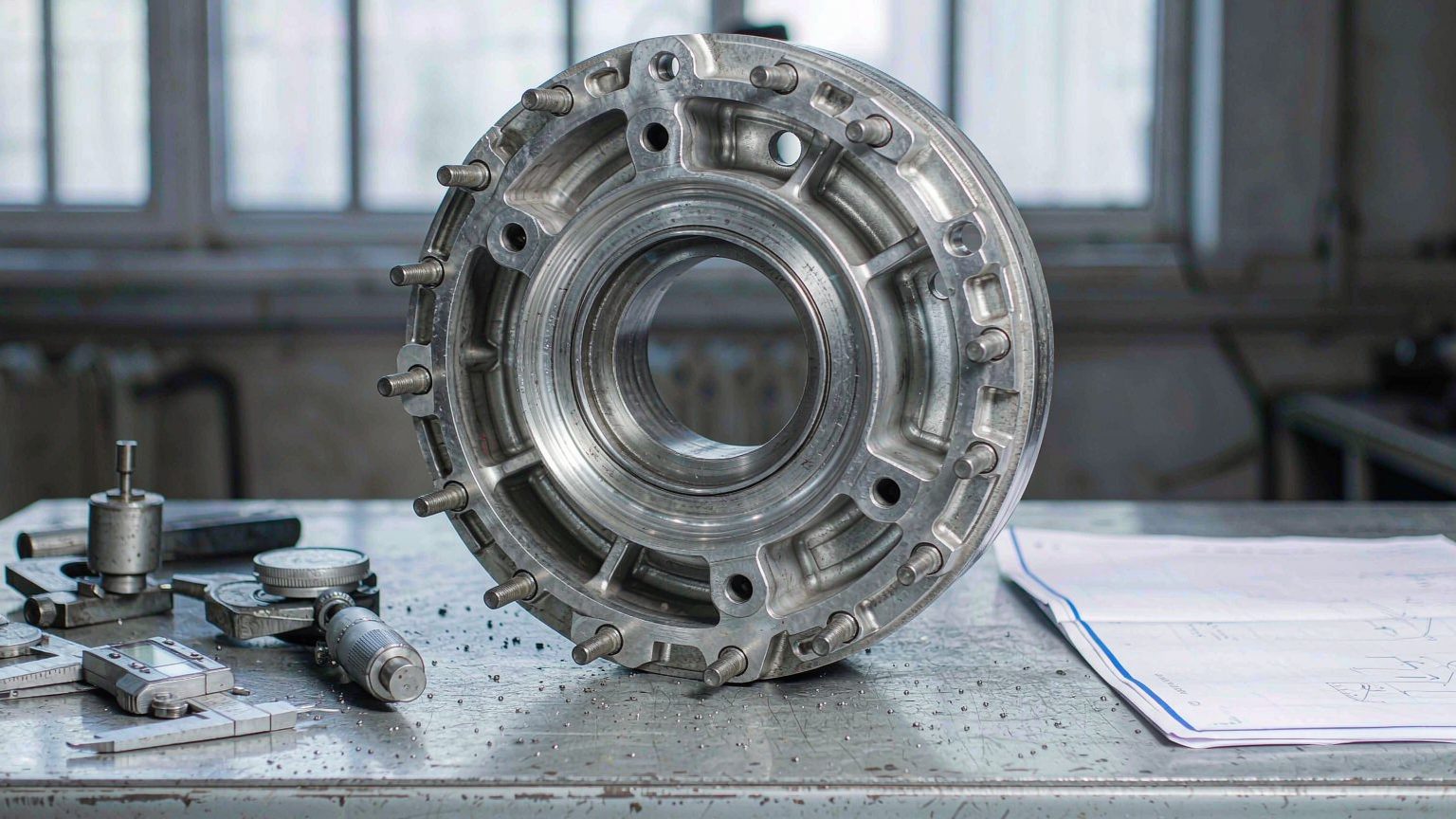
A wheel hub bearing for a Honda Civic is the sealed rolling bearing that carries the hub on the steering knuckle or rear axle member, sets the wheel's position in space and provides the rotation reference the ABS sensor reads. Across Civic generations it appears in two main forms: a press-in bearing cartridge that reuses the original hub flange, and an integrated hub unit or hub assembly that bolts on as a single part. The correct component is decided by generation, front or rear position, encoder type and drawing dimensions, never by the model name alone.
What Is a Wheel Hub Bearing for a Honda Civic?
A wheel hub bearing is a pre-greased, double-row rolling bearing that supports the rotating hub on the suspension and locates the wheel and brake disc. It is a precision locating component rather than a simple rotating support, which is why wear usually appears first as noise, play or an ABS fault instead of a gradual loss of performance.
What the Part Does Under the Car
The front bearing carries more load than the rear one, and that difference affects how a replacement should be chosen and installed. On a strut-type front suspension such as the Civic's, the bearing sits in the steering knuckle and takes three loads at once: the vertical share of vehicle weight plus dynamic load from bumps, the axial force generated when the tyre grips in a corner, and the bending moment applied by the wheel offset. At the rear, on either a trailing-arm or multi-link arrangement, the vertical load is lower but the axial load from cornering is still present, and the bearing also has to hold brake and handbrake hardware true.
Because the bearing fixes the wheel plane, a worn unit changes camber and toe slightly, wears the tyre shoulder and can push the ABS signal out of range before the bearing is audibly noisy. That is why a hub bearing check belongs in any diagnosis of uneven tyre wear or an intermittent ABS light, not only in a noise complaint.
Hub Bearing, Hub Unit or Hub Assembly: What Is the Difference?
The three terms describe how much of the hub is built into one part, and they are not interchangeable when a purchase order is written.
- Bearing cartridge: the bearing alone, pressed into the knuckle or trailing arm and held by a circlip; the original hub flange is pressed into its inner ring during installation.
- Hub unit: bearing, flange and encoder built and sealed as one non-serviceable part, normally bolted to the suspension.
- Hub assembly: a hub unit supplied together with the ABS sensor, harness or mounting bolts, so the repair becomes a bolt-on operation.
Confusing a cartridge with a unit is the most common ordering error in this category, because both are sold under the same short description. The comparison of wheel bearing versus hub assembly sets out the differences before a part number is quoted.
Which Generation of Wheel Hub Unit Does a Civic Use?
Generation is a design classification, not a model-year rule: it records how much of the hub has been integrated into one sealed part, and the actual design on a given car must be confirmed from the part removed or from the drawing.
First-Generation Units: Press-In Cartridge
A first-generation hub bearing is a double-row angular contact ball bearing with seals on both sides and, where ABS is fitted, a magnetic encoder ring on one face. It is pressed into the knuckle bore and retained by a circlip, and the hub flange is then pressed into the bearing inner ring. Replacement is possible at bearing level, which makes bore condition and pressing technique decisive for service life.
Second-Generation Units: Flanged Unit
A second-generation unit adds the mounting flange to the bearing, so the part is bolted to the suspension instead of being pressed in. The encoder is normally integrated and the unit is sealed for life. There is no separate hub to press, which removes one of the main installation risks but makes the part non-serviceable: the whole unit is replaced.
Third-Generation Units: Integrated Hub Assembly
A third-generation unit integrates bearing, flange, wheel studs and encoder in one housing and often carries the ABS sensor or its mounting point. It is the most common form on modern passenger cars. Front and rear versions differ in flange diameter, stud count, offset and sensor position, and mixing them is a frequent cause of fitting problems, so front and rear references are worth keeping apart even when the part looks similar.
| Feature | Generation 1 | Generation 2 | Generation 3 |
|---|---|---|---|
| What is integrated | Bearing and seals only | Bearing, flange and encoder | Bearing, flange, studs and encoder, often the sensor |
| Mounting method | Pressed into knuckle, circlip retained | Bolted to knuckle or axle member | Bolted directly, no press operation |
| ABS signal | Encoder ring, or none on older cars | Integrated magnetic encoder | Integrated encoder, sometimes active sensor |
| Replacement level | Bearing can be replaced alone | Unit replaced as a whole | Unit replaced as a whole |
| Typical failure point | Raceway spalling, seal ingress | Encoder damage, seal ingress | Encoder or harness damage, bearing play |
Front and rear parts for the same vehicle family rarely share dimensions, which is why catalogue pages list them separately; a front hub assembly reference for a Honda application and a rear hub assembly reference show how the two positions diverge in flange and sensor layout. Neither listing should be treated as a fitment statement for a specific car: fitment is confirmed with the OE number, the drawing and a physical sample.
How Do You Identify the Correct Hub Bearing for a Specific Car?
Identification starts with the vehicle and ends with dimensions: the model narrows the search, but only the drawing confirms the part.
The Identification Sequence
- Record the vehicle identification number, model year, engine variant and whether the market version has ABS or stability control.
- Note the position: front left and front right are usually identical, while rear parts differ from front parts in almost every dimension.
- Read every marking on the part removed from the car, including casting numbers on the knuckle side of the flange, not only the bearing face.
- Measure the flange: outer diameter, bolt circle, stud count and stud thread, and the distance from the mounting face to the wheel face.
- Identify the ABS interface: encoder type, encoder position and sensor orientation, since two otherwise identical units can differ only here.
- Compare all of the above against a dimensioned drawing, then confirm with a sample before any volume order is placed.
How to Read a Hub Bearing Drawing
A hub bearing drawing is a fitment document, and the parameters below are the ones that decide whether a part will fit and last.
- Bore and outer diameter of the bearing rings, with tolerances, for press-fit applications.
- Width and offset, which position the wheel plane and therefore affect alignment.
- Flange diameter, bolt circle and stud specification, including knurl diameter and thread.
- Encoder type and pole count, plus sensor air gap and connector orientation.
- Internal clearance or preload, normally set at assembly for sealed hub units and not adjustable in service.
- Seal arrangement and grease fill, including grease type and quantity.
- Load ratings and the reference speed used for the rating.
What an OE Number Tells You, and What It Does Not
An OE number identifies a part as the vehicle manufacturer specified it, but it does not prove that a given aftermarket unit is equivalent. Numbers are superseded, one number can cover several model variants, and market-specific versions can share a number while differing in encoder or flange detail. Treat an OE number as a search key, then verify the physical characteristics. The notes on OE number, fitment and ABS encoder checks explain where cross-references usually break down; the hub bearing RFQ checklist lists what to send a supplier so the drawing comes back correct the first time.
Which Internal Design, Material and Seal Suit Which Duty?
For passenger-car hub units the default is a double-row angular contact ball bearing, because it carries combined radial and axial load in a narrow, light package that suits a driven or non-driven passenger hub.
Ball, Tapered Roller or Cylindrical Roller
Double-row angular contact ball bearings handle the combined loads of normal road use with low friction and need no adjustment in service. Tapered roller bearings carry higher radial and axial loads and are used where wheels are larger or loads heavier, but they are supplied as two opposed rows and require correct preload during installation. Cylindrical roller bearings carry very high radial load with no axial capability and are normally paired with a separate locating bearing.
Material and Heat Treatment
Raceways and rolling elements are made from through-hardened bearing steel of the 100Cr6 / GCr15 family, hardened and tempered to a controlled hardness range and finished to a fine surface texture. Cage material, typically glass-fibre reinforced polyamide or pressed steel, matters at higher speeds and temperatures. Heat treatment and grinding quality determine rating life far more than the nominal steel grade, which is why the drawing and the process control behind it are worth reviewing rather than the material name alone.
Precision Grade and Internal Clearance
Hub bearings are usually produced to a precision class around P6 or better as defined in ISO 492, with the exact class stated on the drawing. Internal clearance in a sealed hub unit is set by design and by the interference fit of the flange, so it is not adjustable after assembly; an incorrect fit, not an incorrect clearance figure, is the usual cause of a tight or loose hub after installation.
Sealing and Lubrication
Sealing decides hub bearing life more than any other single feature in wet or dusty markets. A contact lip seal with an additional labyrinth or cassette shield keeps water and grit out while retaining grease; a single lip without a shield is adequate only for dry, clean use. Grease is normally a lithium-complex or polyurea type selected for wide temperature range and water resistance, filled to a quantity that lubricates the raceways without over-packing the free space, which would raise running temperature.
| Parameter | What it controls | What to confirm on the drawing |
|---|---|---|
| Ring dimensions and tolerances | Press fit and knuckle retention | Bore, outer diameter, width, tolerance class |
| Precision class | Runout, noise and vibration | ISO 492 class and measured runout values |
| Internal clearance or preload | Operating temperature and play | Design preload, mounting interference range |
| Seal arrangement | Water and grit exclusion | Lip material, shield or cassette type, grease retention |
| Grease specification | Life at temperature and speed | Grease type, base oil viscosity, fill quantity |
| Encoder and sensor interface | ABS signal quality | Encoder type, pole count, air gap, connector position |
| Flange geometry | Wheel location and alignment | Bolt circle, stud count and thread, offset |
Why Do Hub Bearings Fail, and How Do You Confirm the Diagnosis?
Most hub bearing failures on a Civic-sized car start with seal ingress or an installation error, not with a manufacturing defect in the bearing steel.
| Symptom | Likely cause | Confirming check |
|---|---|---|
| Hum that changes when swerving left or right | Raceway damage in one wheel bearing | Road test on a quiet surface, load transfer left and right, compare sides |
| Play felt at 12 and 6 o'clock | Worn bearing or loose axle nut | Wheel raised, rock vertically, then repeat at 3 and 9 o'clock to separate bearing from steering play |
| ABS or traction light with no other fault | Damaged or contaminated encoder ring | Read wheel speed on all four wheels and inspect the encoder face for debris or scoring |
| Grease visible around the seal | Seal lip damage or overheating | Clean the area, drive, re-inspect, and compare hub temperature with the opposite side |
| Clicking on take-up in tight turns | Outer CV joint rather than the bearing | Repeat on full lock at low speed; a hub bearing does not click with steering angle |
| Vibration at a narrow speed band | Wheel or tyre imbalance, hub runout | Measure hub flange runout with a dial gauge before condemning the bearing |
What a Road Test and a Lift Check Add
A road test separates bearing noise from tyre noise, because bearing noise follows load transfer while tyre noise follows road surface. On the lift, spin each wheel by hand and feel for roughness, then check for play in both planes and measure flange runout. Heat is a useful confirmation: after a comparable drive, a hub noticeably hotter than its opposite number is suspect. The signs of a failing wheel hub bearing covers the sequence in more detail, including the ABS symptoms that appear before mechanical noise.
How Should a Hub Bearing Be Installed and Inspected on Arrival?
Installation quality explains most of the difference between a hub bearing that lasts and one that returns as a warranty claim within a season.
Installation Sequence for a Press-In Cartridge
- Clean the knuckle bore and check it for scoring, ovality and corrosion; a damaged bore will tilt the new bearing.
- Remove the circlip and inspect the groove before fitting anything new.
- Apply force only to the outer ring when pressing the bearing into the knuckle, using a driver that covers the full ring face.
- Never transmit press force through the rolling elements or the seal, and never use a hammer.
- Fit the circlip fully into its groove and confirm it is seated around the whole circumference.
- Support the inner ring when pressing the hub flange in, so the load path stays through the ring and not through the balls.
- Tighten the axle nut to the vehicle manufacturer's figure with the wheel on the ground, then check end play and runout.
- Road test, and run an ABS self-test or relearn procedure where the vehicle requires it.
Incoming Inspection at the Warehouse
Incoming inspection is cheaper than a returned assembly, and it takes minutes per batch.
- Match carton labels, part numbers and quantities against the purchase order and the approved drawing revision.
- Check that the protective cap, seal lip and flange face are undamaged and free of grease weep.
- Rotate the unit by hand: smooth rotation with light, even resistance is acceptable; roughness or a tight spot is not.
- Inspect the encoder ring for scoring, contamination and correct seating, and check stud threads and knurl.
- Spot-check key dimensions with a caliper or micrometer against the drawing, and keep the record with the batch.
- Retain one sample per batch so a future claim can be compared against what was actually shipped.
Jinan Huayuan Bearing Co., Ltd. (huayuanbearing.com) manufactures and exports wheel hub bearings, hub units, tensioners and CV joint components from Jinan, Shandong, for aftermarket replacement and OE-supply customers, mainly in the Middle East and Southeast Asia. The company develops parts to drawing or sample and supports custom packaging and private label, which is why an approved drawing is the practical starting point for a programme. The supplier evaluation points used for hub assemblies apply equally here, and the rear hub assembly reference for a Honda application shows the level of detail a drawing request should carry.
Frequently Asked Questions About Wheel Hub Bearings for the Honda Civic
How do I know which wheel hub bearing fits my Honda Civic?
A Civic can use a press-in bearing cartridge or an integrated hub unit depending on generation, front or rear position and ABS type, so start from the part removed from the car and its markings. Compare casting numbers, flange bolt circle, stud count and encoder type against the drawing. Where the number is unreadable, confirm with a dimensioned drawing and a physical sample before ordering volume.
Can I replace only the bearing instead of the whole hub?
Only where the design allows it. A first-generation press-in cartridge can be replaced on its own if the knuckle bore, circlip groove and hub flange are undamaged. On integrated second- and third-generation units the bearing, flange and encoder form one sealed assembly, so the unit is replaced as a whole; pressing such a unit apart destroys it.
How long should a Civic wheel hub bearing last?
There is no fixed service interval, because life depends on load, road surface, water and salt exposure, wheel offset and, above all, installation quality. A bearing pressed or bolted correctly, with an undamaged seal, usually outlasts one installed with a hammer or into a damaged knuckle bore. Inspect for play, noise and seal condition rather than replacing on a mileage schedule.
What should I check when a hub bearing delivery arrives?
Match carton labels, part numbers and quantities to the purchase order, then check that the protective cap and seal lip are undamaged and that no grease has wept from the seal. Rotate the unit by hand for smoothness, inspect the encoder ring and stud threads, and spot-check key dimensions with a caliper against the approved drawing.
Purchasing guidance, product information and company updates from Huayuan Bearing.