
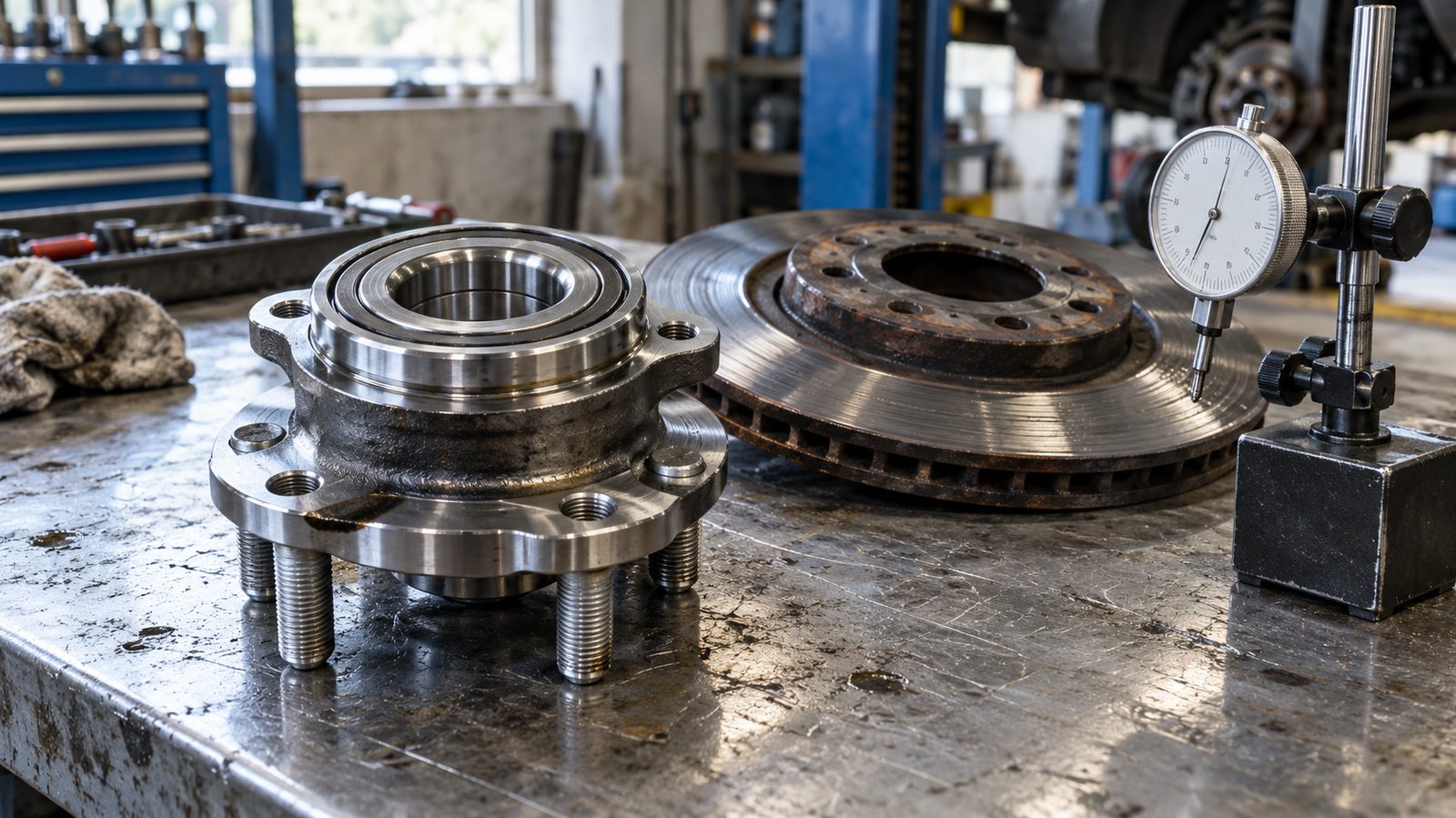
The quickest way to tell which wheel hub bearing type a vehicle uses is to work outward from the axle: confirm whether the hub is driven or non-driven, read the OE number and any bearing marking, check whether the bearing is pressed into the knuckle or bolted on as a complete unit, measure the bore, flange and bolt pattern, and note whether an ABS sensor or magnetic encoder ring is present. That combination identifies the generation and the roller type. Jinan Huayuan Bearing Co., Ltd., at huayuanbearing.com, develops automotive hub bearings, hub units, tensioners and CV joints from drawings and samples for aftermarket and OE customers.
What Is a Wheel Hub Bearing Type, and What Defines It?
A wheel hub bearing type is defined by four properties: the generation of the bearing, the rolling element and the load direction it carries, the way it is mounted and retained, and its sealing and sensing arrangement. Bore, flange and bolt pattern describe the wheel and brake interface rather than the bearing itself, so two hubs with the same bolt circle can still be different parts. A hub bearing carries vehicle weight as radial load and cornering or camber thrust as axial load, and on a driven axle it must also clear the constant velocity joint that passes through its centre.
The four identifiers
- Generation. Gen 1 uses separate bearings pressed into a hub or steering knuckle; Gen 2 combines the bearing with one integrated flange; Gen 3 is a complete hub unit containing bearing, flange and housing.
- Rolling element. Tapered roller, cylindrical roller or ball; this sets radial and axial load capacity and how the bearing is adjusted.
- Mounting and retention. Pressed into the knuckle, bolted to the knuckle or bolted to the axle flange, with a plain bore on a non-driven axle and a splined bore on a driven one.
- Sealing and sensing. A lip seal, a cassette seal, or a seal carrying a magnetic encoder ring that an active ABS sensor reads.
Why similar vehicles use different hub bearings
Vehicle description alone does not fix the bearing type. The same model can be built with a driven or non-driven rear axle, with or without ABS, with different brake disc sizes and with different axle loads across trims and markets, and each change alters the hub. A catalogue keyed only to model, year and engine can therefore return several candidates.
It also helps to know whether the job needs a bearing or a complete assembly; this wheel bearing versus hub assembly guide sets out the distinction.
The same point is drawn from a workshop angle in wheel hub bearing vs wheel hub assembly.
How to Tell Which Wheel Hub Bearing Type a Vehicle Uses: Step-by-Step
Identification is a sequence rather than a single lookup, because the OE number is often corroded away and a catalogue can list more than one candidate for the same vehicle. Work through the steps below and record every measurement.
- Establish the axle layout. Note whether the hub sits on a driven or non-driven axle, whether the wheel is steered, and whether the vehicle has ABS or stability control; those three facts eliminate most candidates.
- Record every marking on the old part. Note the OE number, the bearing maker's number and any casting or laser marking on the flange, and photograph them before cleaning.
- Look at how the part is retained. A circlip, locknut or press fit points to a serviceable bearing inside a hub; a flange held by four bolts usually means a complete hub unit.
- Identify the rolling element. On the removed part, check for tapered rollers, cylindrical rollers or balls, and count the rows.
- Check the ABS interface. Note whether an encoder ring is built into the seal, whether the sensor is active or passive, and where the sensor mounts.
- Measure the interfaces. Record bore, outer diameter, width, flange diameter, bolt circle, bolt count, spline count and pilot diameter.
- Inspect the seal and grease. Note the seal profile, the lip direction and whether the unit is greased for life.
- Confirm against a drawing or a sample. Compare every value with the manufacturer's drawing or a physical sample, and treat catalogue cross-references as a starting point only.
If the vehicle is already on the lift, the symptoms are evidence too: roughness, play and the position of the noise help separate a worn bearing from a wrong-type fitment, as described in this wheel hub bearing noise diagnosis note.
Which Generation Is It: Gen 1, Gen 2 or Gen 3?
The generation tells you what you are actually replacing: a bearing, a flanged bearing unit, or a complete hub unit that bolts to the vehicle. Generations are defined by how much of the assembly is integrated, not by physical size.
| Generation | Construction | How it mounts | ABS interface | What you see on the bench |
|---|---|---|---|---|
| Gen 1 | Two single-row bearings, usually tapered | Pressed into hub or knuckle with separate seals and a nut or circlip | Separate sensor ring or axle-mounted sensor | Loose cones, cups, seal and retaining hardware |
| Gen 2 | Bearing unit with one integrated flange | Outer ring presses into the knuckle; the flange is the wheel face | Encoder ring often built into the inboard seal | A flanged unit that still needs a press |
| Gen 3 | Complete unit: bearing, flange and housing | Bolted to the knuckle or axle flange | Encoder ring usually integrated; sensor mounts on the housing | A sealed, non-serviceable bolt-on unit |
Generation 1
A Gen 1 hub uses separate bearing rows pressed into a hub or knuckle, commonly two single-row tapered roller bearings arranged face to face, with separate seals and an adjusting nut, spacer or circlip to set endplay. The bearings can be replaced individually, which is why Gen 1 parts are often supplied as cone-and-cup sets.
Generation 2
A Gen 2 unit integrates the bearing with a flange on one side. The flange carries the wheel studs or bolt holes, while the outer ring still presses into the knuckle. The unit is normally sealed and pre-set, so endplay is not adjustable, and an encoder ring may be built into the inboard seal.
Generation 3
A Gen 3 hub unit is complete: bearing, hub flange and housing in one sealed, non-serviceable assembly that bolts to the knuckle or axle. It carries the wheel directly, and on a driven axle the bore is splined to accept the constant velocity joint. Encoder rings and sensor mounting features are common at this generation.
Gen 2 or Gen 3: the test on the bench
Ask one question: does the outer ring press into the vehicle's knuckle, or does the unit bolt on with its own housing? If the outer component stays on the vehicle and only the flanged part is replaced, it is Gen 2. If the whole unit comes off with the flange attached, it is Gen 3.
Generation, load and duty cycle are the three inputs to a correct choice; this wheel bearing and hub assembly selection guide works through them.
Which Roller Type and Load Direction Does the Hub Carry?
The rolling element decides how much load a hub can carry and in which direction: tapered and angular-contact ball rows take combined radial and axial load, cylindrical rollers take heavy radial load with little axial capacity, and deep groove ball bearings suit lighter loads at higher speed.
| Rolling element | Load carried | Typical position | Identification clue |
|---|---|---|---|
| Single-row tapered roller | Radial plus axial in one direction; used in opposed pairs | Trailer hubs, older front hubs, driven rear axles | Separate cone and cup, adjustable endplay |
| Double-row tapered roller | Combined radial and axial | Gen 1 to Gen 3 hubs on SUVs and light commercial vehicles | One outer ring with two opposed roller rows |
| Double-row angular contact ball | Radial with moderate axial | Passenger-car Gen 2 and Gen 3 hub units | Two ball rows in a one-piece outer ring |
| Cylindrical roller | High radial, limited axial | Truck and axle hubs, gearboxes | Cylindrical rollers, usually paired with a thrust element |
| Deep groove ball | Light radial and axial | Belt tensioner and idler pulleys | Single ball row, snap-ring grooves on the outer ring |
Radial and axial load
Vehicle weight loads the hub radially, while cornering, camber and braking loads act axially. A tapered roller bearing handles both because its roller axis is angled, but only in one axial direction, so tapered bearings are always used in opposed pairs. A double-row angular contact ball bearing does the same job with lower friction, which is why it dominates passenger-car Gen 2 and Gen 3 units. Cylindrical roller bearings are chosen where radial load is high and a separate thrust element takes the axial component.
How tensioner and CV joint parts differ from hub bearings
A belt tensioner uses a small sealed deep groove ball bearing pressed into a pulley; the load is light and radial, and the usual failure mode is grease loss and noise rather than structural collapse. A constant velocity joint works differently: a cage holds six balls between an inner and an outer race, or a tripod design uses three rollers, to transmit torque through an angle on a driven shaft. Neither is specified by hub bearing dimensions, so both are defined from their own drawings and samples.
How Do You Read the Drawing, OE Number and Markings to Confirm the Type?
A hub bearing drawing and its OE number are the two documents that fix the type: the drawing defines geometry, material and tolerance, and the OE number links the part to a vehicle application.
What a hub bearing drawing has to show
- Interface geometry: bore, outer diameter, width, flange diameter, bolt circle and bolt count, pilot diameter, spline count, and the position of any retaining groove.
- Sensor features: presence, position and pole count of an encoder ring, sensor mounting holes and the air gap reference.
- Sealing and lubrication: seal type and profile, grease specification and fill, and whether the unit is filled for life.
- Bearing internals: rolling element type and size, number of rows, clearance or preload class, and the fit between flange and bearing.
- Material and heat treatment: bearing steel grade, hardening method for races and flanges, and surface protection.
- Marking and packaging: what must be stamped on the part, and how it must be packed and labelled.
OE numbers, supersession and cross-references
OE numbers change over a vehicle's life: a manufacturer may supersede a part several times while the physical fitment stays the same, so a supersession chain can be longer than a catalogue suggests. Cross-references from competing brands help build a candidate list, but they are not proof, because two parts can share a cross-reference and still differ in encoder type or flange thickness. Always confirm the final part by drawing and sample.
The way OE numbers, ABS interfaces and fitment data connect is explained in this guide to OE number and ABS wheel hub bearing fitment.
A supplier-side view of the same problem appears in wheel hub bearing OE cross reference and fitment files.
Jinan Huayuan Bearing Co., Ltd. develops hub bearings and hub units from customer drawings and samples, so a confirmed drawing is also the starting point for a quotation at huayuanbearing.com.
How Do Seals, Grease, Clearance and Material Narrow the Choice?
Seals, grease, clearance and material decide whether a hub bearing reaches its expected service life, and each of them is specified on the drawing rather than chosen at the counter.
Sealing
Seals are the first line of defence against water, salt and grit. The common options are a single lip seal with a garter spring, a multi-lip cassette seal, or a seal with an integrated magnetic encoder ring. Lip direction matters: an outboard-facing lip sheds water while an inboard-facing lip retains grease. A hub used in mud, salt or standing water needs a more robust profile than one used in a dry climate, and seal failure causes more early bearing failures than a wrong bore size.
Lubrication
Most modern hub units are filled for life with a defined grease quantity and are not relubricated in service. Older Gen 1 hubs with separate bearings may be packed during installation. Grease specification, fill level and mixing rules are set by the drawing, and adding a different grease to a sealed unit is not a repair.
Clearance and preload
Bearing internal clearance is a class, not a single number, and the drawing states which class a hub uses. Tapered roller hubs are adjusted to a defined endplay or preload during assembly, while Gen 2 and Gen 3 units are pre-set by the manufacturer and must not be adjusted. Excessive preload generates heat; excessive endplay produces play at the wheel and uneven tyre wear.
Material and heat treatment
Bearing races and rolling elements are typically made from through-hardened bearing steel, while flanges and splined hubs may be case-hardened or induction-hardened to resist wear and torque. Hardness depth, core toughness and surface finish all affect life, and none of them can be judged by eye. The relationship between steel grade, heat treatment and hub life is examined in wheel hub bearing steel quality.
Where Is Each Type Used, and How Do You Verify It at Goods-In?
Position and duty cycle determine which type a vehicle needs, and a goods-in check determines whether the shipment actually matches it.
Position and duty cycle
Front hubs on most passenger cars are both driven and steered, so they use a splined Gen 3 unit or a Gen 2 unit working with a separate CV joint; rear hubs on the same car are often non-driven, with a plain bore and lower axial load. SUVs and light commercial vehicles use larger double-row tapered units because axle load is higher. Trailer hubs commonly use two single-row tapered bearings that the operator adjusts. Belt tensioners sit on the accessory drive and see light radial load at high speed. The same bearing family can therefore appear in very different duty cycles, which is why application data belongs on the drawing.
Goods-in checks before the carton is booked in
Verification is a short, repeatable routine. Check the items below against the drawing and the purchase order, and record the result against the batch number.
| Check | What to confirm | Why it matters |
|---|---|---|
| Marking and number | Part number, batch and brand marking match the purchase order and drawing | Prevents two generations being mixed in one carton |
| Dimensions | Bore, outer diameter, width, flange diameter, bolt circle and bolt count | Press fit and brake or wheel clearance depend on them |
| ABS interface | Encoder ring present or absent, and the sensor type | A wrong interface triggers ABS faults |
| Seal and grease | Seal profile, lip direction and grease fill | Water ingress and early failure |
| Rotation | Smooth rotation with no roughness or play beyond the drawing | Detects handling or press damage |
| Packaging and label | Custom box, private label, barcode and quantity per carton | Protects the distributor's brand at resale |
Installation and replacement points
- Clean and inspect the knuckle bore; burrs, corrosion or an old press mark will distort a new unit.
- Press on the correct ring only, supporting the loaded race, and never hammer the flange or the encoder ring.
- Replace the retaining nut, circlip or bolts with new parts of the specified grade.
- Confirm the ABS sensor air gap and mounting position against the drawing before refitting the wheel.
- Use the vehicle manufacturer's torque figures, which are not interchangeable with generic values.
- Road test, then recheck for play, noise and warning lights.
Huayuan supplies custom packaging and private-label programmes, mainly for customers in the Middle East and Southeast Asia, which is why packaging and marking sit alongside dimensions in this check.
A suspect part should be compared with the patterns described in how to tell a wheel hub bearing is failing.
The ordering data that makes a clean goods-in check possible is listed in the wheel hub bearing RFQ checklist.
FAQ: Wheel Hub Bearing Type Identification
Can I identify the hub bearing type from the VIN alone?
No. A VIN narrows the build configuration, but it does not tell you the bearing generation, the encoder type or the flange dimensions. Use the VIN to collect candidate OE numbers, then confirm the type by measuring the interfaces and checking the drawing and a sample.
Is a Gen 3 hub unit always a bolt-on part?
In practice, yes. A Gen 3 unit includes its own housing and is retained by bolts to the knuckle or axle flange. If the part you are removing presses into the knuckle and leaves the outer ring behind on the vehicle, you are working on a Gen 2 unit.
What if the OE number on the old part is unreadable?
Measure the interface dimensions and the ABS features, then match those values against the drawing. Photograph the part from several angles, including the seal and any sensor ring, because those details often separate two candidates that share the same overall dimensions. Confirm by sample before ordering volume.
Does an ABS warning light mean the wrong hub bearing was fitted?
Not necessarily, but it is a common cause when a hub with an integrated encoder is replaced by one without, or when the sensor or its ring is damaged during installation. Check the sensor, air gap and connector first, then compare the fitted part with the drawing.
Purchasing guidance, product information and company updates from Huayuan Bearing.