
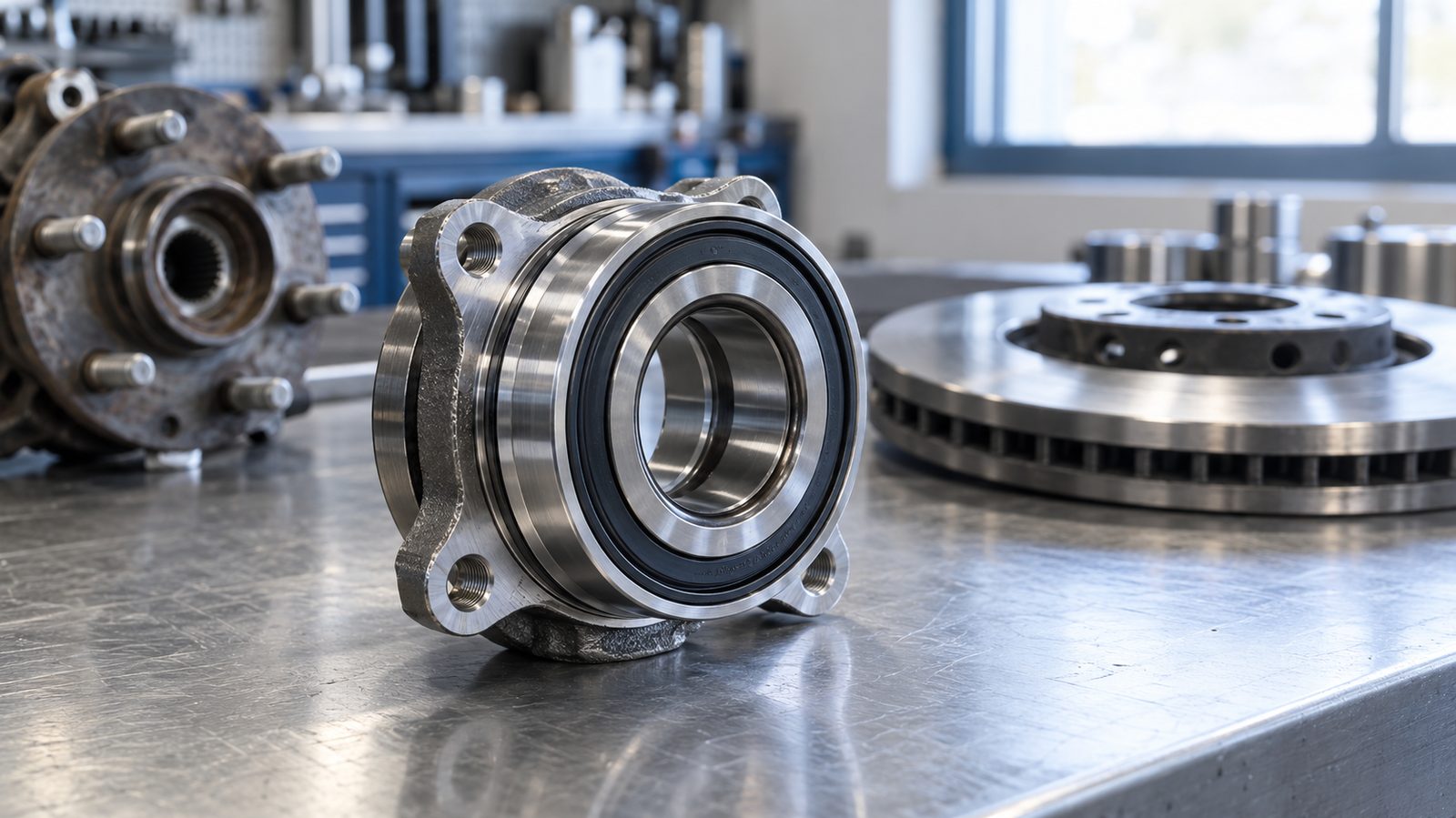
A wheel hub bearing carries the vertical load of the vehicle, centers the wheel on the axle or steering knuckle and lets the wheel rotate with minimum friction. It moves load from the tire contact patch through the rim and flange into the suspension, and it keeps the wheel's axis of rotation stable under cornering, braking and road impact. On most modern cars it also provides the rotating reference that the ABS wheel-speed sensor reads, and on a driven axle the same unit transmits drive torque. Jinan Huayuan Bearing Co., Ltd. (huayuanbearing.com) manufactures wheel hub bearings, hub units, tensioners and CV joint components for aftermarket and OE supply.
What Does a Wheel Hub Bearing Do in a Vehicle?
A wheel hub bearing does three jobs at the same time: it carries the weight of the vehicle, it positions the wheel precisely on the axle or knuckle, and it lets the wheel turn with as little friction as possible. The double row, the seals, the flange and the encoder ring all exist to make those three jobs repeatable over a long service life on real roads.
The load path from tire to chassis
The hub bearing is the last structural joint between the rotating wheel and the stationary suspension. Vertical load enters at the tire contact patch, passes through the rim to the hub flange, from the flange into the outer ring, across the rolling elements into the inner ring and from there into the axle stub or knuckle. The bearing sets both the wheel's position along the axle axis and its alignment in camber, caster and toe, so wear changes alignment as well as clearance. That is why a worn hub bearing can appear first as uneven tire wear or a steering pull rather than as an obvious noise.
Which loads act on a wheel hub bearing?
A hub bearing rarely carries one load type in isolation, so a single radial rating does not describe its duty.
| Load type | Direction | Where it dominates | What it drives in the design |
|---|---|---|---|
| Radial load | Perpendicular to the axle axis | Every wheel position, continuously | Ring section, number and size of rolling elements, two-row layout |
| Axial (thrust) load | Along the axle axis | Cornering, side impact, cambered roads | Contact angle, flange and rib geometry, preload |
| Impact load | Sudden radial and axial spikes | Potholes, curbs, unpaved roads | Case depth, core toughness, cage strength, seal retention |
| Drive torque | Rotation around the axle axis | Driven wheels only | Spline, flange and bolt connection rather than the raceway |
Radial load dominates in straight-line driving and is shared between the two rows of rolling elements. Axial thrust rises sharply in cornering and when a wheel is pushed sideways against a curb, and it is carried mainly by the contact angle of the rows and by the preload between them. Impact load is why a hub bearing is judged on case depth, core toughness and cage strength as much as on static capacity, because a pothole produces a short spike that a smooth-road calculation never predicts.
Why wheel hub bearings are sealed and pre-greased
A wheel hub bearing is a sealed, pre-greased, non-regreasable unit: grease fill and seal arrangement are fixed at production and are not serviced in the field. That is the clearest practical difference between an automotive hub bearing and an open industrial bearing that is lubricated on a schedule. The consequence for importers and workshops is that contamination is the main enemy: once water, salt or grit passes a damaged seal lip, the lubricating film breaks down and the damage advances with every rotation.
What the bearing contributes to ABS wheel speed sensing
Many hub bearing units also generate the signal for the ABS and traction control system, using either a magnetic encoder ring built onto a rotating ring or a toothed ring, depending on the design. The sensor reads that ring across a fixed air gap, so the encoder must finish in the correct plane and on the correct side once the unit is pressed into the knuckle. Encoder type, position and pole count are drawing-specific and should be confirmed on the drawing and on a physical sample rather than inferred from a catalog photo; the same discipline applies to OE number and fitment checks for ABS wheel hub bearings.
How Is a Wheel Hub Bearing Structured, and What Does Each Part Do?
A wheel hub bearing is a double-row angular-contact bearing that is assembled, preloaded, greased and sealed as one replaceable unit, and in most current designs it also carries the mounting flange.
Rings, rolling elements and cage
The inner ring or rings sit on the spindle or axle stub and rotate with the wheel, while the outer ring is the fixed side, pressed into the knuckle or hub bore or bolted through a flange. Between the rings run two rows of rolling elements, and a cage keeps them evenly spaced and guides them through the loaded and unloaded zones of each revolution. The rows are preloaded against each other at assembly, and that preload is what gives the unit its stiffness and its ability to resist radial and axial load at the same time.
Flanges, hub bolts and mounting bores
On flanged designs the flange is a load-bearing interface, not a bracket. The wheel and brake disc bolt to it, so flange diameter and face runout control wheel and disc runout, the spigot centers the wheel, and bolt circle, hole count and thread decide whether the vehicle hardware fits at all. On press-fit designs the knuckle bore is equally critical, because a worn or out-of-round bore lets the outer ring creep, which costs preload and shortens life.
Seals, grease and the encoder ring
Each side of the bearing is closed by a seal, usually a multi-lip elastomer or cassette design with an internal grease barrier; the inboard seal faces road water, salt and grit, while the outboard seal protects the brake side. Grease type and fill quantity are specified on the drawing and are calculated for the life of the unit rather than for a service interval. Where wheel-speed sensing happens at the hub, one ring also carries the encoder, which adds a positional requirement to an otherwise purely dimensional part.
| Component | Function | What to confirm on the drawing or sample |
|---|---|---|
| Inner ring (one or two) | Rotating side on the spindle or axle stub | Bore diameter, shoulder position, spline or press-fit detail |
| Outer ring | Fixed side in the knuckle or hub bore | Outside diameter, width, flange detail, mounting holes |
| Rolling elements | Carry load between the rings | Type (ball, tapered roller, cylindrical roller), size, number per row, contact angle |
| Cage | Spaces and guides the rolling elements | Material and running clearance to the rings |
| Seals | Keep grease in, keep water and grit out | Lip design, number of lips, material, fitted height |
| Grease | Lubricates for the whole service life | Fill quantity, type and distribution |
| Flange and hub bolts | Mount the wheel and brake disc | Flange diameter, spigot, bolt circle, thread, bolt grade |
| Encoder ring | Rotating reference for the ABS sensor | Magnetic or toothed, position, side, pole count |
Which Type of Wheel Hub Bearing Fits Which Application?
The generation number of a hub bearing describes how much of the mounting interface is built into the unit, and that is what determines how it is installed and replaced.
First-generation wheel hub bearings
A first-generation wheel hub bearing is the bearing alone: a double-row angular-contact ball or tapered roller design with no integrated flange. It is pressed into the hub or knuckle, or in some rear-axle designs it is fitted and then set up in service. Generation 1 parts remain common on older platforms and on rear axles where the hub is a separate serviceable casting.
Second-generation hub bearing units
A second-generation unit adds one flange. The bearing arrives already mounted in a carrier with a face for the brake disc or drum and the wheel, so it is fitted as a complete assembly and there is normally nothing to adjust.
Third-generation hub units
A third-generation hub unit integrates the bearing, the wheel flange and the mounting flange in one piece that bolts directly to the knuckle or axle, and it usually contains the ABS encoder as well. It removes the pressing and preload-setting steps from the repair, which is why it dominates current passenger-car platforms and why the correct unit must be matched by number rather than by appearance. The differences between these families are set out in more detail in the wheel bearing versus hub assembly guide.
| Assembly type | What is built in | How it mounts | What matters at replacement |
|---|---|---|---|
| Generation 1 | Bearing only, no flange | Pressed into the hub or knuckle | Correct fit and, on separable designs, correct end play or preload setting |
| Generation 2 | Bearing plus one flange for disc or drum and wheel | Bolted or pressed to the axle or knuckle | Flange geometry and bolt pattern match |
| Generation 3 | Bearing, wheel flange and mounting flange in one unit, usually with encoder | Bolts directly to the knuckle or axle | Complete unit match, encoder position and side |
| Belt tensioner pulley bearing | Sealed bearing set in a pulley | Bolted to the accessory drive | Pulley diameter, offset and belt alignment |
| CV joint (ball cage) | Cage, balls and housing transmitting torque at an angle | Outboard or inboard driveshaft end | Joint type, spline count, boot and grease specification |
Tapered or cylindrical rolling elements: which one fits the load?
Rolling element shape follows the load case. Tapered (conical) rollers carry combined radial and axial load, with one thrust direction handled per row, so they are used in opposed pairs and can be adjusted; they suit positions where thrust is high and where a separable, settable bearing is acceptable, such as rear axles and heavier vehicles. Balls and cylindrical rollers handle predominantly radial load with lower friction and drag, so they suit sealed, non-adjustable passenger-car hub units where efficiency and grease life matter more. Neither shape is inherently better for every application: the correct choice is the one the axle was designed around, and the drawing is the authority.
Tensioners and CV joint components in the same driveline family
Two further parts belong to the same sealed, pre-greased component family. A belt tensioner pulley bearing carries accessory belt load at continuous speed, and its life is governed by pulley bearing sealing, grease and belt alignment rather than by wheel loads, which is why a misaligned or worn belt can destroy a sound pulley bearing. A constant-velocity (CV) joint transmits torque through a large steering or suspension angle while keeping driveshaft speed constant, using a cage and ball set inside a housing protected by a boot and its own grease specification. Both are matched to a vehicle primarily by OE number, with dimensions as the confirmation step.
How Do Material, Heat Treatment and Precision Grade Affect Fit?
Material specification, heat treatment and precision grade decide how long a hub bearing lasts and how quietly it runs, so they belong in the purchasing conversation as well as the engineering file.
Bearing steel and heat treatment
Hub bearing rings and rolling elements are normally made from high-carbon chromium bearing steel, through-hardened for general service, with case-hardened or induction-hardened variants where impact load is significant, as in flanged hub units and CV joint components. For a buyer the important point is that heat treatment is a specified, repeatable process parameter: case depth, surface hardness and core toughness should be stated on the drawing or in the technical agreement rather than assumed. Steel cleanliness, meaning the level of oxide inclusions and other non-metallic content, affects rolling contact fatigue life directly, and is examined further in hub bearing steel quality.
Precision grade and internal clearance
Precision grade describes dimensional and runout tolerance, not strength. A hub bearing is normally held to a controlled automotive tolerance band for bore, outside diameter, width and, critically, axial and radial runout, because runout transmits into the vehicle as wheel vibration, brake pulsation or a repeating noise. Internal clearance describes the small amount of movement between the rings and rolling elements; on a sealed unit it is set during assembly and determines how load is shared between the two rows, while on a separable tapered design the equivalent setting is made by the mounting nut torque at installation.
How to read the parameters on a drawing
When comparing a drawing with a sample, work through the interface dimensions first and the performance parameters second. Interface dimensions decide whether the part fits and stays fixed; performance parameters decide how it behaves afterwards. A part that passes on bore and outside diameter but fails on encoder position, flange spigot or bolt pattern is still the wrong part.
| Drawing parameter | What it defines | Risk if it is wrong |
|---|---|---|
| Bore diameter | Fit on the spindle or axle stub | Will not seat, or spins on the shaft |
| Outside diameter and width | Press fit in the knuckle or hub bore | Loose bore, creeping outer ring, lost preload |
| Flange diameter and spigot | Centering of wheel and brake disc | Runout, wheel wobble, brake pulsation |
| Bolt circle, hole count, thread | Attachment of wheel and disc | Will not bolt up, or unsafe joint |
| Encoder type, position, side | ABS wheel-speed signal | Wheel speed fault with no mechanical symptom |
| Internal clearance or preload | Load sharing between the two rows | Noise, heat, shortened life |
| Seal type and grease fill | Resistance to water and contamination | Early failure from lubricant breakdown |
What Makes a Wheel Hub Bearing Fail, and How Do You Confirm It?
Most wheel hub bearing failures begin as surface damage on the raceways and end as noise, play or heat, and the sequence normally gives enough warning to replace the part before a wheel is at risk.
Noise and vibration as the first signal
Raceway damage produces a rhythmic noise that rises with road speed and usually changes when the vehicle is loaded sideways in a corner, because load shifts from one row to the other. A noise that appears or disappears in a turn points strongly at the loaded wheel, whereas tire noise tends to change with road surface and tire rotation rather than with cornering load. Confirming which wheel is responsible is a matter of load transfer and careful listening, described in wheel hub bearing noise diagnosis and in practical terms in what a bad wheel bearing sounds like.
Play, roughness and heat
With the wheel raised and supported, movement felt at the tire in the horizontal and vertical planes indicates play, and slow rotation by hand reveals roughness, catching or a dry rumble that a sound unit does not show. Heat is a later symptom: an abnormally warm hub after a short drive means friction has risen, and by that point the grease film has usually broken down. A check that combines play, roughness and heat is more reliable than any single symptom, and the sequence of checks is set out in how to tell a wheel hub bearing is failing.
Damage introduced during installation
A large share of early hub bearing failures is created at fitting rather than on the road. Pressing through the rolling elements instead of the ring being installed marks the raceways, a driver that touches the cage deforms it, dust left in the bore contaminates the grease, and a unit seated against a dirty or burred shoulder sits off its stop and loses preload. In each case the bearing arrives sound and fails early for a reason that no inspection of the part itself reveals.
How Do You Install and Replace a Wheel Hub Bearing Correctly?
Installation is the stage a workshop controls most directly, and these steps apply to press-fit and bolted hub units alike.
- Confirm the part before the vehicle is lifted. Match the OE number, then verify bore, outside diameter, flange geometry, bolt pattern and encoder position and side against the old unit.
- Clean and inspect the bore and spindle. Remove corrosion, burrs and old locking compound, and check the bore for out-of-round or scoring.
- Press on the ring, never through the rolling elements. Use a driver that contacts only the ring being fitted, and support the opposite side so pressing force does not travel through the rollers.
- Keep the unit square and seat it fully. A bearing pressed in at an angle or stopped short of its shoulder will lose preload or creep in service.
- Protect the seals and the encoder. Do not let a seal lip catch on a keyway or thread edge, and keep magnetic encoder rings away from metal particles.
- Torque to the vehicle manufacturer's figure. On separable tapered designs the axle nut torque sets end play, so it is a measurement rather than a habit.
- Road test and re-check. Confirm no noise under cornering load, no play with the wheel raised and no ABS warning before releasing the vehicle.
What Should Importers Verify When a Hub Bearing Shipment Arrives?
Incoming inspection should confirm identity first, then geometry, then workmanship, because a correct-looking bearing with the wrong encoder, flange or bolt pattern cannot be corrected downstream.
- Part number and inner and outer packing match the purchase order, including any supersession reference.
- Bore, outside diameter, width, flange diameter and bolt pattern measured against the drawing on a sample basis.
- Encoder ring present, in the specified position and on the specified side.
- Seals seated, undamaged and concentric, with no grease weeping at the lip.
- Rotation feel smooth and consistent in both directions, with no roughness, catching or detectable play.
- Threads clean, hub bolts present and correctly seated, corrosion protection intact.
A written inspection record for each receipt makes a recurring complaint provable and helps separate a product issue from a handling or fitting issue. For the ordering side of the same process, see the wheel hub bearing RFQ checklist and the wheel bearing and hub assembly selection guide. Jinan Huayuan Bearing Co., Ltd. develops wheel hub bearings, hub units, tensioners and CV joint components by drawing and by sample, supports custom packaging and private-label programs, and serves importers, distributors and workshop suppliers mainly in the Middle East and Southeast Asia.
Frequently Asked Questions About Wheel Hub Bearings
What does a wheel hub bearing do at each wheel position?
At every wheel position it carries the vehicle's weight, sets the wheel's alignment and allows low-friction rotation. On a driven wheel it also transmits drive torque through the hub or flange connection, and on vehicles with wheel-speed sensing at the hub it provides the rotating reference for the ABS sensor. Front and rear positions differ mainly in load case, not in function.
How long should a wheel hub bearing last?
There is no fixed figure, because service life depends on road conditions, vehicle load, wheel and tire size, driving style, brake heat and, above all, installation quality and seal integrity. It is more useful to judge condition than to quote a mileage: noise under cornering load, detectable play, roughness on rotation and abnormal hub temperature are the practical replacement triggers.
Can a sealed wheel hub bearing be regreased or repaired?
No. Sealed hub units are non-regreasable by design and are replaced as a complete part. Once contaminants have entered past the seal or the grease film has broken down, raceway damage is already in progress and cannot be reversed by adding grease or adjusting the unit. Separable tapered designs are a different case, but they are set up to a specification rather than repaired.
Do I need the OE number to order a replacement hub bearing?
An OE number is the fastest way to match the correct unit and should be the first check rather than the last. It is not sufficient on its own, because one vehicle platform can use different hub variants depending on brake size and ABS configuration. The drawing and a physical sample remain the final confirmation, and a supplier that works from drawings can confirm encoder type, flange geometry and bolt pattern before production.
Purchasing guidance, product information and company updates from Huayuan Bearing.