
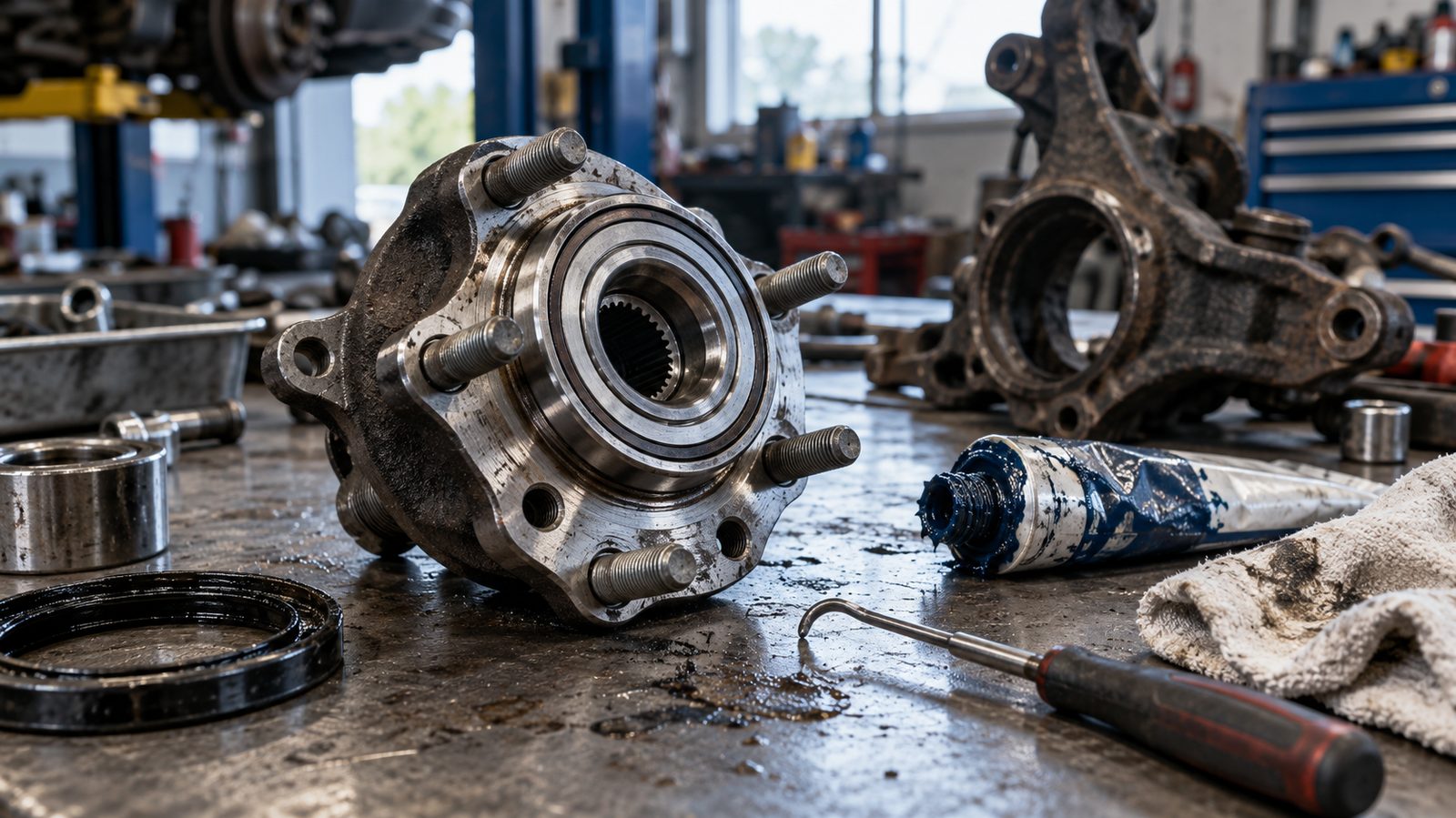
Wheel hub bearing grease and seal types are two separate specifications that must be matched to each other. The grease is defined by its base oil, thickener and additive package, and the common families are lithium soap, lithium complex, polyurea and calcium sulfonate complex. The seal is defined by its design: single lip, double lip, cassette, labyrinth or a lip seal with an integrated magnetic encoder. A hub bearing survives only when both are chosen for the same operating condition, meaning water, heat, load and ABS function, and both are confirmed on the drawing rather than assumed from the part number.
What are the grease and seal types used in wheel hub bearings?
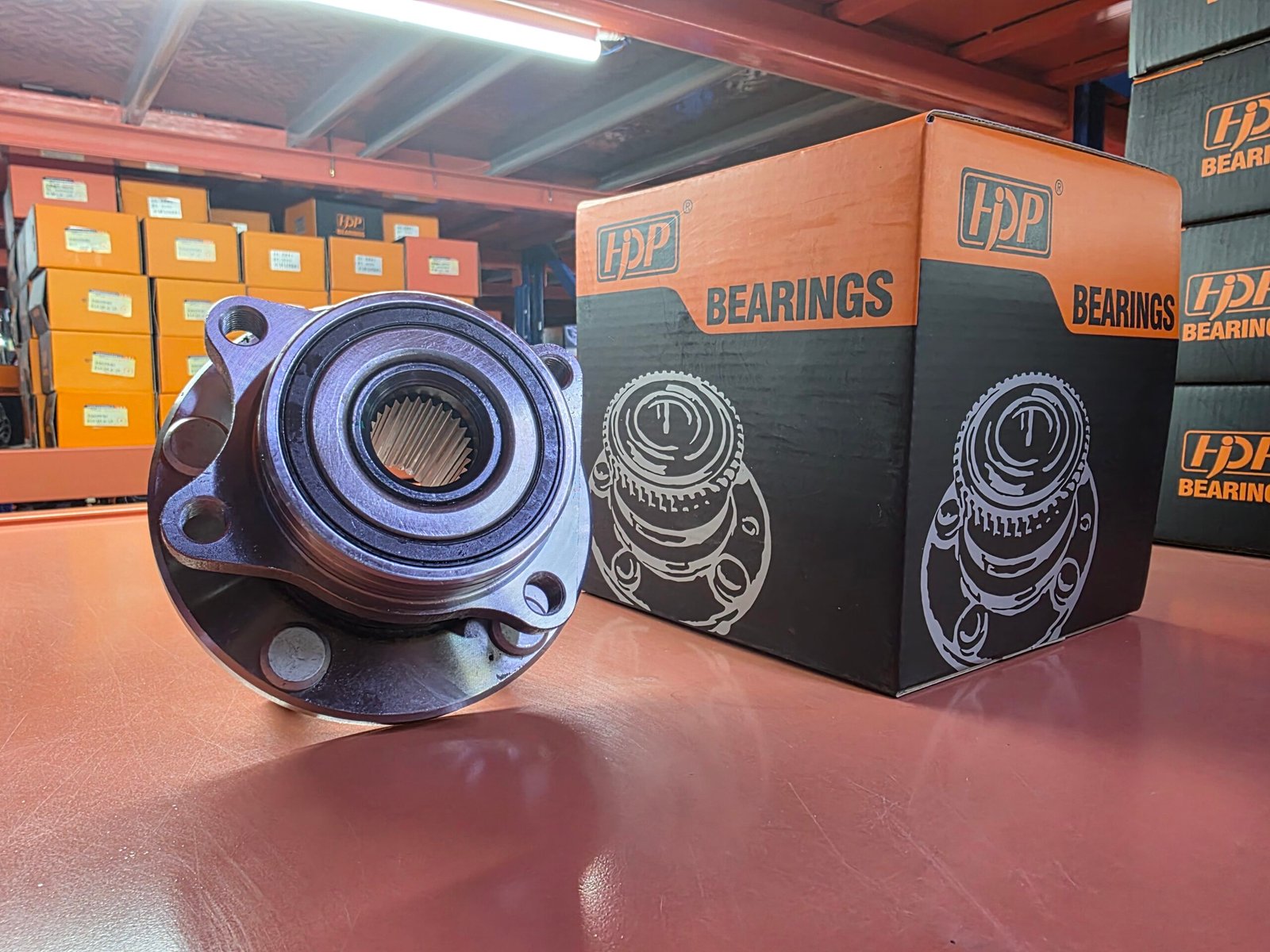
Wheel hub bearings run on a sealed-for-life grease made of base oil, thickener and additives, and that grease is held in place by one of five seal families: single lip, double lip, cassette, labyrinth or an encoder seal. The two specifications are interdependent. An expensive grease cannot compensate for a worn lip, and a cassette seal cannot rescue grease that was never rated for the temperature at the flange. Both are fixed at the drawing stage, so both have to be read from the drawing.
What is wheel hub bearing grease actually made of?
Hub bearing grease is a base oil carried in a thickener structure with an additive package; the base oil does the lubricating, and everything else controls how long it stays in place and what it protects.
- Base oil. Mineral or synthetic, commonly a polyalphaolefin. Its viscosity at running temperature sets the film thickness that separates rolling elements from raceways; its viscosity at low temperature sets starting drag, which matters on ABS-equipped hubs in cold climates.
- Thickener. The soap or non-soap structure that holds the oil. It sets the dropping point, water resistance and compatibility with other greases.
- Additives. Anti-wear and extreme-pressure agents, oxidation inhibitors, rust and corrosion inhibitors, and sometimes polymers for shear stability.
- Fill quantity. Normally stated as a percentage of the free space rather than an absolute mass. Overfilling a sealed hub unit raises churning temperature and can push grease past the lip; underfilling shortens life at the outer raceway.
In the field, the wrong thickener family and mixed greases cause more hub failures than a simple shortage of grease. The four families below cover most automotive wheel applications.
| Thickener family | Behaviour that matters at the hub | Where it is typically specified | Watch-outs |
|---|---|---|---|
| Lithium soap (12-hydroxystearate) | Good mechanical stability and moderate water resistance; adequate at moderate hub temperatures | General automotive wheel bearings and many generation 1 double row bearings | Softens progressively with water ingress; incompatible with polyurea |
| Lithium complex | Higher dropping point and longer high-temperature life; better shear stability under sustained load | Hub units close to the brake, heavier vehicles, hot-climate duty | Higher cost; still depends on the correct base oil viscosity for the temperature |
| Polyurea | Good oxidation resistance at high temperature and low starting torque; often chosen for low-noise factory fill | Sealed generation 2 and generation 3 hub units | Incompatible with lithium and most other thickeners; full removal required before repacking |
| Calcium sulfonate complex | Strong water washout and corrosion resistance with good extreme-pressure behaviour | Wet, salted, coastal and off-road duty | Higher cost and narrower availability; check compatibility before switching |
Thickeners are not interchangeable. Lithium and polyurea greases are generally incompatible, and mixing them can soften the structure and release base oil. Any repacking therefore requires complete removal of the old grease, not a top-up.
Which seal designs appear on wheel hub bearings and hub units?
Seal design decides what the bearing is protected from, and a seal that carries a magnetic track also generates the ABS signal, which makes it a functional component rather than a cover. Contact lip seals keep water out but add friction; labyrinth seals add almost no drag but protect far less against submersion.
| Seal design | How it works | Drag | Suited to | Limitations |
|---|---|---|---|---|
| Single lip, spring loaded | One elastomer lip with a garter spring running on a ground counterface | Low to moderate | Inboard positions and dry road duty | Wears quickly once abrasive dust reaches the lip; poor under submersion |
| Double lip | Main sealing lip plus a secondary dust lip ahead of it | Moderate | Dusty roads, trailers, mixed duty | Slightly higher friction and running temperature |
| Cassette | Complete cartridge with an excluder ring plus lip, running on its own counterface | Moderate | Wet, muddy and off-road duty | Higher cost; installation depth and squareness are critical |
| Labyrinth, non-contact | Tortuous clearance path with no rubbing contact | Very low | High-speed positions and secondary protection | Weak against submersion and fine dust under pressure |
| Shield | Metal plate with a small clearance gap | Very low | Internal protection only | Not a wheel-side seal; no water protection |
| Encoder seal | Lip seal bonded to a multipole magnet ring that the ABS sensor reads | Moderate | Generation 2 and 3 hubs with ABS | Magnet ring is damaged by pressing, hammer blows, metal debris or a wrong air gap |
Generation 2 and 3 units often pair an outboard cassette or labyrinth seal with an inboard lip or encoder seal, so the two sides of the same hub do not necessarily use the same design. Reading both sides of the bearing, not just the visible one, is part of routine wheel bearing seal inspection.
How do generation 1, 2 and 3 hub units differ in sealing and lubrication?

Generation 1, 2 and 3 hub units differ mainly in where the mounting flange sits and how much sealing and ABS function is built into the bearing, and that difference decides whether the grease and seal can ever be serviced after assembly.
Generation 1: a separate bearing with its own seals
A generation 1 hub bearing is a double row angular contact bearing, or a tapered roller pair, with seals pressed into the outer ring and a grease fill set at production. It is mounted on a spindle and retained by a nut, so adjustment or preload is part of the job. Some designs can be repacked when the seals are replaced, which is why the grease family matters more here than on a sealed unit.
Generation 2: a flanged outer ring
A generation 2 unit carries a flange on the outer ring and bolts directly to the knuckle or axle housing. The seals are integrated, there is no adjustment, and the unit is sealed for life. Because the flange is stationary, brake heat reaches the bearing through the housing rather than through the hub face, and grease temperature rating becomes the limiting factor in heavy braking duty.
Generation 3: a flanged inner ring with an integrated encoder
A generation 3 unit puts the flange on the rotating inner ring, splined to the driveshaft, with the wheel and brake disc bolted to it. The inboard seal usually carries the magnetic encoder for ABS. Pressing on the wrong ring, or heating the unit beyond the grease limit, damages either the lip or the magnet, and both failures appear later as a leak or an ABS warning. Raceway cleanliness and heat treatment tolerances are equally critical at this generation; background on that is covered in this note on bearing steel quality and heat treatment.
Where do tapered and cylindrical roller bearings fit?
Tapered roller bearings carry combined radial and axial load, so they dominate commercial vehicle, trailer and heavy-duty wheel positions, and they are adjusted by nut or shim rather than sealed as a unit. Cylindrical roller bearings carry very high radial load with a locating shoulder and are common in gearbox and some hub positions. In both cases the seal is a separate component in the hub or axle housing, and in oil-bath axles the bearing shares the axle lubricant rather than a packed grease fill.
Do tensioners and CV joints use the same grease and seal logic?
Drive belt tensioners and CV joints follow the same principle but not the same hardware. A tensioner pulley runs on a sealed deep groove ball bearing with a lifetime grease fill and shielded or double-lip seals, and it fails when the seal dries and the grease escapes. A CV joint, often called a ball cage or constant velocity joint, is packed with a molybdenum disulphide grease and sealed by the rubber boot and clamps rather than by a lip seal, so a split boot means grease loss and abrasive ingress long before any bearing surface shows wear.
Which grease and seal combination suits which operating condition?
Match grease and seal to four variables before looking at anything else: water exposure, temperature, load and ABS function. A combination that ignores one of them fails early no matter how good the other three are, and the correct pairing is confirmed by drawing and sample for each part number.
- Wet, salted or coastal duty. Specify a water-resistant thickener such as calcium sulfonate complex or a lithium complex, and pair it with a cassette or double lip seal. Direct high-pressure washing at the seal face is a common cause of ingress even on a correctly specified hub.
- High brake heat. Specify a lithium complex or polyurea grease on a synthetic base oil, and check that the encoder seal, if fitted, is rated for the same temperature. Grease that softens at the flange will migrate past a healthy lip.
- Dry dust and sand. Prioritise the dirt exclusion side: a double lip or cassette seal keeps abrasive particles away from the primary lip, which extends life more than an upgrade in grease does.
- ABS-equipped generation 2 and 3 hubs. The encoder seal must match the sensor pole count and air gap, and a plain seal is not a substitute. Encoder configuration belongs on the drawing.
- Heavy load and commercial duty. Tapered roller sets with a separate heavy-duty seal and the correct preload setting outperform any sealed ball unit in this position.
- Cold climate. Lower base oil viscosity reduces starting drag and avoids a slow ABS signal at first rotation; too high a viscosity can also starve the raceway until the hub warms up.
The wider logic of choosing between a bearing and a complete unit is set out in this wheel bearing and hub assembly selection guide.
How do you read a drawing or datasheet to confirm the grease and seal specification?
Grease and seal are confirmed from the drawing or the sample, never from the model number alone, because two bearings with identical boundary dimensions can differ in seal design, grease fill, clearance and encoder and will not interchange. Jinan Huayuan Bearing Co., Ltd., the manufacturer behind huayuanbearing.com, develops wheel hub bearings, hub units, tensioners and CV joint components for aftermarket and OE supply from a drawing or a sample, and the grease and seal specification is fixed at that stage rather than picked from a catalogue later.
The parameters to check on a hub bearing drawing are:
- Boundary dimensions. Bore, outer diameter, width, flange diameter, bolt circle, bolt hole count and thread.
- Seal specification. Design, elastomer material, inboard and outboard position, encoder pole count and nominal air gap where applicable.
- Grease specification. Thickener family, base oil viscosity, fill percentage and permitted operating temperature range.
- Internal geometry. Clearance group or preload, contact angle, ball or roller complement and cage material.
- Ratings. Dynamic and static load ratings, limiting speed and unit weight.
- Marking and packaging. Laser mark, box label, cross-reference field, inner wrap and pallet configuration.
An OE or cross-reference number is a starting point only, because the same number is reused across variants with different seals or encoders; the identification logic is explained in this guide to OE number fitment and ABS hub identification. When a purchase order depends on a grease or seal claim, the evidence trail matters as much as the claim itself, and this note on wheel hub seal and grease evidence in procurement shows how that file is assembled.
How should wheel hub bearings be installed so the grease and seals survive?

Most hub failures blamed on grease or seals begin at installation, because pressing, heating or cleaning destroys the lip or washes the factory fill out of the bearing. The sequence below protects both.
- Confirm the part against the drawing or OE reference, including ABS or non-ABS configuration, before the vehicle is stripped.
- Clean the spindle or knuckle bore and remove old seal residue, rust and burrs; do not run a wire brush over the seal counterface.
- Never wash a sealed hub unit with solvent or brake cleaner. It removes the factory grease fill and dries the lip.
- Support the ring specified by the maker when pressing, normally the inner ring or the flange, and never press through the outer ring, the balls or the encoder side.
- Use a flat driver or the correct adapter, and check that the seal enters square; a cocked seal leaks from the first kilometre.
- Fit dry, or with the lubricant named on the drawing; do not pack extra grease behind the lip unless it is specified.
- Torque the axle nut or flange bolts to the vehicle maker figure, with the wheel off the ground where the procedure requires it; over-torque reduces internal clearance and raises running temperature.
- Clean the ABS sensor face and check the air gap; metal debris on the encoder ring produces an intermittent signal that mimics a bearing fault.
- Rotate the hub by hand before refitting the brake, listening and feeling for roughness or a dry lip.
- Recheck for grease traces around the seal after the first heat cycle, when the hub has reached normal running temperature.
What are the common grease and seal failure modes, and what do they look like?
Every grease and seal failure leaves physical evidence on the lip, the grease or the raceway, and reading that evidence is what separates a genuine material problem from an installation or handling problem.
| Failure mode | What you see | Usual cause | Prevention |
|---|---|---|---|
| Water ingress | Milky or grey-brown grease, rust trails on the raceway, dirt tracks under the lip | Worn or wrong seal, submersion, direct high-pressure washing at the seal | Correct seal family, cassette or double lip in wet duty, no direct spray |
| Grease leakage | Wet ring around the lip, grease thrown onto the brake shield or inner wheel | Overfill, overheating, lip reversed or nicked during fitting | Correct fill, proper driver, square seating |
| Lip grooving | Visible groove on the counterface under the lip | Abrasive dust past the dust lip, dry running | Dust lip or cassette seal, clean assembly |
| Encoder damage | ABS warning, no signal, cracked or scored magnet ring, metallic particles on the ring | Pressing on the encoder side, hammer fitting, wrong sensor air gap | Press on the specified ring only, no impact tools, verify air gap |
| False brinelling | Evenly spaced marks on the raceway at roller or ball spacing | Long storage with vibration and no rotation | Rotate stock, control storage conditions, adequate grease |
| Grease breakdown | Dark, hard or cracked grease, discoloured races | Grease not rated for hub temperature, brake drag, overfill | Specify grease by temperature, correct the brake drag |
When is noise a seal problem rather than a bearing problem?
A dry or hardened lip produces a light chirp or scraping that changes with speed but not with cornering load, while a damaged raceway rumbles and changes when the vehicle is loaded side to side. Distinguishing the two before replacement avoids fitting a second unit to cure a noise caused by a brake shield or a dry seal. The diagnostic sequence is set out in this guide to telling whether a wheel hub bearing is failing, and a finer breakdown of sound types is in this note on wheel hub bearing noise diagnosis.
What should an importer check on arrival?
Goods-in inspection for hub bearings is a short, repeatable check of seal condition, grease retention, encoder presence and marking, and it catches most transit and production problems before they reach a workshop. Huayuan Bearing supplies custom packaging and private label programmes, so label and artwork checks belong in the same routine as the technical checks.
- Carton and label against the purchase order. Part number, quantity, label artwork and revision level for private label orders.
- Seal seating. No gap between seal and outer ring, no lip inversion, no nicks on the elastomer.
- Encoder ring. Continuous magnetic track, no cracks, no metal dust on the surface.
- Grease retention. No grease on the inner wrap or box, and a smooth hand rotation with no grinding.
- Corrosion. Bore, flange face and splines checked after sea freight, especially on mixed loads.
- Sample record. Photograph the pulled sample per lot and keep the drawing revision on file with the inspection note.
The full document set that supports these checks is listed in this wheel hub bearing RFQ checklist.
What do buyers still ask about wheel hub bearing grease and seal types?
Can two wheel hub bearing greases be mixed?
Generally no. Greases are classified by thickener, and lithium and polyurea families are incompatible: mixing can soften the structure, lower the dropping point and release base oil. A hub repacked with the wrong grease often fails sooner than one that was simply under-lubricated. If the original grease type is unknown, remove the old grease completely before refilling.
Can a sealed hub unit be re-greased?
Generation 2 and generation 3 hub units are sealed for life and have no service fill point; opening the seal destroys the lip and the encoder on ABS versions. Generation 1 bearings with replaceable seals can be repacked when the seal and grease specification are known. In every case, follow the drawing rather than workshop habit.
How much grease should a wheel hub bearing contain?
Fill is normally specified as a percentage of the free space between the rolling elements and the seals, not as a fixed weight. Too little starves the outer raceway; too much raises churning temperature and forces grease past the lip. The figure belongs on the drawing and should be confirmed by drawing and sample for each part number.
Does seal type affect the ABS signal?
Yes. On generation 2 and 3 hubs the inboard seal carries a multipole magnetic ring that the ABS sensor reads, so the seal is a functional component. Fitting a plain seal in place of an encoder seal disables the sensor, and a damaged ring or the wrong pole count gives an intermittent signal. Encoder configuration must be confirmed on the drawing.
Purchasing guidance, product information and company updates from Huayuan Bearing.